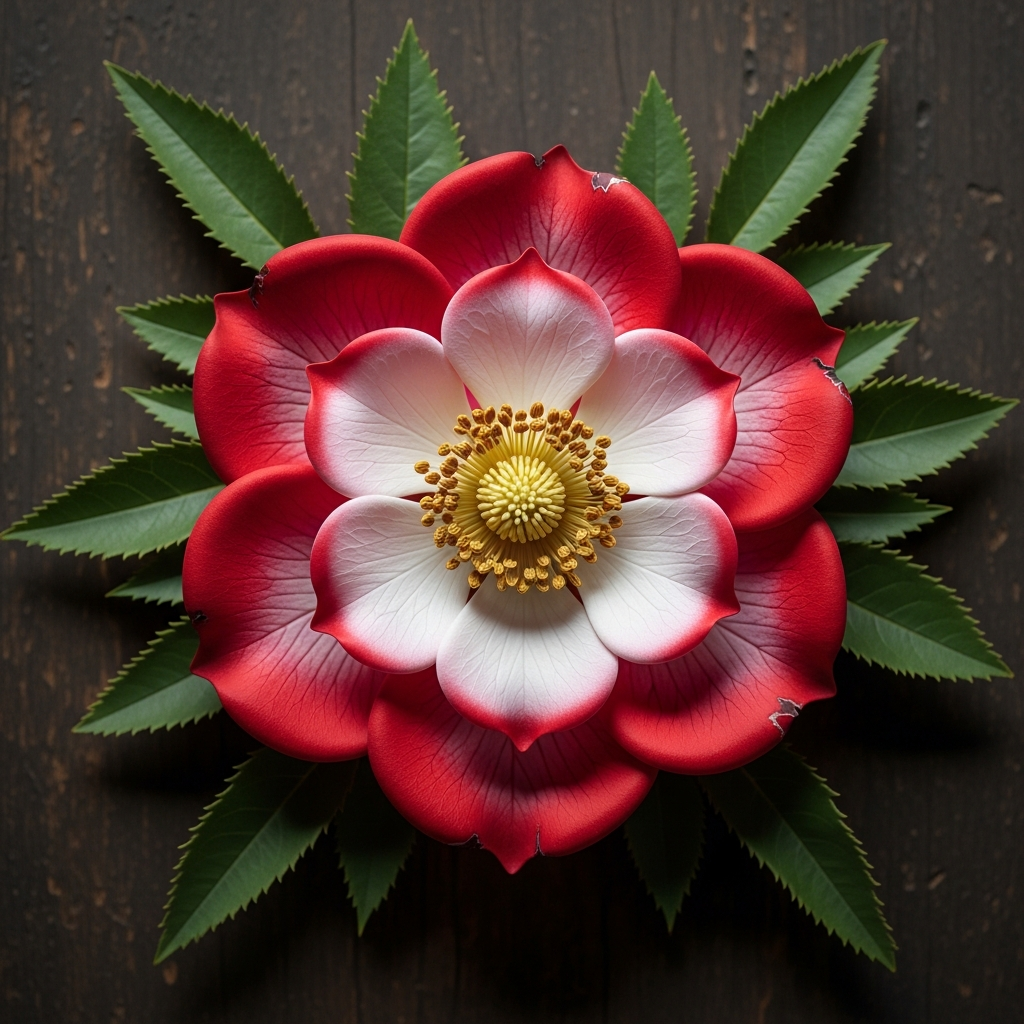
The Tudor Rose is a timeless and instantly recognizable emblem of England, a potent floral symbol that stands as a testament to the nation’s dramatic journey from civil war to dynastic unity. It is an extraordinary heraldic badge created by King Henry VII, meticulously designed to symbolize the political and martial union of the formerly warring Houses of Lancaster and York. This iconic symbol features a vibrant red rose—the traditional emblem of the House of Lancaster—superimposed upon a crisp white rose, which represented the House of York, signifying the peace and tranquility achieved after the devastating Wars of the Roses. The Tudor Rose remains the official floral heraldic emblem of England, universally recognized across government, monarchy, and cultural institutions as a powerful mark of identity and enduring peace.
The Genesis of the Tudor Rose: Ending a Dynasty’s Conflict
The story of the Tudor Rose is inextricably linked to one of the most tumultuous periods in English history: the Wars of the Roses, a series of dynastic civil wars fought between 1455 and 1487. This prolonged and bloody conflict pitted two rival branches of the House of Plantagenet against each other: the House of Lancaster, whose symbol was a red rose, and the House of York, famously represented by a white rose. The mere existence of the Tudor Rose is, therefore, a monumental piece of political messaging, designed to signal the definitive end of that brutal era and the dawn of a new, unified reign.
The Wars of the Roses had exhausted the nobility and the common people alike, creating a widespread longing for stability and a clear, legitimate monarch. When Henry Tudor, a Lancastrian claimant, defeated Richard III of York at the Battle of Bosworth Field in 1485, he did more than just win a battle; he seized the crown and faced the colossal task of healing a deeply fractured kingdom. His claim to the throne was tenuous at best, so the new king, Henry VII, immediately understood that his authority would rely as much on symbolic, unifying gestures as on military might. The crafting of the Tudor Rose was perhaps his most brilliant public relations move.
The White Rose of York and the Red Rose of Lancaster
To fully appreciate the genius of the Tudor Rose, one must first understand the intense rivalry of its components. The white rose, a symbol of the House of York, was often associated with ideas of purity, innocence, and religious connotations, particularly linked to the Virgin Mary. Conversely, the red rose, the badge of the House of Lancaster, symbolized deep passion, war, and the lineage of John of Gaunt, the fourth son of King Edward III.
The visual dissonance between these two flowers reflected the military and political chasm between the families. Battles like Towton and Barnet saw countless lives lost under the banners of the red and white roses. Therefore, when Henry VII began using the Tudor Rose, he was not simply introducing a new badge; he was visibly merging two symbols that had, for generations, been signals to fight and kill. The resulting Tudor Rose was a profound statement: all previous allegiance was now consolidated under one, unifying emblem. This symbolic act helped to solidify the support of former Yorkist loyalists who could see their emblem still represented within the new royal badge.
Henry VII: The Architect of the Tudor Rose
Henry VII understood that a successful reign required consolidating power not just through military force and legal decree, but through an unwavering, visual narrative of peace and legitimate succession. The Tudor Rose was the centerpiece of this narrative. It was not merely a decorative flower; it was a political treaty rendered in petals.
The formal creation of the Tudor Rose was cemented by Henry VII’s strategic marriage to Elizabeth of York, the eldest daughter of the Yorkist King Edward IV. This union, which took place in 1486, was the human embodiment of the Tudor Rose itself, blending the Lancastrian and Yorkist lines. The King essentially institutionalized peace through matrimony and heraldry. The Tudor Rose became a permanent visual reminder to everyone—from the humblest peasant to the most powerful noble—that the two great houses were now one, and the civil wars were over. Its presence on coinage, royal documents, and architectural carvings served as constant propaganda for the new dynasty.
The Anatomy and Heraldry of the Tudor Rose
The design of the Tudor Rose is a deliberate and beautiful exercise in heraldic layering, making it instantly recognizable and highly distinct from a natural flower. Its form is precisely dictated, ensuring its meaning is never diluted, a critical factor for a state-level emblem. The official form always places the red rose of Lancaster atop the white rose of York, clearly demonstrating the unified and superior new lineage: the House of Tudor.
A typical heraldic depiction of the Tudor Rose involves a double rose: the five outer petals are white (York) and the five inner petals are red (Lancaster). This visual arrangement is highly deliberate, presenting a unified whole that is greater than the sum of its parts. Furthermore, the Tudor Rose is often depicted with a crown placed above it, or “ensigned” with a royal crown, signifying its status as the emblem of the monarch and the realm. This “ensigned Tudor Rose” elevates it from a mere dynastic symbol to a national one.
The Design and its Meaning
The complexity of the Tudor Rose‘s design is what gives it such powerful semantic weight. The overlapping petals communicate integration, not merely juxtaposition. The Tudor Rose is a layered symbol, literally and figuratively. The central gold seeds (called “proper” in heraldry) surrounded by the alternating red and white petals, framed by a layer of five green sepals, all contribute to an intricate and balanced composition.
The color symbolism inherent in the Tudor Rose is critical to its message. The red represents the blood spilled during the wars, but also the vibrant power of the new regime. The white symbolizes the purity of the peace achieved and the legitimate claim inherited through the Yorkist line. This dual coloration in the Tudor Rose means that the symbol itself tells the entire story of the dynasty’s founding—a narrative of conflict resolved by powerful union. This powerful visual metaphor has ensured the longevity and cultural relevance of the Tudor Rose for centuries. The use of this specific design was so pervasive that it quickly became shorthand for the concept of ‘England’ itself.
Royal Adoption and Standardization of the Tudor Rose
From Henry VII onwards, the Tudor Rose was standardized and became mandatory for royal display. It was an essential motif on all state paraphernalia. For example, the King’s new palace, Richmond, and his chapel at Westminster Abbey were lavishly decorated with the Tudor Rose. The sheer volume of these decorations was intended to bombard the public with the image of stability and royal legitimacy.
The early use of the Tudor Rose was also visible in the creation of new coinage. Minting coins bearing the new emblem was a practical way to distribute the image of the unified dynasty to every corner of the kingdom. Each time a subject handled a piece of currency, they were reminded of the peace secured by the Tudor line. The visual standardization of the Tudor Rose across different media—from the stonework of grand buildings to the minuscule detail on a gold sovereign—underscores the Tudors’ sophisticated use of state branding to secure their often-challenged position. The symbol ensured that the legacy of the Wars of the Roses was not forgotten, but neatly contained and superseded by the greater, unifying symbol of the Tudor Rose.
The Tudor Rose Across the Dynasty: Symbol of Power and Continuity
The potency of the Tudor Rose did not diminish after the reign of Henry VII; instead, it grew, evolving to suit the ambitions and personal narratives of the succeeding monarchs. It became a flexible, foundational symbol that could be merged with other heraldic devices to celebrate alliances, marriages, and international prestige, further embedding the Tudor Rose as the emblem of the English state. The continuous and strategic use of the Tudor Rose across five monarchs ensured its permanent place in the national identity.
The continuity of the Tudor Rose helped the dynasty project an image of uninterrupted legitimacy, despite the profound religious and political upheavals of the sixteenth century. When Henry VIII broke with Rome, the Tudor Rose remained a constant, suggesting that the English crown, and by extension the nation, was fundamentally unchanged in its sovereignty and prestige. This unwavering display was essential for maintaining public order during periods of seismic change, such as the dissolution of the monasteries.
Henry VIII and the Splendor of the Tudor Rose
Henry VIII, the second Tudor monarch, used the Tudor Rose with even greater grandeur than his father. His reign was characterized by vast building projects—most famously Hampton Court Palace—where the Tudor Rose appears in almost every corner, often carved in wood, stone, and plaster. These magnificent displays were designed to showcase the wealth and absolute power of the King.
Henry VIII also famously combined the Tudor Rose with the symbols of his many wives to cement marital alliances and display his lineage to the world. A beautiful recent example that highlights this practice is the discovery of a heart-shaped 24-carat-gold pendant, which the British Museum recently secured. This exquisite piece, dating from Henry VIII’s marriage to Catherine of Aragon, uniquely features the Tudor Rose intertwined with Catherine’s emblem, the Spanish pomegranate. This incredible find showcases how the Tudor Rose was an active, personal symbol used by the King to declare his dynastic and marital status, demonstrating the intricate and highly personal political applications of the Tudor Rose within the royal family’s daily life.
Elizabeth I and the Imperial Tudor Rose
Queen Elizabeth I, the final and perhaps most famous Tudor monarch, further solidified the status of the Tudor Rose. During her long and successful reign, the emblem became strongly associated with a golden age of national pride and burgeoning global influence. For Elizabeth I, the Tudor Rose was less about civil war and more about celebrating an established, powerful monarchy.
Elizabethan art and portraiture frequently featured the Tudor Rose, often in conjunction with other symbols of her power, such as the French fleur-de-lis, signifying the English claim to the French throne. This blending of national and imperial symbols within the artwork helped to portray the Queen as a formidable European power, making the Tudor Rose a subtle yet effective tool of international diplomacy and self-promotion. By the end of her reign, the Tudor Rose was entirely synonymous with England’s global standing, a visual anchor for the nation’s sense of self and imperial ambition, ensuring the survival of the Tudor Rose far beyond the end of the dynasty.
The Tudor Rose in Architecture and Art: A Ubiquitous Presence
The enduring power of the Tudor Rose is best seen in its omnipresence in physical structures and decorative arts dating from the Tudor period and beyond. It is not merely confined to textbooks or museums; it is carved into the very fabric of British heritage, appearing on everything from monumental castles to the smallest personal possessions. Its ubiquitous placement served as a constant reminder of the ruling power and the political stability it represented.
The architectural legacy of the Tudor Rose is vast, providing modern visitors with a tangible connection to the past. The symbol’s consistent design made it ideal for repetition across large building projects, creating a visual rhythm of loyalty and unity. You can often see the Tudor Rose used as a protective motif, placed in strategic locations like gateways, ceilings, and stained-glass windows, literally guarding the royal space. Even after the Tudor dynasty ended, the Tudor Rose was preserved by successive monarchs, who understood its deep emotional resonance as a symbol of English continuity and legitimacy.
From Palaces to Pennies: A Ubiquitous Symbol
The deliberate spread of the Tudor Rose to all levels of society was a masterstroke of political branding. While grand palaces like Hampton Court and St. James’s Palace showcase monumental carvings and magnificent ceiling bosses featuring the Tudor Rose, its reach extended far beyond the court.
Consider the following examples where the Tudor Rose became an integral part of English life:
- Royal Armaments and Uniforms: Soldiers wore the Tudor Rose on their uniforms, making it a badge of national identity and military service.
- Legal and Governmental Documents: Official seals, royal warrants, and legal instruments were often impressed or adorned with the Tudor Rose, giving them an air of supreme authority.
- Coinage: As mentioned, the Tudor Rose was a prominent feature on Tudor-era currency, ensuring even the poorest subject handled the royal emblem daily.
- Churches and Cathedrals: After the Reformation, the Tudor Rose became a common feature in stained glass and carvings in churches across the country, symbolizing the monarch’s role as the Supreme Head of the Church of England.
This pervasive use, from high politics down to the most mundane object, secured the Tudor Rose’s place in the collective consciousness. It ensured that, regardless of a person’s status, they lived under the watchful and unifying symbol of the Tudor Rose.
Modern Interpretations and Artistic Legacy
Today, the Tudor Rose continues to inspire artists, designers, and artisans, moving beyond its purely political origins to become a celebrated motif in decorative art. Its clear, symmetrical structure makes it a popular subject for modern crafts, jewelry, and luxury items. The message of coming through struggle stronger, which is inherent in the design of the Tudor Rose, is as relevant today as it was in the 15th century, giving the symbol a modern philosophical depth.
In contemporary design, the Tudor Rose often appears as an elaborate tattoo design, symbolizing national pride, a connection to English heritage, or simply an appreciation for its intricate floral geometry. In fashion, the image is frequently stylized and incorporated into textile prints, embroidery, and accessories, proving that the heraldic power of the Tudor Rose can transcend its historical context and appeal to a modern aesthetic sensibility. It serves as a classic, instantly recognizable motif that bridges the past and the present, and is continually reinvented while retaining its core symbolism.
The Tudor Rose Today: A National Emblem of Enduring Unity
The legacy of the Tudor Rose is not confined to the history books; it is an active symbol in modern Britain. Long after the House of Tudor faded from the throne, the emblem it created continued its role as the definitive floral badge of England. It has been consciously preserved and utilized by succeeding monarchies and governments, who recognize its unique power to evoke peace, continuity, and national identity.
The Tudor Rose is visible in countless official settings, serving as an unbroken visual link to the nation’s royal past. When you see it today, you are looking at a living piece of history that continues to convey the message of national unity that Henry VII first intended. This enduring presence speaks volumes about the original design’s effectiveness as a symbol.
The Tudor Rose as England’s National Flower
The most important modern role of the Tudor Rose is its designation as the official floral emblem of England. Unlike the thistle of Scotland or the shamrock of Ireland, the Tudor Rose carries a weighty political history within its petals. It is featured prominently on the Royal Arms of the United Kingdom, where it represents England alongside the other national symbols.
Furthermore, the Tudor Rose is a common sight in places of high national importance. It is often carved into the wood paneling of Westminster Palace, used on the livery collars of yeomen warders at the Tower of London, and incorporated into the emblems of various British regiments. It is a subtle, yet pervasive, reminder of the country’s origins and its foundational act of union. The simple act of adopting the Tudor Rose as the national flower ensured that the powerful message of peace over conflict is reinforced daily, securing its role as a ubiquitous part of English culture.
A Symbol of Enduring Unity: Recent Discoveries
The symbolic power of the Tudor Rose in contemporary culture is often highlighted by new historical findings that capture the public imagination. As previously noted, the recent acquisition by the British Museum of Henry VIII’s personal gold pendant provides a fantastic modern example of the Tudor Rose‘s enduring relevance. The media coverage surrounding this “most important Tudor find in 25 years” instantly brought the Tudor Rose back into the national conversation.
This historical treasure, which pairs the Tudor Rose with the pomegranate of Catherine of Aragon, is a tangible, emotional artifact from the earliest days of Henry VIII’s reign. Its rediscovery and public display serve as a powerful teaching moment, reminding people that the Tudor Rose was not just a stiff, heraldic device, but a living, emotional symbol of alliances, love, and political strategy. The news reports highlight the careful craftsmanship and political intent behind the symbol, proving that the story of the Tudor Rose continues to evolve and fascinate the world. This continuous engagement with history ensures the Tudor Rose remains a fresh and meaningful emblem in the 21st century.
Conclusion: The Unfading Legacy of the Tudor Rose
The Tudor Rose is far more than a decorative flower; it is a profound piece of statecraft, a symbol whose enduring power lies in its narrative of transformation. Conceived by Henry VII to mend the deep wounds of the Wars of the Roses, the Tudor Rose literally superimposed conflict onto peace, war onto marriage, and division onto dynasty. Its intentional and pervasive use across coinage, architecture, and royal regalia ensured that its message of national unity was successfully disseminated and permanently etched into the English identity.
From the opulent ceilings of Hampton Court to its subtle inclusion on the uniforms of the royal household, the Tudor Rose stands as an unbroken visual thread that connects modern Britain to its dramatic past. It is a masterclass in political branding that successfully transcended the dynasty that created it. The recent excitement over the discovery of Henry VIII’s pendant proves that the stories encapsulated within the red and white petals of the Tudor Rose continue to capture the world’s imagination, securing its status as one of history’s most successful and beautiful national emblems. The Tudor Rose is truly an emblem of enduring significance, an icon of unity that continues to flower across centuries of history.
*
Frequently Asked Questions
What is the Tudor Rose and why was it created?
The Tudor Rose is the traditional floral heraldic emblem of England, created by King Henry VII following his victory in the Wars of the Roses in 1485. Its creation was a deliberate political act to symbolize the unification of the two warring houses: the red rose of the House of Lancaster and the white rose of the House of York. The combined symbol, the Tudor Rose, was designed to promote peace, stability, and the legitimacy of the new Tudor dynasty, signaling the end of the devastating civil wars.
What are the colors of the Tudor Rose and what do they represent?
The Tudor Rose is a composite flower featuring both red and white petals. The colors represent the two houses that were united:
- Red Petals: Represent the House of Lancaster, the lineage of Henry VII.
- White Petals: Represent the House of York, the lineage of his wife, Elizabeth of York.
The layering of the red petals on top of the white petals in the Tudor Rose represents the final, successful fusion of the two rival claims under the new and superior House of Tudor.
Where can I see the Tudor Rose today?
The Tudor Rose is a remarkably ubiquitous symbol and can be seen in numerous official and historical locations across England. Some of the most prominent places where the Tudor Rose is found include:
- Royal Palaces: It is heavily carved into the architecture of Hampton Court Palace, St. James’s Palace, and Westminster Abbey.
- Official Emblems: It is a key component of the Royal Coat of Arms of the United Kingdom and is used on the official badges of many regiments and government bodies.
- Current Coinage: The Tudor Rose has often featured on British coins throughout history and continues to appear in various stylized forms.
Did any other monarch change the Tudor Rose after Henry VII?
While the core design of the Tudor Rose (red over white) remained constant, later monarchs often combined it with other personal or international symbols to suit their political needs. Henry VIII frequently merged the Tudor Rose with the emblems of his various wives, such as the pomegranate of Catherine of Aragon or the falcon of Anne Boleyn. Queen Elizabeth I often paired the Tudor Rose with the French fleur-de-lis to reinforce English claims to the French throne, showcasing the symbol’s adaptability as a tool of state messaging.