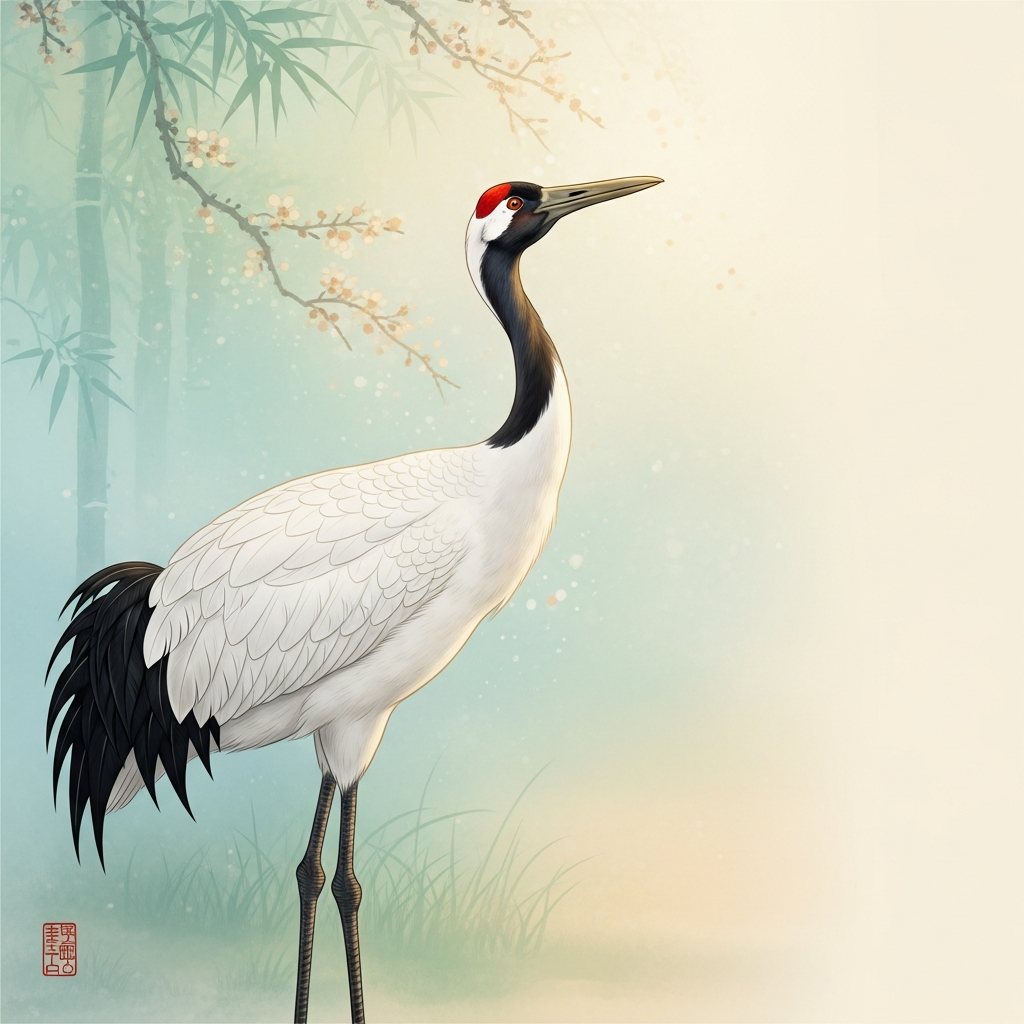
The Red Crowned Crane Japanese Art tradition, centered on the magnificent Tanchōzuru, is much more than mere decoration; it is a profound cultural language. This majestic bird, characterized by its striking white plumage, black markings, and vivid red crown, has graced scrolls, screens, and silks for centuries, becoming an indelible icon of the nation’s aesthetic and spiritual ideals. If you want to understand the true spirit of Japanese design, you must first appreciate the history, the artistry, and the deep, rich symbolism embedded within every representation of the Red Crowned Crane Japanese Art.
In my own life, I once spent an entire week in Kyoto studying the intricate patterns on an antique uchikake (wedding kimono). The design was a dynamic canvas of woven gold thread, showing a flock of cranes mid-flight against a backdrop of pine and waves. I remember the feeling of tracing the delicate embroidery—the sheer audacity of depicting such a powerful, wild creature with such refined grace. It wasn’t just a garment; it was a wearable story, a testament to the fact that the imagery of the Red Crowned Crane Japanese Art holds a sacred, almost magical place in the collective Japanese imagination. It convinced me that this motif transcends simple aesthetic appreciation and speaks directly to the human desire for permanence and enduring love.
What is the Core Symbolism Behind the Red Crowned Crane in Japanese Culture?
The Red Crowned Crane Japanese Art motif is deeply interwoven with a select set of core cultural values, making it one of the most recognizable and auspicious symbols in the country’s artistic lexicon. These values are the reason the Tsuru (crane) appears everywhere from formal state occasions to simple, everyday goods.
| Symbol | Cultural Significance | Artistic Context |
| :— | :— | :— |
| Longevity | Believed to live for 1,000 years (Manzuru). | Often paired with pines and tortoises, also symbols of long life. |
| Fidelity/Loyalty | Mates for life; known for graceful, synchronized pair-dances. | Essential motif for wedding kimono (uchikake). |
| Good Fortune | The Tsuru is said to carry happiness from Mount Horai (Heaven). | Used in New Year’s celebrations and gifts for new beginnings. |
| Hope/Healing | Symbol of resilience, famously linked to Senbazuru (1,000 paper cranes). | Modern context, especially post-WWII, representing peace. |
The bird’s status as a symbol of longevity is perhaps its most famous attribution. Legend suggests the crane lives for a thousand years, a belief that elevates the bird from a biological entity to a mythological one. This profound association with eternal life means that any piece of Red Crowned Crane Japanese Art immediately confers wishes for a long and prosperous existence upon its owner. When you see a crane depicted on a gift, you are not merely looking at a bird; you are receiving a thousand years of good wishes.
Furthermore, the crane is renowned for its lifelong pair-bonding, a behavior that instantly translated into a powerful symbol of fidelity and martial harmony in the human world. This is why the motif is practically mandatory in traditional Japanese wedding attire and is often seen in pairs, gracefully dancing or standing side-by-side. The image of the pairing cranes, a staple of Red Crowned Crane Japanese Art, reassures the viewer of the enduring nature of love and commitment, a sentiment that resonates across all generations and continues to drive its popularity.
Finally, the imagery of a crane soaring high against the sun or clouds speaks to success and good fortune. The fluid lines and dynamic posture in many forms of Red Crowned Crane Japanese Art capture a sense of effortless ascent. This visual metaphor for rising above challenges and achieving great heights makes the artwork a powerful inspiration and a perfect motif for corporate gifts or celebratory artwork commemorating major milestones. The combination of these powerful attributes ensures the crane’s perpetual relevance in both classic and contemporary Japanese life.
A Historical Flight Path: The Crane Across Japanese Art Eras
The history of Red Crowned Crane Japanese Art is a journey that mirrors the development of Japanese aesthetics itself, with the bird’s depiction evolving dramatically across distinct historical periods. From the elegant simplicity of ancient ink wash to the dazzling detail of the Edo period, the crane has consistently served as a muse for the nation’s greatest masters.
The Crane in Classical Ink and Early Scroll Painting (Heian to Muromachi Periods)
In the earliest periods, the crane motif was often rendered in the Chinese-influenced Sumi-e (ink wash painting) style, brought by Zen Buddhist monks. These early examples of Red Crowned Crane Japanese Art emphasized simplicity and spiritual depth. The artists used only black ink, playing with the concentration of the wash to suggest the brilliant white plumage and the texture of the feathers.
- Focus on Negative Space: The stark white of the crane was often left unpainted, utilizing the negative space of the paper or silk to represent the bird’s body. This minimalist approach requires incredible skill, where a single, perfectly placed brushstroke must convey the bird’s entire posture and spirit.
Zen Influence: The simplicity echoed Zen principles, aiming to capture the essence* of the creature rather than its photographic reality. The result is an image of profound tranquility and grace, often depicting the cranes in silent contemplation or preparing for flight, connecting the viewer to nature’s quiet power.
These ancient scrolls were not merely decorative; they were meditative tools, allowing the viewer to reflect on the crane’s symbolism of enduring life and peaceful solitude. The power of the crane’s outline, often set against a sparse, misty landscape, defines this classical era of Red Crowned Crane Japanese Art.
The Flourishing of Grandeur: Rinpa and the Edo Period
The Edo period (1603–1868) marked a spectacular shift, elevating Red Crowned Crane Japanese Art from meditative scrolls to dazzling, grand-scale decorative masterpieces. This was the era of the Rinpa School, which brought vibrant colors, gold leaf, and bold compositions to the fore.
A prime example is the work of master artist Ogata Korin (1658–1716), a titan of the Rinpa style. His famous panels, such as Seven Japanese Red Crown Crane, show the birds in magnificent detail, often set against screens covered in brilliant gold leaf. The gold not only provided a luxurious background but also symbolized the bird’s celestial nature and illuminated the interior spaces of samurai residences and wealthy merchant homes.
In this context of Red Crowned Crane Japanese Art, the crane was rendered with:
- Vibrant Mineral Pigments: The black neck and tail feathers were painted with rich, deep black, while the red crown was rendered with a vivid, striking vermillion. This contrast amplified the bird’s natural majesty.
Dynamic Compositions: Unlike the static poses of Sumi-e*, Rinpa compositions often showed the cranes in active, dramatic poses—wading, calling, or taking flight—demonstrating a new focus on nature’s energy and splendor.
This decorative, maximalist approach ensured that Red Crowned Crane Japanese Art became synonymous with wealth, prosperity, and high social status, solidifying its position as a motif of profound cultural importance.
Capturing Fleeting Moments: Ukiyo-e and the Woodblock Print
Simultaneously, the popular art form of Ukiyo-e (Pictures of the Floating World) embraced the crane motif, making Red Crowned Crane Japanese Art accessible to a broader public. Master printmakers like Utagawa Hiroshige (1797–1858) immortalized the crane not just as a symbol, but as an integral part of the Japanese landscape and seasonal change.
In his prints, the crane often appeared as:
- Seasonal Marker: Cranes are often depicted against crisp winter snow, capturing the fleeting, beautiful moments of the natural world. This connects the bird not only to longevity but also to the concept of time and the cyclical nature of life.
- Dynamic Silhouette: Hiroshige often employed the bird’s silhouette, sometimes in pairs or small flocks, flying over water or rice fields, using the clean lines of the woodblock medium to emphasize the bird’s elegant form.
The democratization of Red Crowned Crane Japanese Art through Ukiyo-e prints meant that the powerful symbolism of fidelity and good fortune was no longer restricted to the elite, but could be shared and celebrated by people from all walks of life, embedding the image even deeper into the national consciousness.
The Cranes in Motion: Red Crowned Crane Japanese Art Across Different Media
The influence of the Tsuru is not limited to two-dimensional paintings and prints. The image of the Red Crowned Crane Japanese Art is a versatile design element, adapting its symbolic power to three-dimensional crafts, textiles, and modern installations, proving its enduring adaptability.
Textile Triumphs: Kimono and Obi Design
In the world of Japanese textiles, the crane is an almost required motif for garments associated with celebration and transition, particularly weddings and coming-of-age ceremonies. The elegance of the Red Crowned Crane Japanese Art motif perfectly complements the flowing lines of silk.
The most powerful textile example is the Uchikake (formal wedding over-kimono). These are often entirely covered in embroidered cranes, sometimes numbering dozens, collectively representing the Senbazuru (thousand cranes) wish for an incredibly long and happy marriage.
Design Techniques: Cranes are often rendered using luxurious techniques like gold and silver thread embroidery (zuihō*), which gives the birds a three-dimensional texture and catches the light beautifully, enhancing the sense of auspiciousness and grandeur.
- Contextual Pairing: Cranes are rarely depicted alone on textiles; they are frequently paired with other symbols like Pine (Matsu) for endurance and Bamboo (Take) for flexibility, creating an overall composition that guarantees a lifetime of virtue and resilience for the wearer.
The intricate work involved in creating a kimono featuring the Red Crowned Crane Japanese Art pattern reflects the profound hopes and dreams placed upon the new union, transforming the garment into a powerful, wearable piece of fine art.
The Grace of Clay: Ceramics and Lacquerware
The motif also finds a home in the applied arts, particularly in sophisticated ceramic and lacquerware designs. When used on serving ware or decorative pieces, the imagery of the Red Crowned Crane Japanese Art transforms everyday objects into items of cultural significance, imparting the values of longevity and good fortune to the user.
On high-end lacquerware, such as layered boxes (Jūbako) or writing desks, the crane is often executed using the Maki-e technique. This involves sprinkling gold or silver powder onto wet lacquer to create a glittering, durable surface. A single, stylized crane in Maki-e on a black lacquer box is the epitome of refined elegance.
- Stylization: In ceramics, the crane is often more abstracted, its long neck and round body simplified into a sophisticated pattern that allows for repetition. The stark contrast of the bird’s form against a rich, dark glaze or a pristine white porcelain highlights the minimalist beauty inherent in the Red Crowned Crane Japanese Art aesthetic.
- Thematically Appropriate: Since these items are frequently used in family gatherings, the crane symbol on the ceramics subtly reinforces the idea of family longevity and generational prosperity.
Red Crowned Crane Japanese Art in the Modern Era: From Wabi-Sabi to Conservation
The story of the Tsuru does not end in the Edo period; it continues to evolve. In the contemporary world, the Red Crowned Crane Japanese Art motif has adapted its timeless symbolism to new aesthetic philosophies and has even taken on a powerful new meaning related to global conservation.
The Crane in Contemporary Design Trends
Today, the elegance of the Red Crowned Crane Japanese Art is a perfect fit for global interior design movements that favor natural elements, simplicity, and texture. It has become a key motif in the rise of the Japandi (Japanese-Scandinavian) and Wabi-Sabi design trends.
Japandi Appeal: In Japandi interiors, the crane’s clean lines and monochromatic palette—white body, black details, red spot—offer a powerful yet subtle accent. Framed Red Crowned Crane Japanese Art prints in the Sumi-e* style provide the necessary touch of calm, natural elegance without overwhelming the minimalist aesthetic.
- Wabi-Sabi Connection: The concept of Wabi-Sabi, which finds beauty in imperfection and impermanence, resonates with the crane’s existence in the wild. Contemporary artists often depict the crane with slightly textured lines or against a distressed background, suggesting the passage of time and the beauty of natural erosion, extending the meaning of Red Crowned Crane Japanese Art beyond just perfection.
The New Symbolism: Conservation and Hope
Perhaps the most significant modern shift in the meaning of Red Crowned Crane Japanese Art relates to the bird’s real-world status. The species itself is considered endangered, making its depiction in art a subtle but profound statement on conservation and the preservation of natural beauty.
The real-life Red Crowned Crane Japanese Art has become a metaphor for fragile beauty that must be protected. When a contemporary artist chooses to paint a crane, they are not just celebrating longevity; they are often quietly advocating for its survival in the wild.
- Art as Activism: Modern digital and mixed-media artists are creating pieces of Red Crowned Crane Japanese Art that highlight the isolation of the birds, often contrasting the vivid red of the crane’s crown with stark, almost abstract backgrounds, drawing attention to their vulnerability.
- A Symbol of Resilience: The bird’s successful recovery in some regions, particularly Hokkaido, reinforces its classic role as a symbol of hope and resilience, a message that continues to inspire globally.
In conclusion, the Red Crowned Crane Japanese Art is a fluid, living tradition. It carries the weight of ancient myth and the promise of a thousand years, yet it remains perfectly adaptable to the contemporary moment. Its timeless elegance ensures that the image of the majestic Tsuru will continue to soar through Japanese culture and inspire artists and enthusiasts around the world for many centuries to come. The power of Red Crowned Crane Japanese Art lies in its ability to condense the grandest human aspirations—long life, enduring love, and hope—into the graceful form of a single, magnificent bird.
*
Frequently Asked Questions (FAQ)
What is the Japanese word for the Red Crowned Crane?
The Japanese word for the Red Crowned Crane is Tsuru (鶴). More specifically, it is often called Tanchōzuru (丹頂鶴), which literally translates to “red crest crane,” directly referring to the bird’s distinctive red patch on its head. This term is central to understanding the vocabulary used in Red Crowned Crane Japanese Art.
Why are Red Crowned Cranes associated with weddings in Japanese culture?
Red Crowned Cranes are a ubiquitous symbol in Japanese weddings because they are known to mate for life, representing marital fidelity, harmony, and eternal love. The inclusion of the crane motif, often on the bride’s ceremonial uchikake kimono, serves as a powerful, centuries-old blessing for the couple to enjoy a lifelong, prosperous partnership, making it a foundational element of Red Crowned Crane Japanese Art in the textile world.
What is the meaning behind folding 1,000 paper cranes (Senbazuru)?
The tradition of folding 1,000 paper cranes, known as Senbazuru, is rooted in the legend that the crane lives for 1,000 years. If a person folds 1,000 paper cranes, they are granted a wish by the crane. Today, Senbazuru has become a global symbol of hope and healing, often given to those who are ill, or as a collective wish for peace, directly tying back to the enduring longevity symbolism found in Red Crowned Crane Japanese Art.
Which famous Japanese artists depicted the Red Crowned Crane?
Several famous Japanese artists incorporated the crane into their work across different schools and periods. Key figures include:
- Ogata Korin (Edo Period, Rinpa School): Known for grand, decorative screens featuring the crane on gold leaf.
- Utagawa Hiroshige (Edo Period, Ukiyo-e): Depicted cranes in his famous landscape woodblock prints, often capturing them in winter scenes.
These masters cemented the crane’s place as a classic subject within the history of Red Crowned Crane Japanese Art.
*