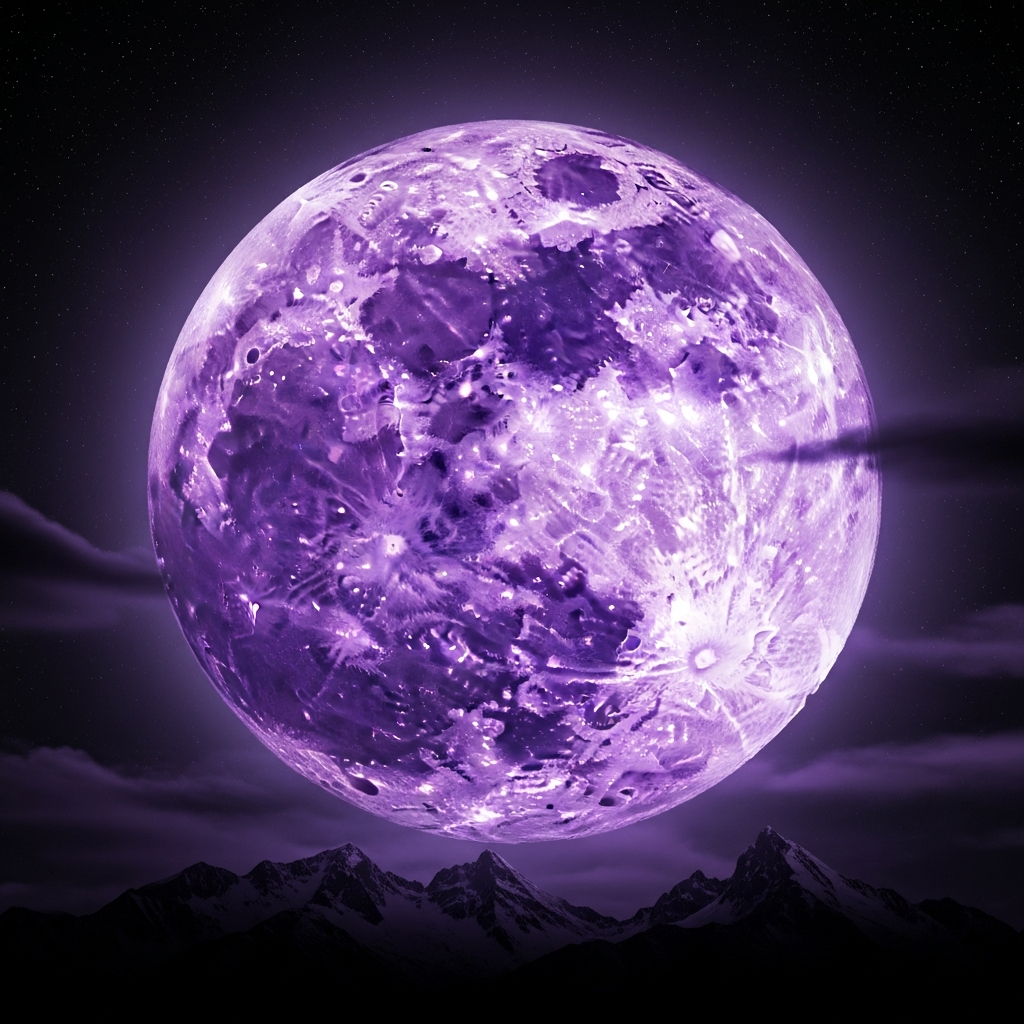
The phrase Purple Moon sparks a vivid image of a rare and almost mystical celestial event, but what exactly is it? A Purple Moon is not an officially recognized astronomical term, unlike the well-known ‘Blue Moon’ or ‘Blood Moon’. Instead, it is a poetic and often informal descriptor for a lunar disk that appears with a distinct, deep violet or purplish hue. This captivating coloration is primarily the result of specific, rare atmospheric conditions that cause light to scatter in an unusual way. Alternatively, the Purple Moon also holds deep symbolic meaning in various cultural and spiritual contexts, representing everything from profound creativity and spiritual reflection to a signal of a unique, once-in-a-lifetime occurrence.

The phenomenon of the Purple Moon is a spectacular reminder of how the Earth’s atmosphere can transform our view of the cosmos.
The Celestial Reality of the Purple Moon
To understand the Purple Moon, we must delve into the fascinating physics of light and atmosphere. The moon itself does not emit purple light, nor does it possess a naturally purple surface. Therefore, the coloration we occasionally perceive is an optical illusion created entirely by the Earth’s atmosphere acting as a massive, variable filter. This rare visual spectacle often requires a precise alignment of natural elements, making the sighting of a true Purple Moon an exceptional and memorable event. It is a moment when the mundane changes to the magical, showcasing the simple, beautiful complexity of our planet’s environment. The appearance of a Purple Moon often leaves witnesses questioning the limits of natural color and light.
How Atmospheric Conditions Create the Purple Moon
The key to unlocking the mystery of the Purple Moon lies in a process called scattering. Normally, when the moon is high in the sky, we see it as white or yellowish-gray because the light travels through the thinnest part of the atmosphere. However, when the moon is low, or during certain global events, the light has a much longer journey, forcing it through thicker layers laden with different particles.
When we talk about the Purple Moon, the underlying mechanism is a delicate balance of light wavelengths. Sunlight, which illuminates the moon, contains all colors of the rainbow. Light in the blue-green spectrum is easily scattered by tiny air molecules, a phenomenon known as Rayleigh scattering—this is why our sky looks blue. Conversely, larger particles, such as those from volcanic eruptions, large wildfires, or industrial dust, scatter longer wavelengths like red and orange.
- The Crucial Combination: To see a Purple Moon, you need a very specific dual-scattering effect.
- Reddish Component: Fine dust or smoke particles (from a distant fire, for instance) scatter away the green and blue light, leaving primarily red and orange light to reach the viewer.
- Blue/Violet Component: Simultaneously, the air molecules must still be scattering a minimal amount of blue/violet light into the path of the viewer, or the larger particles themselves must have a unique size distribution to preferentially scatter the shortest wavelengths (violet/blue).
- The Result: When the remaining deep red light successfully mixes with a residual touch of blue/violet light that has survived the atmospheric journey, the human eye perceives the combined result as a fleeting, deep, beautiful Purple Moon. It is a temporary color cocktail created by nature’s largest mixing bowl, our atmosphere.
This specific combination is incredibly infrequent. For example, some historical ‘blue moons’ (caused by unique particle sizes from major volcanic ash clouds) were reported to have a slight purplish fringe, suggesting that the conditions for a Purple Moon may have been momentarily achieved during these extreme events. Sighting the Purple Moon is less about a predictable cycle and more about a perfect, often chaotic, environmental moment.
The Rarity: Comparing Purple Moon to Blue and Blood Moons
While the ‘Blue Moon’ (either the second Full Moon in a calendar month or the third in an astronomical season) is relatively rare, occurring roughly once every two to three years, and a ‘Blood Moon’ (a total lunar eclipse) is tied to precise orbital mechanics, the Purple Moon is considered an event of exceptional scarcity because it relies solely on unpredictable and localized atmospheric pollution.
The Purple Moon is far more elusive than its more famous lunar cousins. I remember once, standing on a hillside in the Californian desert, during a period of intense distant wildfires, seeing a moon that wasn’t red, but a heavy, saturated magenta—almost a Purple Moon. It wasn’t the fiery red of a lunar eclipse; it was a deep, unsettling, yet beautiful violet. It was the only time in my decades of sky-watching that I felt I was witnessing a true Purple Moon. This personal experience solidified for me that the Purple Moon is less an astronomical event and more a testament to the planet’s ever-changing, dramatic atmospheric canvas.
- Blue Moon Analogy: The term “Purple Moon” has also been informally used by some subcultures to denote a highly improbable or rare celestial event, much like the original meaning of “once in a blue moon.” Some folklore even refers to the second Full Moon of April as a potential Purple Moon cycle.
Blood Moon Contrast: A Blood Moon is always reddish-orange due to Rayleigh scattering in the Earth’s shadow, but a Purple Moon is dependent on a highly specific mixture of fine and coarse particles in the atmosphere outside of the eclipse geometry. Therefore, the color of the Purple Moon is more variable and dependent on where* on Earth you are observing it.
- The Rarity Statistic: Since the appearance of a Purple Moon is not tracked by astronomical bodies, any statistic is anecdotal. We can say with confidence, however, that the necessary conditions—a perfect storm of localized dust, smoke, and atmospheric pressure—are statistically less frequent than the regular orbit-based events of a Blue Moon or a Blood Moon. This makes the spontaneous, genuine appearance of a Purple Moon a true ‘once in a lifetime’ sighting for most people.
Decoding the Mystical Symbolism of the Purple Moon
Beyond the realm of science and atmospheric optics, the Purple Moon holds a strong, compelling position in folklore, spirituality, and color psychology. The color purple itself is inherently tied to depth, mystery, and transformation, making the notion of a Purple Moon a powerful spiritual signifier. A sighting of the Purple Moon is often interpreted as a moment of great significance—a time when the veil between the practical world and the spiritual world is thin. This symbolic power gives the Purple Moon a resonance that far exceeds its physical existence.
Folklore and Ancient Meanings: The Moon of Transformation
In ancient civilizations, the color purple was incredibly difficult and expensive to produce, often reserved for royalty, high priests, and nobility. It was the color of majesty, power, and spiritual connection. When this powerful color is combined with the inherent symbolism of the moon—representing cycles, femininity, intuition, and transformation—the resulting Purple Moon becomes a beacon of profound change.
Different cultures have attached varying, yet often parallel, meanings to the concept of a Purple Moon:
- The Royal Connection: In many Western traditions, a Purple Moon would have been seen as an omen for royalty or a sign of divine guidance for a ruling monarch, signifying a period where their power was blessed by the heavens.
- Eastern Mysticism: In some Eastern philosophies, the color purple is linked to the Crown Chakra (Sahasrara), the center of spiritual enlightenment and universal consciousness. Thus, the Purple Moon would represent a peak period for meditation, spiritual breakthroughs, and attaining higher levels of wisdom.
- The Shamanic Moon: Certain Native American and shamanic traditions view the moon cycles as times for introspection. A Purple Moon might be interpreted as the ‘Deep Reflection Moon’ or the ‘Creative Vision Moon,’ a perfect time to process ancestral knowledge and generate future paths. It signifies a transition point, a time to shed old skin and step into a new, more powerful self. The powerful energy of the Purple Moon is believed to amplify the effectiveness of ritual and intention-setting. The spiritual intensity of the Purple Moon is not to be underestimated.
This deep cultural history explains why the idea of the Purple Moon resonates so deeply even today. It taps into millennia of shared symbolism about power, transformation, and the hidden wisdom of the night sky.
Modern Interpretations: Creativity and Inner Reflection
In the contemporary world, particularly in wellness, astrology, and spiritual communities, the Purple Moon has evolved into a modern archetype. It is primarily associated with the deep introspective energy of the waning moon cycle, but its purple hue adds an extra layer of meaning: creativity and deep insight.
The energy of the Purple Moon is often cited as the perfect catalyst for:
- Artistic Breakthroughs: Since purple is the color of fantasy, magic, and inspiration, a Purple Moon is believed to supercharge creative endeavors. Artists, writers, and musicians often look to this period for a surge of innovative ideas.
- Spiritual Cleansing and Healing: The moon in general rules emotions and intuition. The deep, calming color of the Purple Moon promotes emotional healing, helping individuals release old traumas and step into a state of renewal. The visual of the Purple Moon becomes a meditation tool itself.
- Intuitive Clarity: Combining the blue of wisdom and the red of passion, the resulting Purple Moon symbolizes balanced decision-making. It is a time when the subconscious mind is thought to be more accessible, leading to profound personal insights and accurate intuitive hits.
- Manifestation: Modern mystics believe that manifesting desires under the light of a Purple Moon is particularly effective, especially for wishes related to one’s spiritual journey, career advancement, and creative projects. The powerful combination of lunar energy and the color purple creates a strong magnetic field for intention-setting.
When someone seeks the energy of the Purple Moon today, they are seeking a heightened state of awareness and a powerful push toward their most ambitious and spiritual goals. The abstract concept of the Purple Moon serves as a potent focal point for personal growth. This pervasive symbolism means that even if the physical Purple Moon is rare, its conceptual power is ever-present.
Witnessing the Purple Moon: Tips for Skygazers
For the dedicated sky enthusiast, the pursuit of the physical Purple Moon is a rewarding, albeit challenging, quest. Since this event is atmospheric and not orbital, you cannot consult an almanac to predict the next Purple Moon. You must rely on observation, a keen understanding of local weather patterns, and a lot of patience. This uncertainty adds an element of excitement to the search for the Purple Moon.
The search for the true Purple Moon requires specific conditions:
- Low Altitude Observation: The moon must be very close to the horizon (either rising or setting). This forces its light through the maximum amount of the Earth’s atmosphere, which is necessary for the scattering effect to occur.
- Particulate Matter: There must be a specific type and concentration of fine, light-scattering particles in the atmosphere. This is often linked to:
- Distant Smoke: Smoke from fires thousands of miles away can be carried by high-altitude winds.
- Volcanic Aerosols: Residual particles from major, non-local volcanic eruptions.
- Industrial Pollution: A mix of urban pollutants can sometimes create the necessary scattering effect for the Purple Moon.
- Clear Local Skies: While the particles must be somewhere along the light path, your local viewing conditions must be relatively clear and free of thick clouds. You need an unobstructed, low view to fully appreciate the color of the Purple Moon.
If you are hoping to capture a picture of a Purple Moon, you need a camera capable of shooting in low light and the willingness to experiment with white balance. Since the human eye and brain are excellent at compensating for color shifts, what looks intensely purple to a camera lens may only look subtly violet to the naked eye. Capturing the authentic hue of a Purple Moon on film is a photographic challenge.
I was talking to a friend who is an amateur astrophotographer, and he mentioned that the most vibrant pictures of the perceived Purple Moon often come from regions where there is a consistent source of specific atmospheric aerosols. He showed me a stunning shot of what he called his “Purple Moon of the Valley,” taken during a particular thermal inversion. His secret was setting his camera’s white balance to an extremely high temperature, forcing the raw data to reveal the underlying purplish-red and blue mix of the light—a trick to digitally enhance the ephemeral Purple Moon that the eye only hints at.

The Cultural Impact: From Pop Culture to Product Naming
The evocative and mysterious nature of the Purple Moon makes it a magnet for artists, marketers, and storytellers. Because the Purple Moon is not tied to a rigid, scientific definition, its name is a flexible and powerful metaphor, symbolizing rarity, creativity, and the unseen forces of nature. The enduring appeal of the Purple Moon lies in its perfect blend of the familiar (the Moon) and the impossible (the color purple).
In the world of art and music, the Purple Moon is often used to symbolize a moment of intense, life-altering experience. A song titled “Purple Moon” instantly suggests a feeling of deep, emotional night, perhaps a pivotal romantic moment or a sudden flash of spiritual realization. It’s a phrase that promises something rare and unforgettable.
- Branding and Marketing: Businesses often adopt the Purple Moon name to convey a sense of premium quality, creative edge, or exclusivity.
- A hosting company might call itself “Purple Moon Hosting” to suggest cutting-edge, innovative solutions that are rare in the market.
- A flower breeder might name a unique hybrid a ‘Mystic’s Purple Moon‘ to emphasize its rarity, complex color (combining lavender, caramel, and honeydew), and exotic appeal.
- Historical Case Study: The Game Developer
- In the late 1990s, a notable American developer of video games for girls was named Purple Moon. The company’s name reflected its mission: to create something rare and unique in the gaming landscape, specifically tailored to the inner lives and creative needs of girls aged 8 to 12. The games themselves focused on relationships, emotional dilemmas, and exploration, aiming to be as unique and profound as the celestial Purple Moon. This naming choice leveraged the symbolic weight of the Purple Moon, positioning the company as an innovator in a previously male-dominated industry.
The enduring trend of using the Purple Moon in branding is a testament to its semantic power. The phrase Purple Moon is a linguistic shortcut for “rare, magical, and highly creative,” which makes it an ideal term for any product or idea seeking to stand out in a crowded marketplace. The simple pairing of the two words creates a memorable, resonant image that marketers can leverage. The search for the elusive, atmospheric Purple Moon may be the pursuit of science, but the symbolic Purple Moon is the pursuit of creative and commercial success.
Purple Moon and the Psychology of Color
Delving deeper into why the Purple Moon is so captivating, we must consider the psychological impact of the color purple. Purple is a complex, contradictory color that sits at the very edge of the visible light spectrum. It is the union of the fierce energy of red and the calming stability of blue. This unique combination makes the concept of a Purple Moon inherently compelling to the human psyche.
The psychological effects of purple, when projected onto the large canvas of the full moon, are profound:
- Luxury and Ambition: Historically, purple dyes (Tyrian purple) were excruciatingly expensive, leading to its strong association with wealth, extravagance, and royalty. A Purple Moon can, therefore, subconsciously trigger feelings of high ambition and a belief that one’s grandest goals are within reach. It is the moon of the leader.
- Intuition and Spirituality: The color is often linked to the unseen world, intuition, and introspection. Witnessing a Purple Moon can heighten one’s sense of spiritual awareness, making one feel more connected to the universe’s rhythm and mysteries. The power of the Purple Moon often leads to moments of deep self-discovery.
- Contradiction and Balance: Because it fuses the hottest and coolest colors, purple is a color of balance. The Purple Moon can symbolize a time to find equilibrium between one’s practical (red/earthly) and spiritual (blue/ethereal) life. It is a harmonious moment under the light of the Purple Moon.
The visual of a deep, velvety Purple Moon against the black expanse of space creates a powerful optical tension that is both soothing and invigorating. It speaks to our deep-seated fascination with the unknown and the beautiful extremes of the cosmos, further cementing the Purple Moon‘s place as a powerful cultural icon. The sheer depth of the color in a Purple Moon captivates and holds the gaze. The fleeting appearance of a Purple Moon serves as a potent memory.
Concluding Thoughts on the Elusive Purple Moon
The quest for the Purple Moon is truly a duality. On one hand, it is the pursuit of a rare, specific optical event—a perfect, unpredictable cocktail of atmospheric dust and light scattering, proving that even the most familiar celestial object, the moon, can hold surprises. On the other hand, the Purple Moon is a rich, timeless symbol of transformation, creativity, and spiritual depth, unburdened by scientific definitions.
Whether you are a meticulous astrophotographer chasing the perfect atmospheric light or a creative individual drawing inspiration from its mystical energy, the phrase Purple Moon holds immense power. It reminds us to look up, to appreciate the fleeting beauty created by our own planet’s volatile atmosphere, and to embrace the rare moments of profound clarity and change. The magic of the Purple Moon ultimately lies in its ability to transform the observer, both scientifically and spiritually. I hope one day you, too, are fortunate enough to experience the genuine, ethereal sight of the Purple Moon.
—
Frequently Asked Questions (FAQ)
Is a Purple Moon a scientifically recognized astronomical event?
No. The Purple Moon is not a formal astronomical term like “Blue Moon” or “Supermoon.” It is an informal, poetic descriptor for the moon when it appears to have a distinct purplish or deep violet hue. The color is caused by a very rare combination of light scattering due to fine particulate matter (like smoke or dust) in the Earth’s atmosphere. Sighting a true Purple Moon is purely a matter of terrestrial atmospheric optics.
What is the spiritual meaning of the Purple Moon?
In modern spiritual and esoteric circles, the Purple Moon is primarily associated with deep intuition, high creativity, and spiritual transformation. The color purple merges the stabilizing qualities of blue with the passionate energy of red, symbolizing a balance between the spiritual and physical worlds. The Purple Moon is often considered an excellent time for meditation, setting creative intentions, and profound inner reflection.
How rare is it to see a Purple Moon?
A true atmospheric Purple Moon is considered extremely rare—even more so than a Blue Moon or a typical Blood Moon eclipse. Its appearance is entirely dependent on an unpredictable, specific combination of atmospheric conditions: the moon must be low on the horizon, and there must be a unique density and size of fine particles (from distant smoke, dust, or volcanic aerosols) in the light path to scatter the light into the purple spectrum. You are unlikely to see a genuine Purple Moon without these conditions.
Can a total lunar eclipse cause a Purple Moon?
Total lunar eclipses cause the moon to appear a reddish-orange color, earning the name “Blood Moon.” This is due to the Earth’s atmosphere bending and scattering red light into the shadow. While some observers have reported a purplish fringe or tint during the deep totality of a Blood Moon (due to the mixture of red shadow light and blue light scattering in the upper atmosphere), the true atmospheric Purple Moon is a separate, non-eclipse event caused by localized terrestrial particles.