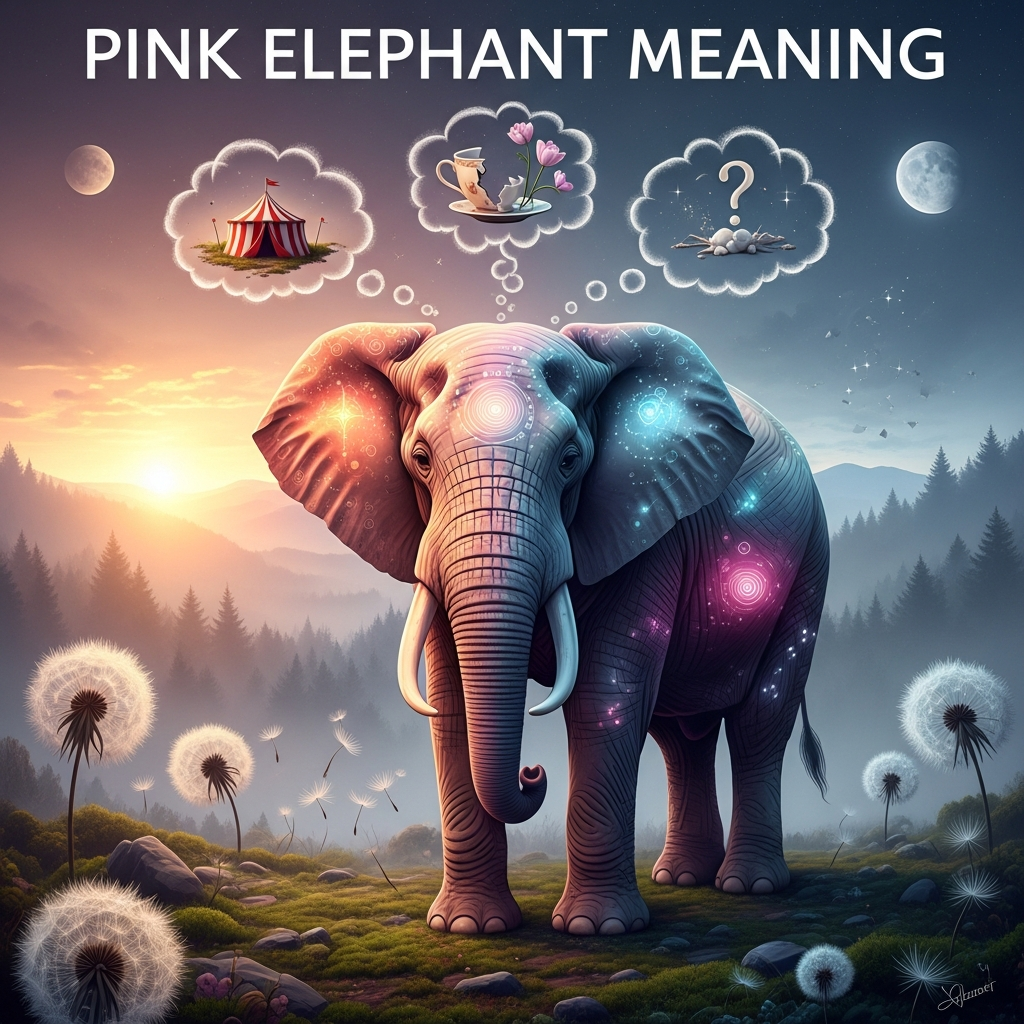
Pink Elephant Meaning: A Comprehensive Guide to Psychology, Origins, and Symbolism
The phrase “Pink Elephant” is far more than a whimsical image of a colorful pachyderm. In modern English, it serves as a powerful metaphor spanning the realms of psychology, literature, medical history, and popular culture. Whether you have encountered this term in a psychology textbook regarding “Ironic Process Theory” or heard it used as an idiom for alcohol-induced hallucinations, understanding the Pink Elephant meaning requires a deep dive into how the human mind processes information and imagery.
In this comprehensive guide, you will explore the multifaceted layers of this phenomenon. You will learn why telling someone “not to think of a pink elephant” is the fastest way to make them do exactly that, and how this colorful metaphor has evolved from a literary device into a cornerstone of cognitive science.
1. Defining the Pink Elephant: An Overview of Meanings
To understand the Pink Elephant meaning, one must first acknowledge its two primary definitions:
- The Psychological Definition: It refers to the “Ironic Process Theory,” where the attempt to suppress a thought makes that thought more persistent.
- The Idiomatic/Medical Definition: It is a euphemism for visual hallucinations caused by heavy alcohol withdrawal or “Delirium Tremens.”
Beyond these, the pink elephant has also been used to represent something that is glaringly obvious yet ignored (similar to the “Elephant in the Room”) or something that is exceedingly rare and unique.
2. The Psychology of the Pink Elephant: Ironic Process Theory
Perhaps the most famous application of the Pink Elephant meaning is in the field of cognitive psychology. If you were told, “Whatever you do, do not think about a pink elephant for the next sixty seconds,” what would happen? Almost immediately, a vivid image of a pink elephant would appear in your mind.
The Research of Daniel Wegner
In the late 1980s, social psychologist Daniel Wegner conducted a landmark study on mental suppression. Although he originally used a “White Bear” as his subject, the “Pink Elephant” has since become the more popular cultural equivalent. Wegner discovered that the act of trying to suppress a thought actually triggers a monitoring process in the brain.
How Mental Suppression Backfires
When you attempt to push a thought away, your brain employs two processes:
- The Operating Process: This is the conscious effort to find something else to think about.
- The Monitoring Process: This is an unconscious search to check if the forbidden thought is still present.
The irony lies in the fact that the monitoring process must constantly “think” of the pink elephant to ensure you are not thinking of it. This creates a state of hyperaccessibility, where the suppressed thought becomes more prominent than it would have been otherwise.
The Impact of Cognitive Load
You might find that when you are stressed or tired (high cognitive load), these “pink elephants” become even harder to ignore. This is because your conscious “Operating Process” lacks the energy to distract you, while the unconscious “Monitoring Process” continues to highlight the forbidden thought.
3. Historical Origins: Why a Pink Elephant?
Why was an elephant chosen, and why the color pink? The history of the Pink Elephant meaning is rooted in early 20th-century literature and the social perceptions of the era.
Jack London’s Contribution
The first recorded literary mention of “pink elephants” is often attributed to the American author Jack London. In his 1913 autobiographical novel, John Barleycorn, London describes a character in the throes of alcoholic hallucination as seeing “blue mice and pink elephants.”
Before this, the common idiom for hallucinations involved “snakes in the boots” or “blue devils.” London’s shift toward larger, more surreal animals like elephants added a layer of absurdity that resonated with the public.
Evolution into Popular Culture
By the 1940s and 50s, the pink elephant had become a standard trope in cartoons and films to signify intoxication. The most famous example is arguably the “Pink Elephants on Parade” sequence in Walt Disney’s Dumbo (1941). In this scene, Dumbo and Timothy Q. Mouse accidentally drink water spiked with champagne, leading to a surreal, technicolor hallucination of dancing pink elephants.
4. The Medical Context: Delirium Tremens and Hallucinations
While the psychological “Pink Elephant” is a harmless mental exercise, the medical Pink Elephant meaning has a darker origin. It is closely linked to Delirium Tremens (DTs), a severe form of alcohol withdrawal.
What are Delirium Tremens?
DTs occur when a person who has been drinking heavily for a long period suddenly stops. Symptoms include tremors, confusion, seizures, and vivid visual hallucinations.
Why do people see animals?
Medical research suggests that during withdrawal, the brain’s sensory processing becomes hyper-excitable. Hallucinations often involve “zoopsia”—seeing animals. While real hallucinations are rarely as neatly colored as “pink elephants,” the term became a convenient shorthand for the terrifying and disorganized visual disturbances experienced during severe withdrawal.
5. Symbolic Meaning: Rarity and Uniqueness
In certain contexts, the Pink Elephant meaning shifts toward the positive. Because pink elephants do not exist in nature (though albino elephants can appear reddish-pink when wet), the term is sometimes used to describe:
- Extraordinary Rarity: Something that is one-of-a-kind or highly improbable.
- Creative Imagination: A symbol for thinking outside the box or embracing the surreal.
- Distinct Branding: Many businesses (most notably the Delirium Tremens beer brand from Belgium) use the pink elephant as a logo to symbolize a bold, unforgettable experience.
6. How to Manage the “Pink Elephant” in Your Mind
If you find yourself struggling with intrusive thoughts—the psychological “pink elephants”—simply trying to “stop thinking about them” will likely fail. Experts suggest the following strategies to regain control:
A. Focused Distraction
Instead of telling yourself “don’t think of X,” give your mind a specific “Y” to focus on. For example, focus on the intricate details of a red car or the lyrics of a complex song.
B. Postpone the Thought
Research suggests that if you tell yourself, “I will think about the pink elephant in 10 minutes,” the urgency of the thought often dissipates. By acknowledging the thought rather than suppressing it, you reduce its power.
C. Mindfulness and Acceptance
Mindfulness involves observing your thoughts without judgment. Instead of fighting the pink elephant, you simply note, “I am having a thought about a pink elephant,” and let it pass like a cloud in the sky. Acceptance is often the most effective way to end the cycle of Ironic Process Theory.
D. Reduce Cognitive Load
Since suppression fails more often when you are stressed, prioritizing sleep and stress management can help your brain naturally filter out intrusive imagery.
7. The Pink Elephant vs. The Elephant in the Room
It is important to distinguish the Pink Elephant meaning from another common idiom: the “Elephant in the Room.”
- The Elephant in the Room: Refers to an obvious problem or difficult situation that people are intentionally ignoring because it is uncomfortable to discuss.
- The Pink Elephant: Refers to a psychological paradox of thought suppression or a surreal hallucination.
While both involve elephants, the former is about social avoidance, while the latter is about cognitive or sensory perception.
8. Cultural Impact and Modern Usage
Today, the pink elephant remains a staple of the English language. You will find it in:
- Political Discourse: Used to describe candidates or ideas that are seen as improbable or “hallucinatory.”
- Marketing: Used to grab attention through surrealism.
- Mental Health Awareness: Used to explain to patients how “thought suppression” contributes to anxiety and OCD (Obsessive-Compulsive Disorder).
9. Conclusion: Why the Pink Elephant Matters
The Pink Elephant meaning is a fascinating intersection of science, history, and art. It teaches us about the limitations of our willpower and the intricate ways our brains process reality. Whether it is a warning about the dangers of addiction, a lesson in psychological irony, or a symbol of the rare and beautiful, the pink elephant continues to stomp through our collective consciousness.
By understanding that the harder we fight a thought, the stronger it becomes, we can learn to navigate our mental landscapes with more grace. The next time someone tells you not to think of a pink elephant, you can smile, knowing exactly why your brain is doing the opposite—and how to let that elephant walk right on by.
10. Frequently Asked Questions (FAQ)
What does it mean when someone says they are “seeing pink elephants”?
This is an old-fashioned idiom meaning the person is heavily intoxicated or suffering from hallucinations, typically due to alcohol withdrawal (Delirium Tremens).
Why is the pink elephant used in psychology?
It is used to demonstrate Ironic Process Theory. It shows that attempting to suppress a thought makes it more likely to surface because the brain must constantly monitor for the thought it is trying to avoid.
Who first used the term “pink elephant”?
The phrase was popularized by Jack London in his 1913 book John Barleycorn, where he described alcoholic hallucinations.
Is seeing a pink elephant always negative?
Not necessarily. In branding and creative circles, a pink elephant can symbolize uniqueness, rarity, and a bold, imaginative spirit.
How do I stop thinking about a “pink elephant” or intrusive thought?
Instead of suppression, try “Acceptance and Commitment Therapy” (ACT) techniques. Acknowledge the thought without fighting it, or use “focused distraction” by giving your mind a specific, different task to complete.
Does the “Pink Elephant” have a spiritual meaning?
In some spiritual contexts, an elephant symbolizes strength and wisdom. A pink elephant, being rare, might be interpreted as a sign of a unique spiritual awakening or a call to pay attention to the subconscious mind.