The Mantilla is far more than just a piece of fabric; it is a profound cultural symbol, an exquisite art form, and a timeless expression of Spanish elegance. This iconic lace veil, traditionally draped over the head and shoulders, carries centuries of history, connecting the wearer to Spain’s rich heritage, royal traditions, and deeply rooted spiritual life. Today, the Mantilla continues its legacy, evolving from daily wear into a sophisticated statement piece, primarily cherished for weddings, religious ceremonies, and major national events across Spanish and Latin cultures.
What Exactly Is a Mantilla?
The Mantilla is a traditional Spanish head covering, a light lace or silk veil worn draped over a woman’s head and shoulders. It is typically anchored by a high, ornamental comb called a peineta. Historically worn daily, the Mantilla now serves primarily as a formal accessory for special occasions like weddings and religious rites.
The term Mantilla itself is a diminutive of manta, which translates roughly to ‘cloak’ or ‘blanket,’ suggesting its original purpose as a large protective covering. While its primary association is with Spain, the elegant garment has been adopted by various Latin cultures, becoming an enduring symbol of modesty and refined femininity. The delicate nature of a genuine Mantilla—often handcrafted with painstaking attention to detail—makes it a highly valued heirloom.
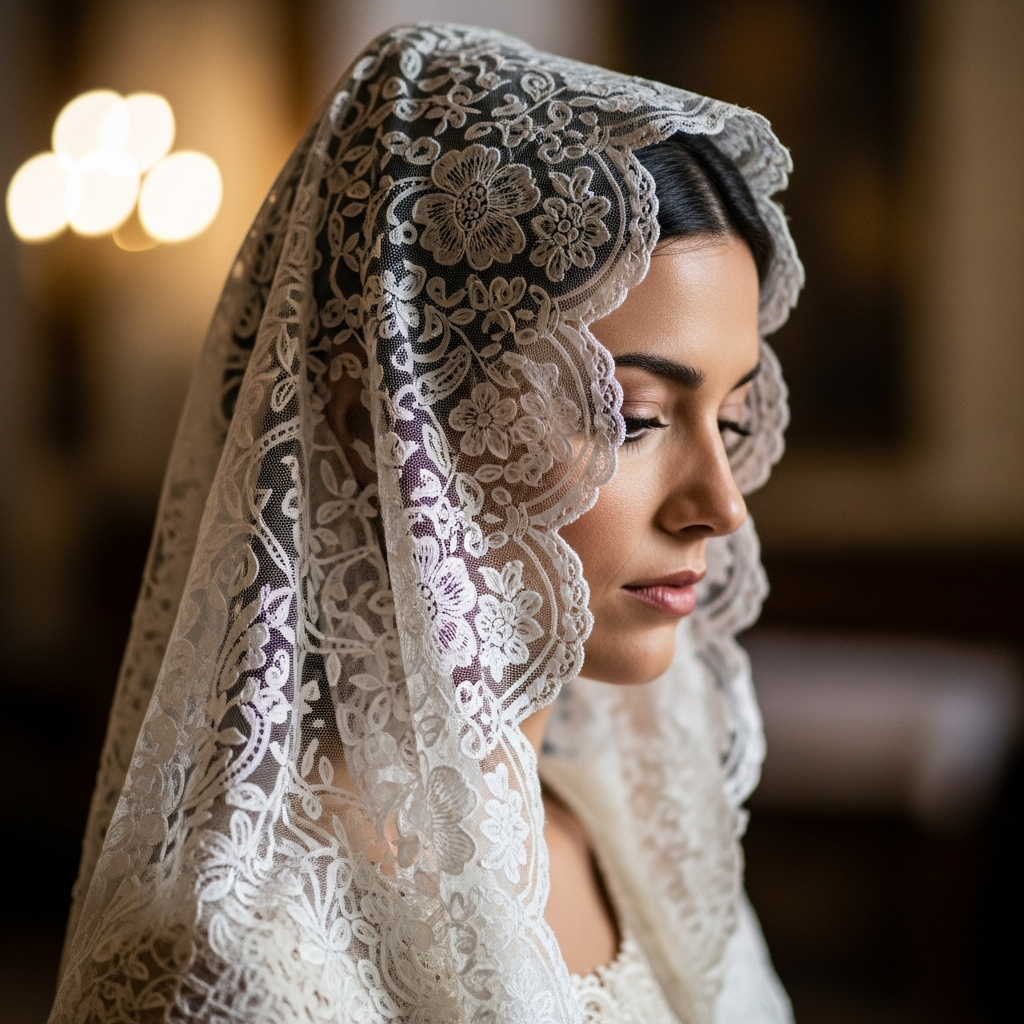
The defining characteristic of the Mantilla is its construction, nearly always featuring fine lace or tulle fabric with intricate patterns and borders. This allows the veil to gracefully cascade down the back and over the shoulders, framing the wearer’s face without completely obscuring it. The sheer beauty of the material, combined with the height and structure provided by the supporting comb, transforms the Mantilla into a true work of wearable art, instantly lending an air of formality and majesty to any ensemble.
A crucial component in the wearing of the Mantilla is the peineta—a large, tortoiseshell or synthetic comb that serves as the internal structure. Without the peineta, the lace would simply collapse. The weight and size of the Mantilla are directly supported by this comb, which is secured tightly into the hair. The peineta elevates the fabric, allowing the lace to spread and form a wide, rounded frame around the head, ensuring the Mantilla‘s silhouette remains distinct and instantly recognizable.
A Journey Through Time: The Rich History of the Mantilla
The history of the Mantilla is intrinsically tied to the social and religious development of the Iberian Peninsula, transforming from a simple garment into a symbol of national identity. Its roots are ancient, but its rise to fame as an iconic fashion statement occurred much later, heavily influenced by royalty and shifting social customs. The journey of the Mantilla offers a fascinating glimpse into European fashion evolution.
The Roman and Visigothic Roots
Head coverings have been a tradition in the Mediterranean and the Near East for millennia, often serving religious or modesty purposes. In the Iberian Peninsula, during the Roman and later Visigothic periods, covering one’s head was a common practice, particularly for married women. These early coverings were simple cloths or shawls, precursors to the sophisticated lace Mantilla we know today. This custom ensured that the concept of a draped head covering was already normalized in the region long before the introduction of fine lacework.
As Spain evolved through the Middle Ages, the tradition of head coverings persisted and became more varied. Different regions adopted different styles, but the core idea of a draped fabric remained. This cultural groundwork provided fertile ground for the future popularity of the Mantilla when fine lace became more accessible and popular. The gradual shift from plain cloth to richly woven or knitted materials signaled a transition from purely utilitarian function to a clear fashion statement.
The Golden Age: Spanish Court and Royal Influence
The Mantilla truly cemented its place in history during the 17th and 18th centuries. Initially, it was a practical garment, often worn by women of lower social standing (Majas) to cover their heads when outside. It was a simple, often dark, woolen or cotton cloak. However, as often happens in fashion, members of the aristocracy began to mimic the distinctive style of the common people, leading to a sophisticated elevation of the accessory.
A massive boost to the Mantilla‘s status came directly from the Spanish royalty. Queen Isabella II (reigned 1833–1868) was particularly instrumental in popularizing the accessory, frequently appearing in public wearing one. Her endorsement essentially transformed the Mantilla from an optional head covering into a mandatory symbol of Spanish high society and national pride. The Queen’s preference for the Mantilla ensured that the garment was seen at every major court function, solidifying its association with power and elegance.
Simultaneously, the Spanish-born Empress Eugénie of France, a famous trendsetter in her time, also championed the Mantilla abroad, showcasing its beauty on the international stage. This royal adoption propelled the Mantilla into the European fashion consciousness, ensuring that it was seen not just as a religious item, but as a deeply glamorous one. During this peak era, the materials became increasingly luxurious, with silk lace becoming the most common fabric choice for a true high-fashion Mantilla.
The Decline and Modern Revival
By the late 19th and early 20th centuries, European fashion was rapidly changing, prioritizing less restrictive clothing and headwear. The practical complexity of securing the Mantilla and the high peineta made it impractical for the fast-paced life of the modern era. As a result, the accessory began to decline as a piece of daily attire, gradually becoming reserved for special occasions only.
However, the Mantilla never truly disappeared. Its strong connection to Spanish identity ensured its preservation as a ceremonial piece. Today, the Mantilla enjoys a modern revival, particularly within the bridal industry. Contemporary designers are incorporating the classic lace shape into new, often lighter materials, creating wedding veils that offer the timeless, old-world romance of the traditional Mantilla while catering to a modern aesthetic. The desire for a classic, formal look with a modern twist keeps the Mantilla relevant.
The Anatomy of Elegance: Materials and Craftsmanship
The true value and beauty of a traditional Mantilla lie not only in its historical significance but also in the incredible skill required to craft it. The materials chosen—the type of lace and the comb structure—determine its final look, feel, and cost. Understanding the components of the Mantilla is key to appreciating its enduring legacy.
The Essential Fabric: The Magic of Lace
The choice of lace is paramount in defining the style and quality of a Mantilla. Historically, silk lace was favored, with various regions in Spain specializing in different weaving techniques. A high-quality Mantilla is immediately identifiable by the complexity and quality of its lace, which must be fine enough to drape elegantly yet strong enough to support the tension over the peineta.
Several types of lace are traditionally associated with the Mantilla:
- Chantilly Lace: Famous for its intricate patterns, fine net ground, and softly outlined designs. Chantilly lace is light, airy, and very delicate, making the Mantilla made from this material feel weightless and ethereal.
Blonde Lace (or Encaje rubio*): This is perhaps the most iconic lace type for a white or ivory Mantilla. Known for its large, bold floral or geometric patterns, often made with thicker, shinier silk thread than the net ground. This contrast makes the design stand out beautifully against the hair and shoulders, giving the Mantilla a dramatic, high-contrast look.
- Point de Venise: Though Italian in origin, this needlepoint lace sometimes appears in heavier, more formal Mantilla designs. It is denser and more three-dimensional than the others, lending a regal, almost sculptural quality to the garment.
In modern applications, tulle—a very fine, sheer silk or nylon netting—is often used as the base fabric for a wedding Mantilla, with the elaborate lace trim applied only to the circular border. This method allows for a cathedral-length veil that retains the signature circular shape of the Mantilla while reducing its overall weight and complexity, making it more practical for a bride.
The Hidden Structure: The Comb (Peineta)
No discussion of the Mantilla is complete without detailing the peineta. The peineta is not merely a hairpin; it is a large, often highly decorative, crescent-shaped comb that provides the necessary scaffolding. The height of the peineta is critical, as it is what lifts the Mantilla high above the crown of the head, creating the desired majestic arc and profile.
Traditionally, the finest peinetas were carved from tortoiseshell, valued for its warm color, natural luster, and surprising lightness relative to its size. As tortoiseshell became ethically restricted, artisans shifted to creating high-quality synthetic materials, such as colored acrylics or plastics, that mimic the look and feel of the original material. These modern peinetas are sometimes left plain black or brown, while others are intricately carved or adorned with metal and gemstones to match the opulence of the Mantilla itself.
The synergy between the peineta and the Mantilla is what makes the final look so striking. The sheer lace is expertly gathered and fastened around the crown of the comb, allowing the fabric to fall naturally down the sides. The rigidity and height of the comb ensure that the delicate lacework is displayed to its fullest advantage, turning the back of the woman’s head into a mobile canvas. The combined height of the peineta and the draped Mantilla can add a considerable amount of stature to the wearer, contributing to the garment’s commanding presence.
The Modern Mantilla: Where We See It Today
While no longer a daily fixture, the Mantilla remains a vibrant accessory, adapting to modern trends while steadfastly maintaining its cultural integrity. Its usage today is a careful balance between preserving time-honored customs and embracing contemporary aesthetics, particularly in bridal and ceremonial contexts.
The Wedding Mantilla: Bridal Grandeur
The Mantilla has firmly established itself as a premier choice for modern brides, especially those seeking a look that merges Old-World romance with timeless sophistication. For a 2026 wedding, the Mantilla veil is taking center stage as a significant trend, highly favored for its unique frame and elegant draping. Unlike a standard veil that often gathers at a single point, the bridal Mantilla is characterized by its signature circular edge and the continuous lace trim that frames the bride’s face and shoulders.
The appeal of the wedding Mantilla is often rooted in its cultural significance within Spanish, Latin, and Italian traditions. Modern designs often feature custom-embroidered lace along the border, allowing brides to personalize the design to match their gown’s detailing or even incorporate meaningful symbols into the lace. The luxurious, often cathedral-length bridal Mantilla is chosen by brides who desire a classic, formal statement, adding drama and a sense of legacy to their procession down the aisle. Designers are crafting contemporary interpretations of the Mantilla, focusing on lighter materials and more manageable construction to appeal to the modern woman.
The pricing of a high-quality wedding Mantilla reflects its intricate craftsmanship, often starting from several hundred dollars and climbing significantly based on the lace’s origin, length, and detail. For example, some bridal accessory designers list delicate, wide eyelash lace Mantillas with a guide price range starting around £217 and going up to over £500, depending on selection and customization. Highly personalized or designer Mantilla options can easily cost more, cementing the item’s status as a luxury piece.
Cultural Events and Celebrations
Beyond the wedding aisle, the Mantilla plays a critical role in preserving Spain’s most treasured public ceremonies. In these contexts, the accessory serves as a uniform of reverence, respect, and national identity, often following strict rules regarding color and placement.
One of the most powerful displays of the Mantilla is during Semana Santa (Holy Week), particularly in cities like Seville and Málaga. During the solemn religious processions, women often wear the traditional black Mantilla—a sign of mourning and devout respect for the Passion of Christ. This use of the Mantilla is non-negotiable; it underscores the spiritual gravity of the week, linking the contemporary participant to centuries of religious tradition.
The Mantilla is also frequently seen at cultural events, such as formal bullfights (Corridas de Toros) and regional festivals (Ferias). At these celebratory, yet formal, gatherings, the garment serves as the ultimate expression of Spanish formal dress. Women attending the most prestigious events often wear the Mantilla to signify respect for the traditions of the event. Even members of the Spanish Royal Family and high-ranking female dignitaries will often choose to wear a formal Mantilla when attending specific state or religious events, showcasing its continued importance at the highest levels of society.
Color Symbolism: Decoding the Mantilla
The color of the Mantilla is not arbitrary; it communicates the wearer’s status, the nature of the event being attended, and the specific traditions being observed. The symbolism is particularly important in formal Spanish cultural and religious settings, where adherence to custom is highly valued.
The Black Mantilla: The Color of Devotion and Solemnity
The Black Mantilla is the most historically and culturally significant version of the garment. It is the color of mourning, solemnity, and deep religious devotion. Traditionally, a married woman who wore the Mantilla for daily life would wear a black one.
Today, the black Mantilla is strictly reserved for religious events, funeral services, or formal occasions requiring profound respect and modesty. Its most famous usage is during the aforementioned Holy Week processions, where it reflects a somber, penitential tone. The black lace, when offset by a simple black dress, creates a stunningly dramatic and respectful silhouette. The deep hue of the Mantilla emphasizes the intricate lacework, especially in artificial light or against white skin.
The White or Ivory Mantilla: Joy, Celebration, and Innocence
In stark contrast, the White or Ivory Mantilla—often made from the delicate Blonde lace—is the color of joy, celebration, and youthful innocence. This version of the Mantilla is almost exclusively worn for happy occasions.
The most common modern application of the white Mantilla is as a bridal veil. When worn by a bride, it symbolizes purity and the joyous nature of the wedding ceremony. It is also traditionally worn by young, unmarried women or women celebrating their debut into society, though this tradition is less common now. The lighter color of the Mantilla makes it particularly suitable for daytime events, reflecting the sunshine and the celebratory atmosphere. The texture of the white lace is often the focal point, creating a softer, more romantic feel than the dramatic black counterpart.
The Colored Mantilla: Regional and Festival Flair
While the black and white Mantillas hold the greatest historical weight, colored versions exist, though they are much less common and typically worn only for regional or folk festivals, not for formal state or religious functions.
During certain Ferias (festivals) across Spain, particularly those related to regional identity, women might incorporate the general shape and drape of the Mantilla using brightly colored silks or patterned fabrics that match their regional folk costumes. These colored Mantillas are celebratory, reflecting the vibrancy and local pride of the specific festival, and are generally seen as a fashionable adaptation rather than an adherence to the core, formal tradition of the black or white lace garment.
Frequently Asked Questions
What is the primary difference between a Mantilla and a standard wedding veil?
The key difference lies in the shape and method of attachment. A standard wedding veil is typically a rectangular or oval piece of tulle gathered and secured at the crown or back of the head, often creating volume at the top. In contrast, the traditional Mantilla is a circular or semi-circular piece of lace with a continuous lace border that is attached flat along the perimeter, then anchored by a high, structural comb called a peineta. This anchoring method allows the Mantilla to drape elegantly around the face and shoulders, forming a distinctive, face-framing silhouette that a standard veil cannot replicate.
Is the Mantilla only worn by Spanish women?
While the Mantilla is fundamentally a Spanish invention and cultural symbol, its use is not exclusive to Spanish women. The Mantilla has been widely adopted by women in Spanish-speaking countries throughout Latin America and by women of Italian heritage. More generally, the Mantilla veil style is now seen worldwide in the bridal industry, chosen by any bride who appreciates its distinctive elegance and romantic aesthetic. In a religious context, the accessory is a symbol of faith and modesty, making it appropriate for any Catholic woman who chooses to wear one.
How do I properly secure a Mantilla so it doesn’t fall?
Securing a Mantilla requires structure and several supporting pieces. First, the hair must be prepared—usually swept up into a high bun or elaborate style to provide an anchor. Second, the peineta (the tall comb) is inserted deeply into the bun, providing the necessary height and rigidity. Finally, the lace Mantilla itself is draped over the peineta and secured to the comb, and often further pinned to the hair using many small hairpins, particularly near the temples and behind the ears. This combination of the high-set peineta and multiple pins ensures the heavy lace of the Mantilla remains stable throughout the event.
What is the estimated cost of a genuine, high-quality Mantilla?
The cost of a genuine, handcrafted Mantilla can vary dramatically based on the quality of the lace, its length, and its age. A mass-produced, shorter-length tulle bridal Mantilla may start in the low hundreds of dollars. However, a full-length, cathedral-style wedding Mantilla featuring elaborate, high-quality, handmade Chantilly or Blonde lace can easily cost upwards of $1,000 to $2,000 or more, especially if purchased from a specialty artisan or designer. Antique Mantillas or those featuring historically significant lacework, particularly if they are heirloom-quality, command even higher prices, reflecting the rarity and skill involved in their creation.
*
The Mantilla stands as a powerful testament to the enduring nature of traditional fashion and cultural identity. From its humble beginnings as a simple covering, it ascended through royal courts to become a symbol of national grace and religious devotion. Whether worn by a modern bride seeking a timeless look or by a participant in a solemn procession, the Mantilla continues to command attention. This delicate, yet dramatically structured, lace shawl remains a beloved and highly prized item, forever linking its wearers to a legacy of beauty, faith, and the unmistakable spirit of Spanish artistry. The timeless elegance of the Mantilla ensures its place in the world of fashion and culture for centuries to come.