Lotus Flower Symbolism In Buddhism And Hinduism: The Ultimate Guide To Spiritual Purity
The lotus flower is perhaps the most significant and enduring symbol in the spiritual landscape of the East. Deeply rooted in the mud of ponds and lakes, yet rising above the water to bloom with untainted beauty, the lotus serves as a powerful visual metaphor for the human condition. In both Buddhism and Hinduism, this aquatic flower is not merely a botanical specimen but a sacred icon representing purity and innocence, spiritual awakening, and the eternal journey of the soul. To understand the lotus is to understand the core tenets of these two ancient traditions, as it encapsulates the essence of their teachings on life, death, and liberation.

The Biological Metaphor: From Murky Depths to Celestial Light
Before diving into the complex religious iconography, it is essential to appreciate the natural life cycle of the lotus (Nelumbo nucifera). Unlike many other flowers, the lotus begins its life in the dark, nutrient-rich mud at the bottom of a body of water. To reach the sunlight, it must push through the murky depths, maintaining its integrity despite the surrounding filth. This transformation process is the foundation of its spiritual significance. It mirrors the human enlightenment journey, where an individual must navigate the “mud” of worldly desires, suffering, and ignorance to reach a state of spiritual awakening.
The lotus remains unstained by the mud from which it grows. Its petals possess a natural self-cleaning mechanism, often referred to in science as the “lotus effect.” This characteristic is a perfect visual metaphor for the soul’s potential to remain pure amidst the chaos of the material world. In literary analysis, this is often compared to the resurrection myth or the firebird (Phoenix), where beauty and life emerge from the ashes or the depths. The lotus represents resilience and flexibility, showing that strength and courage are required to rise above one’s circumstances.
Lotus Symbolism in Hinduism: The Flower of Creation and Divinity
In Hinduism, the lotus (known as Padma) is inextricably linked to the ancient deities and the very act of creation. It is considered one of the most sacred animals and plants in the Vedic tradition, often associated with the karmic cycle and the concept of divine justice. The lotus is seen as the womb of the universe, the seat of the gods, and the ultimate symbol of inner wisdom.
1. Lord Brahma and the Creation of the Universe
According to Hindu ancient mythology, the universe began with Lord Vishnu reclining on the serpent Shesha in the causal ocean. From Vishnu’s navel, a magnificent golden lotus emerged, and within that lotus sat Lord Brahma, the creator god. This makes the lotus the axis mundi or the center of the world, connecting the divine realm with the physical manifestation. The world tree root system in other cultures finds its aquatic equivalent here; the lotus stem is the umbilical cord of the cosmos, representing the interconnectedness of all living beings.
2. Lakshmi and the Symbolism of Abundance
Goddess Lakshmi, the deity of wealth, prosperity, and good luck omens, is almost always depicted standing or sitting upon a fully bloomed lotus. In her hands, she often holds two lotus buds, representing the duality of the material and spiritual worlds. For a devotee, Lakshmi’s lotus signifies that one can attain material success without becoming attached to it, much like the lotus leaf sheds water. This is a crucial lesson in human nature: the ability to thrive in the world while maintaining purity and innocence.
3. The Chakras and Sacred Geometry
In the esoteric traditions of Yoga and Tantra, the human body is said to contain energy centers known as Chakras, which are visualized as lotus flowers. The sacred geometry of these lotuses varies, with each having a specific number of petals. The root chakra (Muladhara) is a four-petaled lotus, while the crown chakra (Sahasrara) is known as the “Thousand-Petaled Lotus.” This eternity loop of energy represents the spiritual growth of the practitioner. When the chi energy (or Prana) rises through these centers, it culminates in the opening of the crown lotus, signifying full spiritual awakening and liberation from the karmic cycle.
Lotus Symbolism in Buddhism: The Path to Nirvana
Buddhism adopted the lotus as its primary symbol to illustrate the teachings of the Buddha. In buddhist teachings, the lotus represents the progress of the soul from the primeval mud of materialism, through the waters of experience, and into the bright sunshine of enlightenment journey. It is the ultimate spiritual familiar for those seeking the truth.
1. The Birth of Siddhartha Gautama
Legend has it that when the Buddha (Siddhartha Gautama) was born, he took seven steps, and with every step, a lotus flower bloomed beneath his feet. This folklore and legends highlight the Buddha’s status as an immortal being who was born into the world but was not of the world. The lotus serves as a mythical guardian of his purity, signaling his destiny to become the “Awakened One.”
2. The Five Colors of the Buddhist Lotus
In Buddhist religious iconography, the color of the lotus carries specific allegorical meaning and thematic elements:
- The White Lotus: Represents purity and innocence of the mind and spirit. It is the state of total mental purity and spiritual perfection.
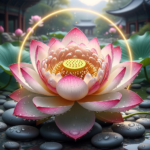
- The Pink Lotus: This is the supreme lotus, reserved for the historical Buddha. It represents the highest divine protection and the earthly manifestation of the Buddha.
- The Red Lotus: Associated with the heart, it symbolizes love, compassion, and the transformation process of the passions. It is linked to Avalokiteshvara, the Bodhisattva of Compassion.
- The Blue Lotus: Symbolizes inner wisdom, knowledge, and the victory of the spirit over the senses. It is often depicted as partially open, representing the ongoing nature of the enlightenment journey.
- The Purple Lotus: Often associated with esoteric knowledge and mystical sects. It represents the eternity loop of the Eightfold Path.
3. The Mud, the Water, and the Air
The Buddha taught that just as the lotus grows in the mud but is not soiled by it, so should the practitioner live in the world without being affected by its bad omens or attachments. This is a core literary device used in sutras to explain the “Middle Way.” The mud represents dystopian society, totalitarianism of the ego, and civilization vs savagery. The water represents the washing away of isolation and alienation, and the air represents the freedom of Nirvana.
The Lotus as a Universal Archetype: Cross-Cultural Connections
While Buddhism and Hinduism are the primary custodians of lotus symbolism, the flower appears in various forms across ancient mythology and cultural symbolism. Its presence in egyptian artifacts, chinese philosophy, and japanese traditions suggests a universal human recognition of its deep rooted meaning.
1. Egyptian Mythology and the Blue Lotus
In ancient Egypt, the blue lotus (Nymphaea caerulea) was a symbol of the sun and rebirth. It was believed that the sun rose out of a giant lotus at the beginning of time. This mirrors the creation vs destruction themes found in Hindu ancient deities. The Egyptians used the lotus in pagan rituals and as a spirit familiar to guide the deceased through the underworld, much like the grim reaper or harvesting souls concept, but with a focus on springtime renewal.
2. Chinese Philosophy and Feng Shui
In chinese philosophy, the lotus is one of the “Eight Auspicious Symbols.” It is used in feng shui placements to promote balance and harmony within a home. The lotus is seen as a good luck omen that can transmute negative energy into positive chi energy. It is also a symbol of feminine beauty and marital harmony, often appearing in japanese traditions as a motif for transient beauty and mortality.
3. Comparison with Other Mythical Symbols
The lotus shares many attributes with other mythical birds and legendary beasts. Like the phoenix or firebird, it represents metamorphosis. Like the world tree root system (Yggdrasil in norse mythology), it acts as an axis mundi. In celtic traditions and native american rituals, plants with similar water-based life cycles are often treated as nature spirits or divine messengers.
Psychological and Philosophical Interpretations
Beyond religion, the lotus offers profound insights into human nature and psychological symbolism. In gothic literature and romanticism era poetry, flowers often represent transient beauty and the passing of time. However, the lotus adds a layer of resilience and flexibility.
1. Overcoming Trauma and Adversity
The “mud” can be viewed as psychological trauma, isolation and alienation, or the civilization vs savagery struggle within the self. The lotus teaches that these dark experiences are the very nutrients needed for spiritual growth. Without the mud, there is no flower. This thematic element is common in classic literature motifs where a tragic hero must undergo a transformation process to find inner wisdom.
2. The Concept of Duality
The lotus exists in three elements: earth (mud), water, and air. This represents the balance and harmony between different states of being. It is a visual metaphor for duality—the idea that light cannot exist without dark, and creation vs destruction are two sides of the same karmic cycle. In esoteric knowledge, this is often linked to sacred geometry and the eternity loop.
The Lotus in Art, Literature, and Iconography
The lotus is a staple of fictional artifacts and mythical weapons in Eastern epics. In the Mahabharata and Ramayana, divine justice is often delivered by gods holding lotus-themed mythical weapons. As a literary device, the lotus is used in poetry analysis to describe everything from a lover’s eyes (“lotus-eyed”) to the feet of a deity (“lotus feet”).
1. Visual Metaphors in Architecture
From the temples of Angkor Wat to the Lotus Temple in Delhi, the flower’s shape is used to create spaces that evoke divine protection and spiritual awakening. These structures act as a mythical guardian for the practitioners within, providing a physical guidance and hope through sacred geometry.
2. Allegorical Fiction and Motifs
In modern dystopian society novels or fantasy folklore, the lotus often appears as a hidden message of hope. It represents a beast of burden (the soul) finally finding its wings. The character motifs of characters rising from poverty to greatness are often modeled after the botanical meaning of the lotus.
Practical Applications: Bringing the Lotus into Your Life
You do not need to be a practitioner of hinduism deities or buddhist teachings to benefit from the symbolism of the lotus. Its deep rooted meaning can be applied to modern life through various native american rituals, middle eastern talisman concepts, or nordic runes-style meditation.
1. Meditation and Mindfulness
Visualizing a blooming lotus during meditation can help in personal growth. Imagine each petal opening as you release a stressor or a bad omen. This practice helps in achieving balance and harmony and connecting with your inner wisdom.
2. Home Decor and Feng Shui
Using lotus imagery in feng shui placements can invite good luck omens and chi energy into your living space. It serves as a constant reminder of purity and innocence and the possibility of springtime renewal even in the darkest of times.
The Lotus and the Cycle of Life and Death
Finally, the lotus represents the cosmic cycle of time passing and mortality. In some cultures, it is associated with harvesting souls, not in a morbid sense like the grim reaper, but as a transition to a higher state of being. It is the divine messenger that tells us that death is not the end, but a metamorphosis.
The karmic cycle is often depicted as a wheel, but the lotus offers a more organic view of divine justice. We reap what we sow in the mud, and our spiritual growth is the harvest. The interconnectedness of the root, the stem, and the flower reminds us that we are part of a larger mother nature system, governed by fire and water elements and sacred geometry.
Conclusion: The Eternal Bloom
The lotus flower remains one of the most potent cultural symbolism icons in human history. Whether through ancient hieroglyphs, greek gods stories, or buddhist teachings, it speaks to a fundamental truth about our existence: that we have the capacity for transformation process and spiritual awakening. By embracing the lessons of the lotus—resilience and flexibility, purity and innocence, and inner wisdom—we can navigate the karmic cycle with grace and find our way to the enlightenment journey.
As you look upon a lotus, remember that it is a divine messenger of guidance and hope. It tells you that no matter how deep the mud of your current circumstances may be, the sun is always shining above the surface, waiting for you to bloom. It is the eternity loop of life, a sacred geometry of the soul, and a testament to the transient beauty of our personal growth.
Frequently Asked Questions About Lotus Symbolism
What does the lotus symbolize in Hinduism?
In Hinduism, the lotus symbolizes purity and innocence, divine beauty, and the karmic cycle. It is associated with ancient deities like Brahma, Vishnu, and Lakshmi, representing the creation vs destruction of the universe and the spiritual growth of the individual through the chakras.
Why is the lotus important in Buddhism?
The lotus is central to buddhist teachings as it represents the enlightenment journey. It illustrates how a person can rise above the suffering and “mud” of the material world to achieve a state of spiritual awakening and Nirvana, remaining unstained by worldly desires.
What do the different colors of the lotus mean?
Each color has a specific allegorical meaning: White for mental purity, Pink for the Buddha, Red for love and compassion, Blue for inner wisdom, and Purple for esoteric knowledge. These colors guide practitioners through their transformation process.
How does the lotus relate to the “mud”?
The mud represents the challenges of human nature, such as greed, ignorance, and dystopian society. The lotus’s ability to grow through the mud and bloom cleanly on the surface is a visual metaphor for overcoming adversity and achieving personal growth.
Is the lotus flower used in other cultures?
Yes, the lotus appears in egyptian artifacts as a symbol of the sun and rebirth, in chinese philosophy as a sign of balance and harmony, and in japanese traditions as a motif for transient beauty. It is a universal ancient mythology symbol for resurrection myth and divine protection.