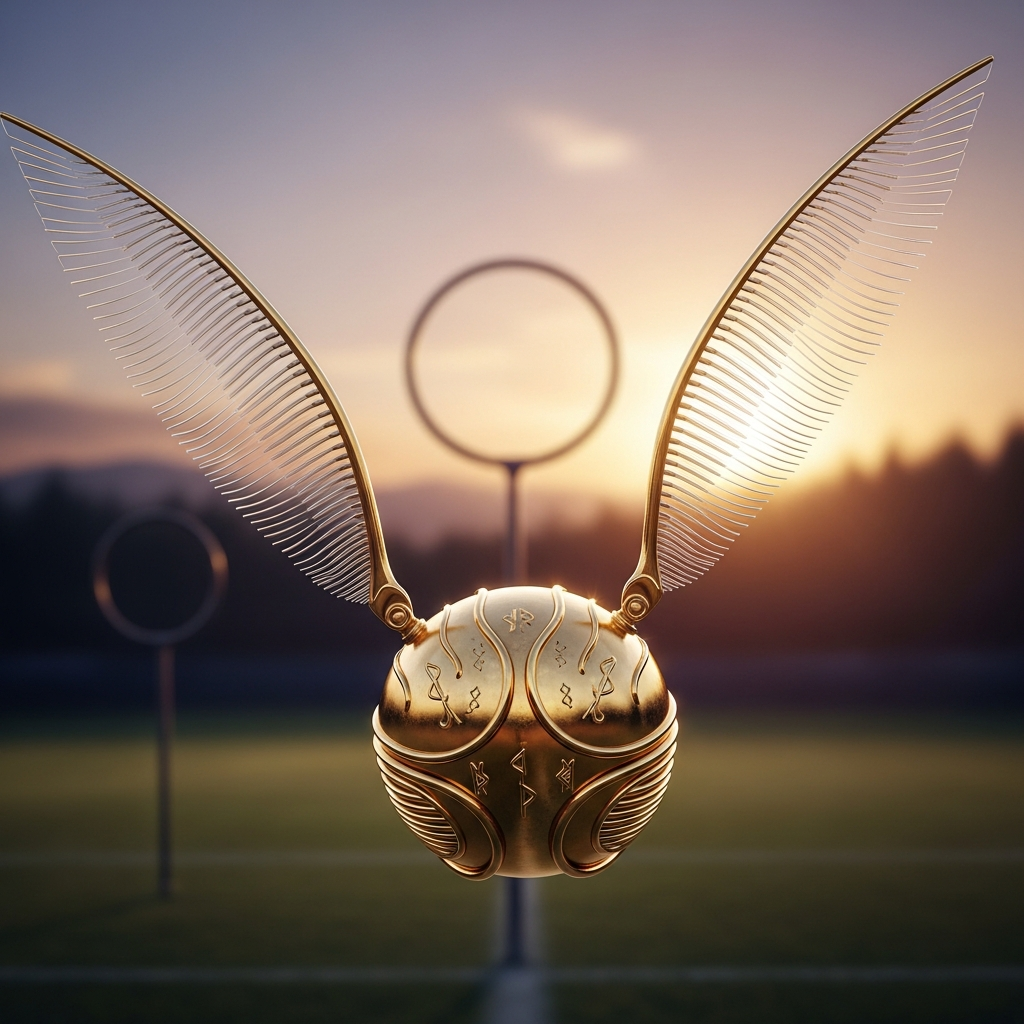
The Golden Snitch is perhaps the most iconic and fascinating object in the game of Quidditch, a high-stakes, high-speed aerial sport played by witches and wizards. It is a diminutive, winged, golden sphere whose capture immediately ends the match and awards the Seeker’s team a massive 150 points. This single action is almost always game-winning, and its incredible speed and unpredictable flight path make the Golden Snitch the ultimate prize in any contest.

The Core Mechanics: Understanding the Golden Snitch
The fundamental appeal of Quidditch revolves around three types of balls: the Quaffle, the Bludgers, and the Golden Snitch. While the Quaffle and Bludgers manage the flow and danger of the game, the Snitch controls its conclusion.
The Golden Snitch is critical because it introduces a unique, high-value objective that overrides the traditional scoring system. Without the Snitch, Quidditch would simply be a game of endurance, a continuous back-and-forth scoring competition.
Anatomy and Appearance of the Golden Snitch
The Golden Snitch is deliberately designed to be as elusive as possible. It is approximately the size of a walnut, perfectly spherical, and plated in a shimmering gold. Attached to its small body are delicate, silver, fluttering wings that beat incredibly quickly, making the ball a mere golden blur as it darts around the field.
Its small size, combined with its fantastic speed, means the Golden Snitch is a massive challenge for even the best Seekers. It is notoriously difficult to track amid the chaos of ten other players, two aggressive Bludgers, and the sheer visual clutter of a fast-paced aerial battle. This near-invisibility is intentional; it elevates the Seeker’s role into one of acute observation and lightning-fast reflexes.
Consider the complexity of spotting this tiny object. A professional Quidditch stadium is enormous, designed to hold thousands of spectators and allow for high-speed maneuvers on broomsticks. Against this vast canvas, and often at high altitudes, the Golden Snitch moves with the erraticism of an insect. Its flight pattern is completely unpredictable, defying human logic and expectation, making the challenge of locating it a profound mental and physical test. This constant, frantic search for the Golden Snitch is what defines the entire position of the Seeker.
The Role and Value: 150 Points and the Game Ender
The primary function of the Golden Snitch is twofold: to provide a massive point bonus and to terminate the game immediately. The 150 points awarded for its capture is a decisive figure.
Why 150 Points?
The standard scoring in Quidditch involves Chasers throwing the Quaffle through one of three hoops, which is worth 10 points. If a team has scored fifteen goals, they have 150 points, meaning the capture of the Golden Snitch is equivalent to scoring fifteen goals at once. This massive point disparity creates an inherent tension in every game.
This scoring system means that a team can be significantly behind in Quaffle goals, yet still win the match instantly if their Seeker catches the Golden Snitch. For example, a team trailing 160-50 (a 110-point deficit) will win 200-160 upon catching the Golden Snitch. This mechanism ensures that attention is never focused solely on the Quaffle; the entire stadium is constantly aware that the match could end, and the tide could turn, in the blink of an eye due to the Golden Snitch.
The secondary, and perhaps more dramatic, function of the Golden Snitch is its ability to end the match. Unlike sports with fixed time limits, a Quidditch match continues until the Golden Snitch is caught. This leads to legendary games that can span days, weeks, or even months, testing the extreme endurance of the players. The record for the longest-ever Quidditch game is reputedly three months.
The presence of the Golden Snitch transforms Quidditch from a standard team sport into a perpetual psychological battle. Every player knows that their current goal-scoring effort could be instantly invalidated by the flash of gold. The Golden Snitch is, therefore, not just a scoring element; it is the central psychological timer and the ultimate dramatic climax of the sport. The entire strategy of the game hinges on predicting when, or if, the opposing Seeker will find the Golden Snitch.
A Century of Change: The Fascinating History of the Golden Snitch
The modern Golden Snitch is a mechanical creation, but its origins are rooted in a tragic and compelling story involving a small, magical bird. Understanding its history is essential to appreciating the significance of the ball today. The development of the Snitch is a testament to the ethical evolution within the magical sporting world.
From Golden Snidget to Golden Snitch: The Origin Story
Before the invention of the mechanical ball, the role of the Snitch was played by a live creature known as the Golden Snidget. This beautiful, tiny bird, native to Great Britain, was revered for its small size, bright gold feathers, and incredibly fast, darting flight. The original rules of Quidditch did not include the Snitch at all; the game focused solely on the Quaffle and the two Bludgers.
The shift occurred in the mid-13th century during a Quidditch match in Kent. A wizard named Barberus Bragge brought a Golden Snidget to the pitch and announced that he would give 150 Galleons (an enormous sum at the time) to the player who caught the bird. The players immediately abandoned their posts, focusing entirely on capturing the Snidget. This event established the 150-point value and the game-ending condition, cementing the bird’s—and later the ball’s—centrality in Quidditch.
However, the practice of using live Snidgets quickly became a conservation crisis. The bird was so fragile and small that Seekers would often crush or fatally injure it upon capture. Its growing rarity led the Wizards’ Council to classify the Golden Snidget as a protected species, banning its use in Quidditch entirely. This necessitated the invention of a replacement object that possessed all the magical speed and elusiveness of the bird, but without the ethical complications.
This pivotal moment in sporting history led to the invention of the mechanical Golden Snitch by a wizard named Bowman Wright. Wright, a skilled metal-charmer from Godric’s Hollow, managed to create a magical ball that perfectly replicated the flight and appearance of the Snidget. This technological advancement ensured the survival of the beloved Golden Snidget while preserving the integrity and excitement of Quidditch. The new mechanical Golden Snitch was quickly adopted, replacing the live bird across all leagues and matches.
The Ethical Debate: Is the Golden Snitch Fair?
Despite its historical necessity, the structure of the Golden Snitch has been the subject of continuous debate among Quidditch fans and strategists. The central argument revolves around whether the 150-point reward unbalances the entire game.
Critics argue that the Golden Snitch makes the hard work of the Chasers and the Keeper virtually irrelevant. A team can expertly control the Quaffle, scoring goal after goal and building up a substantial lead, only to have a single Seeker from the opposing team catch the Snitch and win the match. This dynamic suggests that the outcome is disproportionately determined by one player in one position, making the Golden Snitch a somewhat arbitrary arbiter of victory.
Case Study: The 1994 Quidditch World Cup Final
A famous real-world example highlighting this issue is the match between Ireland and Bulgaria. Ireland dominated the game, racking up a massive lead against Bulgaria. However, the Bulgarian Seeker, Viktor Krum, ultimately caught the Golden Snitch. Krum’s action was a dramatic sacrifice, as he knew his team was too far behind to win even with the 150 points. He caught the Snitch to end the brutal match on his own terms, choosing to lose by a smaller margin rather than prolong the inevitable slaughter of goals.
- Final Score: Ireland won 170-160.
- Significance: This is one of the few instances where the team catching the Golden Snitch still loses the match, demonstrating the overwhelming dominance Ireland had in the traditional scoring.
This example is often cited by those who believe the value of the Golden Snitch should be reduced. They propose lowering the value from 150 to perhaps 100 or 80 points, allowing the Chasers’ efforts to have a more consistent impact on the final outcome. However, proponents argue that the element of instant victory is what makes Quidditch unique and dramatic; the sheer terror and exhilaration of the game hinges on the possibility of a sudden, spectacular end delivered by the Golden Snitch.
The Magic Within: Unique Properties of Every Golden Snitch
What separates the Golden Snitch from any ordinary, enchanted flying object is the distinct, intricate magic woven into its construction. These properties are what make the Snitch a truly singular object of desire and mystery.

The “Flesh Memory” Phenomenon
One of the most peculiar and important magical properties of the Golden Snitch is its ‘flesh memory.’ This mechanism means that the Snitch is enchanted to remember the physical touch of the very first person who catches it. This is a crucial security and fairness measure.
Implications for Gameplay and Records:
The rule surrounding flesh memory dictates that a new Golden Snitch must be used for every single Quidditch match, from local school games to the World Cup Final. This ensures that the Snitch used in the current game has not been touched by anyone except the manufacturers, thus guaranteeing that the legitimate Seeker is the first to make contact during the match.
When a Golden Snitch is caught in a match, the only person permitted to touch it is the Seeker who caught it. Even the referee handles the retrieved Snitch with protective gloves to prevent imprinting a false flesh memory. The referee then uses a special spell to summon the Snitch to display the Seeker’s successful touch, confirming the win and awarding the points.
This magical feature makes the Golden Snitch a unique artifact in sporting history, transforming a simple ball into an enchanted witness. In rare instances, a Golden Snitch may need to be handled by a non-seeker post-game. In these cases, it is imperative to wear thick gloves, highlighting the sensitive and enduring nature of the magical memory embedded in the Golden Snitch. This ensures the integrity of all official Quidditch records.
The Snitch and the Seekers: A Unique Connection
The position of the Seeker is entirely defined by the presence of the Golden Snitch. Seekers are not involved in scoring or defense; their entire existence on the pitch is dedicated to tracking, chasing, and capturing this tiny, fast-moving object.
The Seeker’s Skill Set:
A successful Seeker must possess an extremely rare combination of skills:
- Eagle-Eyed Vision: The ability to spot the Golden Snitch amidst a confusing, fast-moving environment.
- Exceptional Broomstick Handling: Seekers often engage in dangerous dives and high-speed maneuvers, needing to outfly and outmaneuver the tiny ball itself, which can execute unpredictable directional changes.
- Psychological Stamina: The Seeker must maintain intense focus for hours, even days, waiting for a fraction of a second when the Golden Snitch becomes visible and accessible.
The mental game of the Seeker is arguably the most taxing in Quidditch. While Chasers and Beaters are constantly engaging in physical play, the Seeker is often circling, seemingly detached from the main action, waiting for their moment. They must resist the urge to get involved in the scoring, focusing solely on the subtle movements of the Golden Snitch. This mental discipline makes the position one of the most revered and demanding in the sport. The entire momentum of the match, the hopes of the fans, and the ultimate outcome often rest solely on the Seeker’s ability to find the fleeting, golden prize.
Beyond Quidditch: The Golden Snitch as a Cultural Symbol
The cultural impact of the Golden Snitch extends far beyond the boundaries of the Quidditch pitch. Its iconic status as an elusive, yet definitive, prize has made it a powerful symbol in literature, philosophy, and popular culture globally.
Symbolism in Literature and Philosophy
In a broader sense, the Golden Snitch represents the ultimate, elusive goal in life—the single, defining achievement that, once attained, provides ultimate resolution or meaning.
Analogies to Life’s Pursuit:
The pursuit of the Golden Snitch serves as a perfect metaphor for many real-world human experiences:
- The Unpredictable Nature of Success: The Snitch darts and weaves randomly. This mirrors life’s unpredictable journey, where success often comes not through a direct path, but through constant vigilance and the ability to capitalize on sudden, unexpected opportunities.
- Defining the Grand Prize: The 150 points represent the disproportionately large value often placed on a single, defining achievement, such as a monumental scientific discovery, a major artistic breakthrough, or winning a highly coveted award. Many competitions in the non-magical world are structured with a high-stakes final event, earning the moniker of a “Golden Snitch” mechanic.
- The Inner Quest: The fact that the Seeker often searches in isolation reflects the personal, internalized nature of many grand quests. The pursuit of the Golden Snitch is a solitary endeavor, even within a team sport.
Philosophically, the Snitch challenges the notion of fair play versus definitive climax. It forces us to ask whether life is a game of consistent, incremental progress (the 10-point goals) or one defined by sudden, dramatic, and possibly lucky breakthroughs (the Golden Snitch).
The Golden Snitch in Art and Pop Culture
In the non-magical world, the Golden Snitch has become an instantly recognizable piece of iconography. It symbolizes the magic, wonder, and competitive spirit of the wizarding world.
Its design—a perfect gold sphere with fluttering silver wings—is aesthetically pleasing and highly evocative. Consequently, the Golden Snitch is a widely reproduced motif:
- Jewelry and Keepsakes: It is a popular design for pendants, earrings, and trinkets, often symbolizing an unachievable dream or a personal quest for greatness.
- Sporting Logos: Non-magical sports teams and leagues inspired by Quidditch often incorporate the image of the Golden Snitch into their branding and apparel, recognizing it as the ultimate symbol of victory.
- Tattoos and Art: Fans around the world proudly display the image of the Golden Snitch as a permanent symbol of their connection to the wizarding world and its values.
The enduring popularity of the Golden Snitch is a testament to its brilliant design as a plot device. It is a simple object that carries immense narrative weight, driving the action and providing the climactic resolution in every single Quidditch match. The Golden Snitch is more than just a ball; it is a cultural icon, a philosophical metaphor, and the quintessential symbol of competitive magic.
Golden Snitch: Conclusion
The Golden Snitch stands as the definitive element of Quidditch, transforming a chaotic team game into a focused pursuit for an elusive, golden prize. Its history, stemming from the conservation efforts of the tiny, beautiful Golden Snidget, underscores a respect for magical creatures. Its present-day function, awarding 150 points and ending the match instantly, ensures a perpetual, exhilarating tension on the pitch.
Whether one argues for its fairness or criticizes its point value, no one can deny that the Golden Snitch provides the ultimate, unpredictable drama. It forces Seekers to be the most disciplined players on the field, and its magical “flesh memory” ensures that every single Golden Snitch is a unique and singular artifact of the moment of victory. From the first chase to the final catch, the Golden Snitch remains the magnetic heart of the world’s most exciting sport. The pursuit of the Golden Snitch is a relentless quest for glory. The Golden Snitch is simply an irreplaceable object.
*
Frequently Asked Questions
How many points is the Golden Snitch worth, and what happens when it is caught?
The Golden Snitch is worth 150 points to the team whose Seeker catches it. The capture of the Snitch immediately ends the Quidditch match. The team with the highest score at that point, which is usually the team that caught the Snitch, is declared the winner.
What is the “Flesh Memory” of a Golden Snitch?
The Golden Snitch is magically enchanted to remember the touch of the first human who handles it. This is referred to as “flesh memory.” This property is why a brand new Golden Snitch must be used for every game, ensuring that only the Seeker who legitimately catches the Snitch during the match is the first to touch it.
Who invented the Golden Snitch?
The mechanical Golden Snitch was invented by the metal-charmer Bowman Wright. He created the ball as a replacement for the endangered Golden Snidget, a magical bird that was originally used in the game until the Wizards’ Council declared it a protected species.
Can a team still lose the game even if they catch the Golden Snitch?
Yes, a team can still lose the match even after catching the Golden Snitch. While the 150 points are substantial, if the opposing team has amassed a lead of 160 points or more before the Snitch is caught, the catching team will still lose. This scenario is very rare but has happened in famous matches, such as the 1994 Quidditch World Cup Final.