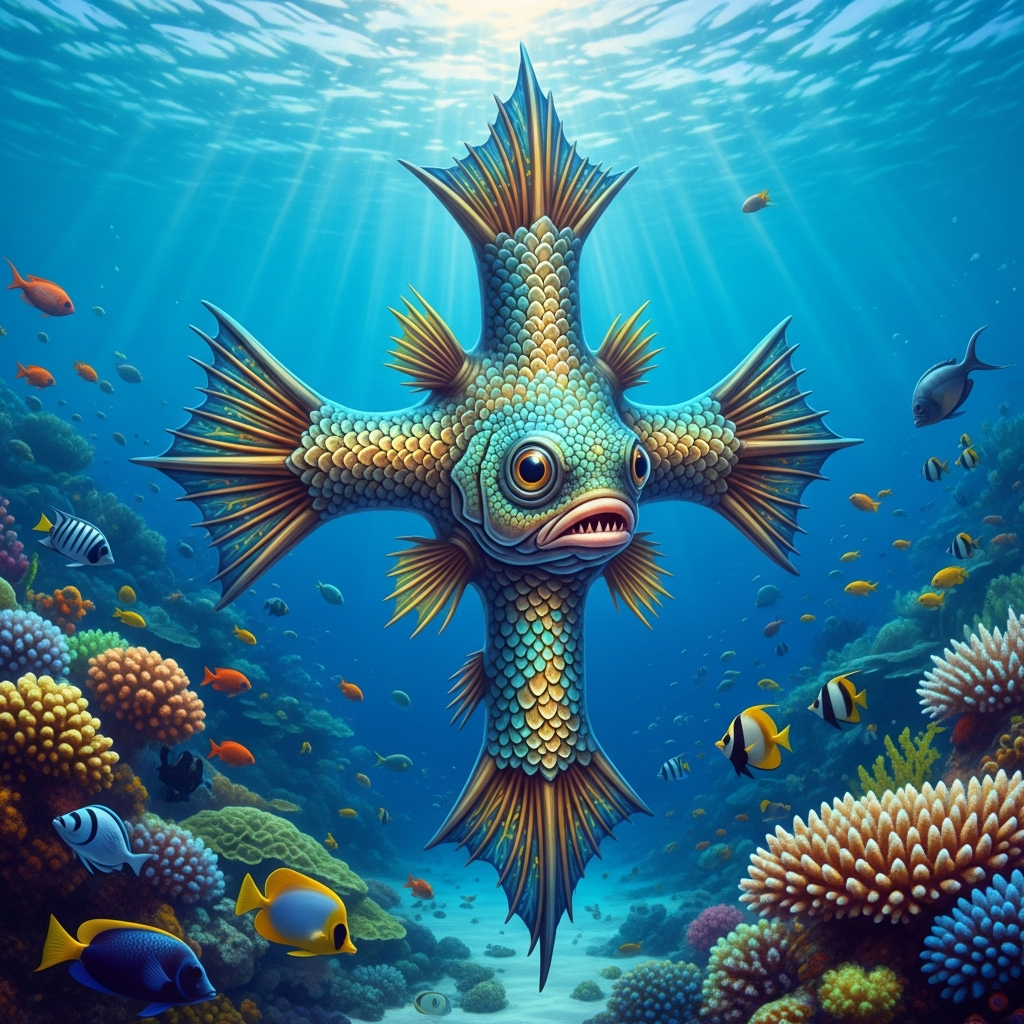
The term Cross Fish most commonly refers to the Crucifix Sea Catfish (Sciades proops), a fascinating marine creature famed not for its living appearance, but for a unique, bony structure found within its body. When the skin and flesh are carefully removed from its head and shoulder girdle, the resulting skeletal element strikingly resembles a Roman cross or crucifix, complete with two smaller “nails” and a shape resembling a shrouded figure. This remarkable natural artifact has woven a dense tapestry of religious folklore and wonder around the Cross Fish, elevating it from a simple marine animal to an object of deep cultural and spiritual significance.
The Cross Fish can be summarized by these key facts:
| Category | Detail |
| :— | :— |
| Scientific Name | Sciades proops |
| Common Synonyms | Crucifix Sea Catfish, Christfish, Gillbacker |
| Habitat | Coastal Atlantic waters of Central and South America |
| Unique Feature | The solidified occipital bone structure that resembles a crucifix |
| Conservation Status | Generally considered a species of Least Concern, though local populations face pressure. |
This mysterious Cross Fish is much more than just a legend, however; it is a vital part of the ecosystems it inhabits and an integral component of global fishing folklore.
The Crucifix Sea Catfish: A Biological Marvel and Natural Cross Fish
The Cross Fish, or Sciades proops, is a large, sturdy species of catfish belonging to the family Ariidae, or the sea catfishes. It is an imposing fish, capable of reaching lengths of up to 100 centimeters (about 39 inches) and possessing a robust, scaleless body characteristic of catfishes. Found predominantly in the brackish estuaries and nearshore coastal waters of the tropical Western Atlantic, from the coasts of Venezuela and Colombia down to Brazil, the Cross Fish is a resilient and adaptable creature. Its biological details reveal a complex life history that contrasts sharply with the simple, solemn symbol it becomes after death.
The physical attributes of the living Cross Fish include the typical catfish features: long, sensory barbels around the mouth that assist in locating food in the murky, benthic environments where it forages. These barbels are crucial for the Cross Fish as it sifts through the sediment for small crustaceans, mollusks, and other invertebrates. The skin is thick and smooth, often presenting a dark gray or brownish coloration, which provides excellent camouflage against the muddy or sandy substrates of its preferred habitats. The fins are rigid and sharp, and caution must be exercised when handling any Cross Fish due to the presence of venomous spines, a defense mechanism common among many catfish species.
Anatomy of the Cross: The Unique Bony Structure
The feature that truly distinguishes Sciades proops and earns it the moniker Cross Fish lies within its skeletal structure. This is not a marking on its skin, but a highly specialized, fused set of bones known as the occipital process and the vertebral shield.
This anatomical section is located just behind the fish’s head, serving as a protective plate and a point of muscle attachment. When cleaned and dried, this ossified shield reveals the iconic shape:
- The Vertical Post: Formed by the main spine extending backward from the skull, often called the neural spine.
- The Horizontal Beam (or Arms): Created by the lateral processes of the vertebra, which are broad and fused to the spine.
- The ‘Nails’ and ‘Shroud’: Smaller, distinct bony elements and foramina (small openings) that happen to fall into positions suggesting the nails and the head of a figure.
This remarkable coincidence is a powerful demonstration of how evolutionary biology can intersect with human culture. The skeletal system of the Cross Fish is simply an efficient biological adaptation, yet the human eye recognizes a familiar, profound symbol in its design. The intricate fusion of the bones is especially crucial for the protection of the animal’s brain and spinal column, a necessity for a bottom-dwelling Cross Fish that often faces pressure from predators and environmental debris.
Habitat and Distribution: Where the Cross Fish Thrives
The geographical range of the Crucifix Sea Catfish is extensive, primarily hugging the coastal lines of the South American continent, an important fact for understanding the cultural spread of the Cross Fish legend. This species prefers environments where freshwater meets saltwater, a zone known as an estuary, which is one of the most productive and challenging aquatic environments on earth.
Key Habitat Characteristics for the Cross Fish:
- Brackish Water: The salinity levels fluctuate dramatically with the tides and river flow, demanding high physiological tolerance from the Cross Fish.
- Muddy Bottoms: The fish’s primary food sources, such as crabs and shrimp, live buried in the soft, silty sediments, making the muddy estuaries ideal foraging grounds.
- Mangrove Forests: These coastal ecosystems provide shelter for juvenile Cross Fish and contribute a massive amount of organic material to the food chain.
The abundance of the Cross Fish in these productive coastal zones makes it a readily accessible target for local artisanal fisheries. This close interaction between human communities and the Cross Fish is what initially sparked the discovery of its hidden, symbolic structure and cemented its place in local folklore. The health of the entire coastal region, therefore, is intrinsically linked to the viability of the habitat of the Cross Fish.
Life Cycle and Behavior: Reproduction and Feeding Habits
The life history of the Cross Fish includes an extraordinary reproductive strategy. Like many sea catfishes, the Sciades proops exhibits paternal mouthbrooding, a fascinating behavior where the male Cross Fish takes on the sole responsibility of protecting the developing eggs.
The female lays a relatively small number of large eggs, often less than a hundred, which the male immediately scoops into his mouth. He then fasts for several weeks or even months, depending on the water temperature, until the young Cross Fish hatch and are large enough to be released into the environment. This prolonged period of abstinence ensures a very high survival rate for the offspring compared to species that scatter their eggs. The dedication of the male Cross Fish to its young is a noteworthy natural wonder, adding a layer of biological dedication to its mythical status.
In terms of diet, the Cross Fish is a classic opportunistic omnivore, with a strong preference for benthic invertebrates. The foraging behavior of the Cross Fish involves a slow, deliberate movement along the seabed, utilizing its highly sensitive barbels to detect the faint chemical signatures of prey hidden in the substrate. This feeding strategy minimizes energy expenditure while maximizing the chances of encountering a meal in the often low-visibility waters of the estuary. The role of the adult Cross Fish in controlling bottom-dwelling crustacean populations makes it an important ecological player.
Folklore and Faith: The Sacred Narrative of the Cross Fish
The legends surrounding the Cross Fish are deeply entrenched in the coastal communities where the species is harvested. These narratives often speak of a miraculous sign or a direct message from the divine, which is understandable given the compelling, man-made appearance of the skeletal structure. The sight of a perfect cross emerging from the remnants of a fish’s head has been interpreted for centuries as proof of a higher power’s presence in the natural world.
Ancient Legends and Modern Beliefs
One of the most persistent legends is that the internal cross of the Cross Fish represents the very crucifix upon which Christ was sacrificed. The smaller bones sometimes found beside the cross are said to be the dice thrown by Roman soldiers for Christ’s clothes, or even the hammer and nails used in the crucifixion. In many Catholic and Christian fishing villages throughout South America and the Caribbean, the discovery of a Cross Fish is not merely a coincidence; it is a profound blessing.
Cultural Significance of the Cross Fish:
- Protective Amulet: Dried Cross Fish skulls are frequently kept as talismans in homes and on fishing vessels to ward off bad luck, protect against storms, and ensure a bountiful catch.
- Religious Artifact: They are sold or given away near churches and religious sites as devotional objects, often included in prayer beads or small altars.
- Symbol of Hope: The symbolic link to the cross provides comfort, representing resurrection and hope amidst the harsh realities of a fisherman’s life.
This symbolic power ensures that the Cross Fish maintains a dual identity—an edible fish providing sustenance and a sacred object inspiring faith. This tradition continues today, with the skeletal remains of the Cross Fish being sought after by tourists and collectors, thus creating a small, specialized economic niche for the fishermen who know how to extract the sacred bone structure without damaging it.
The Cross Fish as a Symbol
It is crucial to differentiate the Sciades proops Cross Fish symbol from the much older Christian symbol of the Ichthys, or the “Jesus Fish.” The Ichthys is an artistic representation of a simple fish profile, an acrostic for “Jesus Christ, God’s Son, Savior,” used by early Christians.
The Cross Fish, conversely, is a literal, tangible object derived directly from nature. It is a natural curiosity that happens to perfectly embody a central religious icon. While the Ichthys is an abstract logo, the skeletal remains of the Cross Fish are treated as a relic, a physical miracle discovered by man. This physical reality gives the Cross Fish a different, perhaps more immediate, spiritual weight than its graphical counterpart. This unique blend of biology and belief makes the Cross Fish a remarkable case study in ethnozoology.
The ‘Cross’ in the Aquatic World: Hybrid Cross Fish and Cross-Breeding in Aquaculture
The word “cross” in a biological context most accurately refers to hybridization, the process of breeding two different species or strains. In the vast and growing world of modern commercial aquaculture, the concept of a Cross Fish is less about religious iconography and more about achieving superior growth, disease resistance, and market viability. These Cross Fish hybrids represent a significant portion of the global seafood industry’s efforts to produce sustainable and efficient protein sources.
The intentional creation of Cross Fish or hybrids is a calculated scientific endeavor, aimed at harnessing “hybrid vigor” (heterosis), which is the increased function or productivity in a hybrid offspring compared to its parent lines. This practice is rapidly advancing, with recent trends in 2026 and 2026 showing increasing investment in research on genetic selection and controlled cross-breeding protocols to meet rising global seafood demand.
Intentional Hybridization: The Science of Cross Fish
Aquaculture scientists meticulously select parent species to create a Cross Fish that combines the most desirable traits of each. This often involves crossing species from the same genus or even family that would rarely, if ever, hybridize successfully in the wild.
Case Studies of Commercial Hybrid Cross Fish:
Hybrid Striped Bass (Palmetto Bass): This is one of the most successful commercial Cross Fish. It is created by crossing the female White Bass (Morone chrysops) with the male Striped Bass (Morone saxatilis*). The resulting Palmetto Bass is exceptionally hardy, grows quickly, and thrives in controlled environments, making it a staple of U.S. aquaculture.
Bester Sturgeon: A classic textbook example of a highly successful Cross Fish. It is a cross between the Beluga (Huso huso) and the Sterlet (Acipenser ruthenus*). The Bester hybrid retains the desirable fast growth of the Beluga and the early maturation of the Sterlet, offering a commercially viable solution for caviar and meat production.
- Sturddlefish: An accidental yet significant recent Cross Fish discovery (2026), this hybrid resulted from the crossing of Russian Sturgeon and American Paddlefish. This surprising genetic compatibility highlights the potential for unintended but successful crosses within the aquatic world.
The development of new strains of Cross Fish is heavily influenced by market demands, where consumers prefer certain meat textures, fat content, or even appearance. For example, some hybrid tilapia are bred specifically for faster fillet yield, making the economics of farming the Cross Fish far more attractive than their purebred counterparts.
The Commercial Impact of Cross Fish in Farming
The economic significance of Cross Fish in aquaculture cannot be overstated. By mitigating the vulnerabilities of single-species farming, hybrids offer a more stable and profitable investment. According to recent global outlooks (circa 2026), aquaculture production continues to drive the expansion of the world’s seafood supply, and hybrid species are a key component of this growth.
The main advantages that commercial Cross Fish bring to the industry include:
- Increased Growth Rate: Hybrid vigor means the fish reach market size faster, turning capital over more quickly for producers.
- Disease Resistance: Combining the genetic defenses of two species often results in a Cross Fish that is more robust against common pathogens, reducing medication costs and fish loss.
- Environmental Tolerance: Hybrid Cross Fish can often tolerate a wider range of temperatures, oxygen levels, and salinities, making them suitable for farming in diverse geographic locations and in recirculating aquaculture systems (RAS).
The creation of a robust, farmable Cross Fish is a testament to sophisticated genetic management and careful husbandry. It ensures that the aquaculture sector can scale up to meet the growing global demand for protein, even as wild capture fisheries face increasing pressure. This intentional cross-breeding is a deliberate, scientific approach to create a biologically superior Cross Fish for human consumption.
Conservation and the Future of the Cross Fish
Whether we speak of the wild Sciades proops or the commercially engineered hybrid Cross Fish, conservation and sustainability remain central to their continued existence. The future of both the wild and farmed Cross Fish populations depends on responsible human interaction with the aquatic world.
Threats to the Wild Population of Sciades proops
The greatest threat to the wild Crucifix Sea Catfish population is habitat degradation. As a resident of coastal estuaries and mangrove systems, the Cross Fish is highly vulnerable to coastal development, pollution from agricultural runoff, and the destruction of mangrove forests. These habitats are critical nurseries and feeding grounds, and their loss directly impacts the reproductive success and survival of the Cross Fish.
Furthermore, while the Cross Fish is not heavily targeted globally, local overfishing in certain areas where the religious artifact is highly prized can lead to localized depletion. Fishermen targeting the fish for its skeletal relic, rather than just for its meat, place a different kind of pressure on the population. Sustainable management requires a balanced approach that respects both the ecological role and the cultural importance of the Cross Fish.
Sustainable Practices and Management for the Cross Fish
Effective management of the wild Cross Fish involves establishing marine protected areas in critical estuarine habitats and implementing size limits to allow the fish to reproduce at least once before being harvested. Recent ethnotaxonomic studies highlight the importance of involving artisanal fishermen in the management process, leveraging their extensive, intimate knowledge of the local Cross Fish population and its migratory patterns.
In the realm of commercial Cross Fish farming, sustainability means responsible genetic stewardship. This includes:
- Preventing Escape: Ensuring hybrid Cross Fish do not escape into the wild, where they could potentially interbreed with and dilute the gene pool of native species.
- Ethical Breeding: Following ethical guidelines to minimize the risk of deformities or reduced welfare in the engineered Cross Fish strains.
- Feed Efficiency: Continuously improving the feed conversion ratio (FCR) of the Cross Fish to reduce the environmental footprint associated with fish farming.
The continued success of the farmed Cross Fish industry is a hopeful indicator for the future of global food security. However, it requires an unwavering commitment to sustainable, responsible practices to ensure that the ecological balance is not upset by this technological advancement. Both the wild and farmed Cross Fish demand our respect and careful management to secure their place in the world for generations to come.
Conclusion
The Cross Fish, whether you encounter it as the legendary Sciades proops with its profound internal symbol or as the scientifically engineered hybrid driving modern aquaculture, stands as a remarkable testament to the complexity of the aquatic world. It is a creature steeped in centuries of folklore, its very anatomy sparking deep religious reverence in coastal communities who see the Cross Fish as a tangible miracle from the sea. Simultaneously, the concept of the Cross Fish has been fully embraced by science, yielding robust, efficient hybrid species that are redefining the sustainability of our global food supply.
From the muddy estuaries where the Crucifix Sea Catfish performs its paternal duty to the high-tech tanks where the Hybrid Striped Bass is raised, the Cross Fish embodies a unique intersection of faith, natural history, and cutting-edge technology. Understanding the Cross Fish means appreciating this dual legacy—recognizing the power of its symbolic significance while acknowledging the crucial biological and commercial roles it plays in our modern world. The narrative of the Cross Fish is a compelling story of resilience and adaptability, a true wonder found beneath the waves. The pursuit of knowledge about the Cross Fish will continue to bridge the gap between myth and biological reality.
*
Frequently Asked Questions (FAQ)
# How do fishermen find the cross inside the Cross Fish?
The Cross Fish bone structure is only revealed after the fish has been harvested. The fisherman must carefully remove the head and then clean the flesh and skin from the bony plate located behind the skull. The resulting ossified structure, consisting of the fused occipital process and vertebral shield of the Cross Fish, is the part that perfectly resembles a crucifix. This process requires a specific technique often passed down through generations in fishing communities.
# Is the Cross Fish safe to eat?
Yes, the Crucifix Sea Catfish (Sciades proops), which is the fish commonly known as the Cross Fish, is widely consumed and considered an important food source in the coastal regions of Central and South America. However, like all catfishes, the living Cross Fish possesses venomous spines on its dorsal and pectoral fins, which can inflict painful wounds if handled improperly. The meat of the Cross Fish itself is safe and often highly prized.
# What is the difference between a natural Cross Fish and a hybrid Cross Fish?
A natural Cross Fish refers to Sciades proops, which gets its name from its unique internal bone structure resembling a cross. A hybrid Cross Fish, on the other hand, is a general term used to describe a “cross-bred fish,” meaning a fish intentionally created by crossing two different species, such as the Palmetto Bass (Hybrid Striped Bass) or the Bester Sturgeon, to achieve superior traits for commercial aquaculture.
*