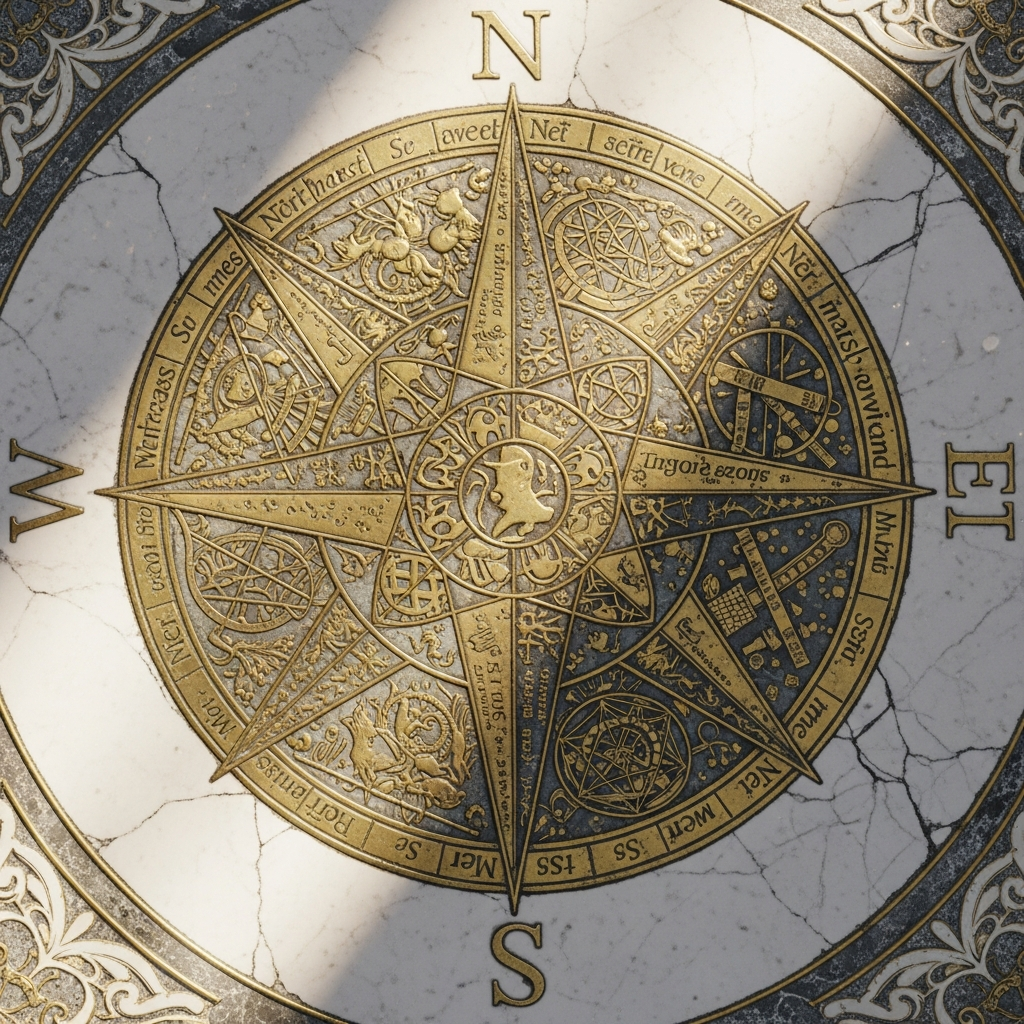
The compass rose is a timeless graphic symbol, intricately designed to display the cardinal directions—North, South, East, and West—along with their intermediate points. Essential for orientation, this stylized rose-like figure has been a fundamental tool across diverse fields, ranging from ancient navigation and cartography to modern architecture and digital interfaces. It helps individuals understand their position and intended path relative to the world around them.

I remember a profound moment from my childhood, standing on the rugged coast of a small island, clutching a weathered map. My grandfather, a retired sailor with salt in his veins and stories in his eyes, pointed to the map’s corner where a beautifully intricate compass rose bloomed. He explained how it was the heart of any map, whispering tales of ancient mariners who relied on this very symbol to navigate uncharted waters. That day, the compass rose transformed from a mere drawing into a gateway to adventure, a silent promise of guidance in a vast, unpredictable world. It taught me that even without a physical compass, understanding directions is crucial, a lesson that has shaped my own journeys, both literal and metaphorical.
A Journey Through Time: The Historical Roots of the Compass Rose
The story of the compass rose is as old as humanity’s desire to explore and understand its surroundings. Its origins are deeply intertwined with early civilizations and their attempts to classify and represent directional phenomena, particularly the winds. The concept of fixed directions predates sophisticated navigational instruments, arising from practical needs for orientation.
From Ancient Winds to Early Navigation
Long before the magnetic compass became widespread, ancient Mediterranean civilizations, notably the Greeks and Romans, began classifying winds and associating them with specific directions. These early systems, like the eight winds described on Athens’ Tower of the Winds (1st century BCE), laid the conceptual groundwork for what would eventually become the compass rose. Initially, there was a clear distinction between these wind-based directional systems and celestial body-based cardinal points used for orientation. However, over time, these systems gradually merged, with wind names eventually denoting cardinal directions.
The direct precursors to the compass rose were the “stella maris” (star of the sea) and the “wind rose,” which specifically denoted the directions of prevailing winds. These wind roses typically featured 8 principal winds, 8 half-winds, and 16 quarter-winds. Early depictions of the compass rose can be traced back to geometric images from the 13th century, appearing in seafarers’ instruction books in places like Venice, Majorca, and Genoa. These initial forms were rudimentary but marked a crucial step in standardizing directional representation on maps.
The Age of Exploration: Refining the Compass Rose’s Role
The 14th century saw the emergence of the first known uses of the compass rose on Italian and Iberian portolan charts. These charts were practical maps, based on the real experiences of navigators, and the compass rose quickly became a fundamental element. The period between the 15th and 16th centuries marked a significant era for the compass rose, as European explorers embarked on voyages across unknown seas. During this Age of Exploration, the ability to determine precise direction and location was paramount for the success and survival of maritime expeditions.
The compass rose served multiple critical purposes during this time. Mariners relied on it to orient themselves, determine wind direction, plot routes, and maintain their desired course across vast oceans. Before the widespread adoption of the rose design, maps often featured numerous intersecting lines radiating from central points, which could be difficult to follow. The stylized, clear design of the compass rose made directional lines much easier to interpret, greatly improving the efficiency of navigation and trade over long distances.
Italian Maritime Prowess and the Flourishing of the Compass Rose
Italy, a nation with a rich maritime history, played a crucial role in refining the compass and, by extension, the compass rose. While the exact origin of the formal magnetic compass is debated, evidence suggests it was refined in Italy around 1200 AD. Many sources attribute the perfecting of the sailor’s compass to Flavio Gioia, an Italian marine pilot from the early 14th century. He is often credited with enclosing the magnetic needle in a box with a glass cover and suspending it over a fleur-de-lis design that pointed north.
The development of the magnetic compass, likely a combination of the earlier wind rose and lodestone technology, spurred the evolution of the modern compass rose. This period saw the Majorcan Cartographic School, with figures like Cresques Abraham, perfecting the use of 8, 16, and 32-wind roses from the 13th to 15th centuries. Works like the Catalan Atlas of 1375 vividly demonstrate highly ornamental compass roses, blending both functionality and aesthetic appeal. The consistent use of the compass rose in these detailed maps significantly advanced sea navigation and trade, providing a reliable method for determining direction over open water.
Deconstructing Direction: The Anatomy and Variations of the Compass Rose
The intricate design of a compass rose is more than just decorative; it is a precisely engineered graphic tool. Its various components and divisions allow for increasingly accurate determination of direction, a testament to centuries of navigational refinement. Understanding its anatomy reveals the thoughtful system behind this universal symbol.
Cardinal, Intercardinal, and Beyond: The Points of the Compass Rose
At its core, every compass rose prominently displays the four cardinal directions: North (N), East (E), South (S), and West (W). These fundamental points are spaced at 90-degree intervals around the central axis. They represent the most basic form of orientation, crucial for any navigational task. A simplified four-pointed compass rose is common in everyday maps and compasses where only basic orientation is needed. For instance, if you are looking at a simple trail map in a park, a four-point compass rose provides sufficient guidance.
Beyond the cardinal points lie the intercardinal (or ordinal) directions: Northeast (NE), Southeast (SE), Southwest (SW), and Northwest (NW). These eight points divide the circle into 45-degree segments, offering greater precision. An eight-pointed compass rose is frequently encountered and provides a good balance between simplicity and detail for many applications. For example, maritime navigators might use an eight-point compass rose to describe wind patterns or general headings.
For even finer resolution, the compass rose can expand to 16, and most comprehensively, 32 points. The 16-point compass rose introduces “half-winds” like North-Northeast (NNE) and East-Northeast (ENE), bisecting the angles of the principal winds into 22.5-degree increments. The highly detailed 32-point compass rose further bisects these angles, resulting in “quarter-winds” (e.g., North-by-East or NbE) with an 11.25-degree difference between each point. “Boxing the compass” refers to the traditional practice of reciting all 32 points, a skill once essential for sailors. This level of detail is particularly useful in specialized applications requiring extreme precision, such as aerial navigation, astronomy, and detailed topographic mapping.
The Art of Orientation: Degrees and Decorative Elements
While the points of the compass rose provide directional names, modern systems also incorporate angular measurements. A complete circle is divided into 360 degrees, with North typically corresponding to 0° or 360°, East to 90°, South to 180°, and West to 270°. This numerical graduation allows for highly precise bearings, especially when used with modern instruments. Advanced compass roses on nautical charts often feature two concentric rings: the outer ring indicating true cardinal directions, and the inner ring denoting magnetic cardinal directions, accounting for magnetic variation.
Historically, the compass rose was not merely a functional diagram but also a work of art. Early cartographers adorned them with intricate designs, making them visually appealing elements on maps. The fleur-de-lis, a stylized lily, became a customary symbol to denote North, possibly introduced by cartographer Pedro Reinel. Its elaborate design helped distinguish North easily, even in low-light conditions on a ship. Similarly, a Christian cross often marked East, symbolizing the direction of Jerusalem from the perspective of the Mediterranean Sea. These decorative elements not only added aesthetic value but also held cultural and symbolic significance for the navigators of the time. The radial symmetry and balanced form of the compass rose also contributed to its aesthetic appeal, evoking a sense of order and harmony.
Naming the Winds: Traditional and Modern Designations
The evolution of the compass rose also reflects a fascinating shift in how directions were named. Historically, particularly in the Mediterranean, directions were often associated with the prevailing winds. Medieval Italianate wind names like Tramontana (North), Greco (Northeast), Levante (East), and Scirocco (Southeast) were common on older compasses. These names were deeply embedded in the daily lives of sailors, who relied on understanding wind patterns for safe passage.
Today, while the traditional wind names are still recognized in some contexts, modern compass roses predominantly use the simplified English cardinal and intercardinal abbreviations (N, NE, E, SE, S, SW, W, NW). This standardization ensures universal understanding, transcending linguistic barriers and making navigation accessible across different cultures and regions. However, the legacy of the wind rose remains, reminding us of the symbol’s meteorological origins and the intimate connection between early navigation and natural phenomena.
Beyond Navigation: The Multifaceted Presence of the Compass Rose in Modern Life
While its roots are firmly planted in the maritime world, the compass rose has long transcended its original purpose, blossoming into a rich cultural symbol with diverse modern applications. Its timeless design and inherent meaning resonate in unexpected places, guiding not just ships, but also our artistic expressions, architectural visions, and even personal philosophies.

Architectural Wonders and Urban Design
The distinctive form of the compass rose makes it a favored motif in architecture and urban planning. One can frequently spot large-scale renditions embedded in the floors of public plazas, courtyards, and even grand cathedrals. These architectural compass roses often symbolize a connection between spiritual orientation and physical space, drawing the eye and grounding visitors within their surroundings. For instance, the striking circular design of rose windows in churches mirrors the radial symmetry of a compass rose, suggesting a divine sense of order and direction.
In modern urban landscapes, the compass rose is used in designing airport runways, where knowing the precise wind directions is crucial for safe takeoffs and landings. This ancient tool helps engineers align runways correctly, preventing potential hazards. Similarly, urban planners and landscape architects incorporate the compass rose into the layout of roundabouts and garden features, not just for aesthetic appeal but also to subtly reinforce directional awareness within complex environments. Imagine walking through a beautifully designed park, and a stone compass rose set into the pathway gently reminds you of your bearings, connecting you to the larger geographical context. This integration showcases the compass rose as a symbol of both beauty and practical orientation in built environments.
Charting New Territories: The Compass Rose in Contemporary Cartography
Despite advancements in digital mapping, the compass rose remains a vital, albeit sometimes simplified, element in contemporary cartography. Modern maps, especially aeronautical and nautical charts, still feature the compass rose due to its unparalleled clarity in depicting orientation and direction. It serves as a visual anchor, helping users quickly understand the map’s alignment, particularly when maps are rotated to fit paper formats or specific views.
In the digital realm, even sophisticated navigation systems like GPS and online mapping services (e.g., Google Maps) often incorporate simplified versions of the compass rose to assist users in orienting themselves. While not always explicitly shown in its traditional ornate form, the underlying concept of indicating North and relative directions persists through icons and directional indicators. This demonstrates the enduring utility of the compass rose; its fundamental purpose of providing clear directional information is so intuitive that it seamlessly translates across technological platforms. Furthermore, the compass rose is now used as a statistical graph by climate experts to visualize wind direction and frequency in a given area, aiding in the study of local climates and planning activities like wind turbine placement or paragliding routes.
Symbol of Wanderlust: The Compass Rose in Art, Fashion, and Personal Expression
The symbolic power of the compass rose extends deeply into art, fashion, and personal expression. It has become a powerful emblem associated with maritime adventure, exploration, and the search for direction and purpose in life.
In art and design, the compass rose appears in various forms, from intricate engravings on vintage clocks to elegant, minimalist logos for travel brands. Its symmetrical and visually balanced design makes it inherently appealing, allowing for endless creative interpretations. Many designers leverage its timeless qualities—simplicity, symmetry, and functionality—to convey a sense of order, journey, and aspiration. You might see it on a piece of furniture, perhaps a drop table with a stunning compass rose crafted from contrasting woods, a beautiful nod to both artistry and practical purpose.
The compass rose tattoo is a particularly popular choice, symbolizing guidance, personal journeys, and the pursuit of one’s true path. Individuals choose these tattoos to represent their adventurous spirit, their ability to navigate life’s challenges, or a significant turning point in their lives. The design options are vast, ranging from classic, bold lines to more modern, geometric interpretations, sometimes incorporating other symbols like anchors, maps, or personalized quotes. It’s a powerful way for people to carry a reminder of their inner compass, a constant prompt to stay true to their direction.
Metaphorical Journeys: Guiding Life’s Pathways
Beyond its tangible applications, the compass rose holds profound metaphorical meaning. It represents the journey of life itself, with its various points symbolizing choices, opportunities, and the different paths one can take. For many, it’s a symbol of hope, resilience, and the inherent human desire to seek purpose and meaning. The idea of “finding one’s direction” is deeply ingrained in the symbolism of the compass rose, making it relevant for anyone navigating personal growth or professional challenges.
This symbol often evokes a deep connection with the universe, with its cardinal points sometimes associated with the passage of time, the seasons, the elements of nature, or the cycles of life. Different cultures may imbue the compass rose with varied meanings, viewing it as an emblem of balance, harmony, protection, or human spirituality. For instance, the Celts reportedly used similar symbols in rituals, and alchemists related its points to the four elements and the process of transformation. This rich tapestry of interpretations highlights the compass rose as more than just a navigational tool; it is a universal emblem of life’s directional quest.
The Unwavering Relevance of the Compass Rose in a Connected World
In an era defined by rapid technological advancements, one might assume that an ancient symbol like the compass rose would fade into obsolescence. Yet, its enduring presence across diverse platforms and contexts proves its timeless value. The compass rose continues to serve as an essential guide, reminding us of our fundamental need for orientation and connection to the world around us.
Digital Age Adaptations: How the Compass Rose Persists
While digital devices offer instantaneous location data, the underlying principle of directional awareness, epitomized by the compass rose, remains critical. Modern applications often present a simplified compass rose or a North arrow icon, ensuring that even with sophisticated GPS technology, users can quickly grasp their orientation. This shows that clarity in direction is still a fundamental requirement, regardless of how advanced the navigation system. The visual simplicity and immediate comprehension offered by the compass rose are qualities that transcend the specific medium, making it adaptable to new interfaces like virtual reality, space exploration systems, and augmented reality.
The compass rose in its digital forms helps maintain a link between our technologically driven present and our historical past. It provides a familiar and intuitive visual cue in complex digital environments, guiding us through cyberspace with the same clarity it once offered across vast oceans. This enduring utility underscores the fact that while the tools of navigation evolve, the core human need to know “where we are” and “where we’re going” remains constant.
Educational Value and Enduring Symbolism
For students of geography, history, and navigation, the compass rose is an indispensable educational tool. It provides a foundational understanding of cardinal and intercardinal directions, making abstract geographical concepts tangible and accessible. Learning about the compass rose makes maps less confusing and more engaging for younger generations, fostering a sense of curiosity about exploration and the wider world.
Beyond its practical applications, the compass rose continues to carry profound symbolic weight. It is often seen as a symbol of protection and good fortune, especially for those embarking on journeys. Its balanced form and association with orientation, direction, and freedom evoke a sense of adventure and the pursuit of life paths. Whether it’s the inspiration behind a personal logo, a piece of jewelry, or a public monument, the compass rose resonates with our collective human story of discovery and the ongoing quest for meaning.
A Timeless Beacon for Exploration and Discovery
The compass rose stands as a powerful testament to humanity’s innate drive to explore the unknown and chart new territories. It connects us to a shared history of navigators, cartographers, and adventurers who, armed with this essential symbol, pushed the boundaries of their known worlds. From ancient portolan charts to modern digital displays, the compass rose has continuously adapted, proving its enduring relevance.
As we look to the future, whether it involves exploring distant planets or navigating the complexities of our increasingly interconnected world, the compass rose will undoubtedly continue to inspire and guide. It reminds us that direction is not just about physical movement but also about purpose, growth, and the journey of life itself. The compass rose is more than a diagram; it is an eternal beacon, ever pointing the way forward.
Frequently Asked Questions about the Compass Rose
What are the main points on a compass rose?
The main points on a compass rose are the four cardinal directions: North (N), East (E), South (S), and West (W). Many also include the four intercardinal (or ordinal) directions: Northeast (NE), Southeast (SE), Southwest (SW), and Northwest (NW).
Why is it called a compass rose?
The term “compass rose” comes from its traditional stylized design, which often resembles the petals of a blooming rose radiating outwards from a central point. The “compass” part refers to its use in showing directions.
Is the compass rose still used today?
Yes, the compass rose is still widely used today. It appears on modern maps, nautical charts, aeronautical charts, and even in simplified forms within digital navigation systems like GPS and Google Maps to aid orientation. It also holds significant cultural and symbolic meaning.
What is the history of the compass rose?
The history of the compass rose dates back to ancient Greek and Roman civilizations, which classified winds and associated them with directions. Its more recognizable form appeared on Italian and Iberian portolan charts in the 14th century, evolving from earlier “wind roses” to become crucial for maritime navigation during the Age of Exploration.
What does the fleur-de-lis on a compass rose signify?
The fleur-de-lis, a stylized lily, is a traditional decorative element on many compass roses that specifically marks the North direction. It was likely introduced by Pedro Reinel and helped easily distinguish North from other directions.
How many points can a compass rose have?
A compass rose can have various numbers of points, typically:
- 4 points: Cardinal directions (N, E, S, W).
- 8 points: Cardinal and intercardinal directions (N, NE, E, SE, S, SW, W, NW).
- 16 points: Includes “half-winds” for more precision (e.g., NNE, ENE).
- 32 points: The most detailed version, including “quarter-winds” (e.g., NbE, NEbN), with each point separated by 11.25 degrees.