Rose Window
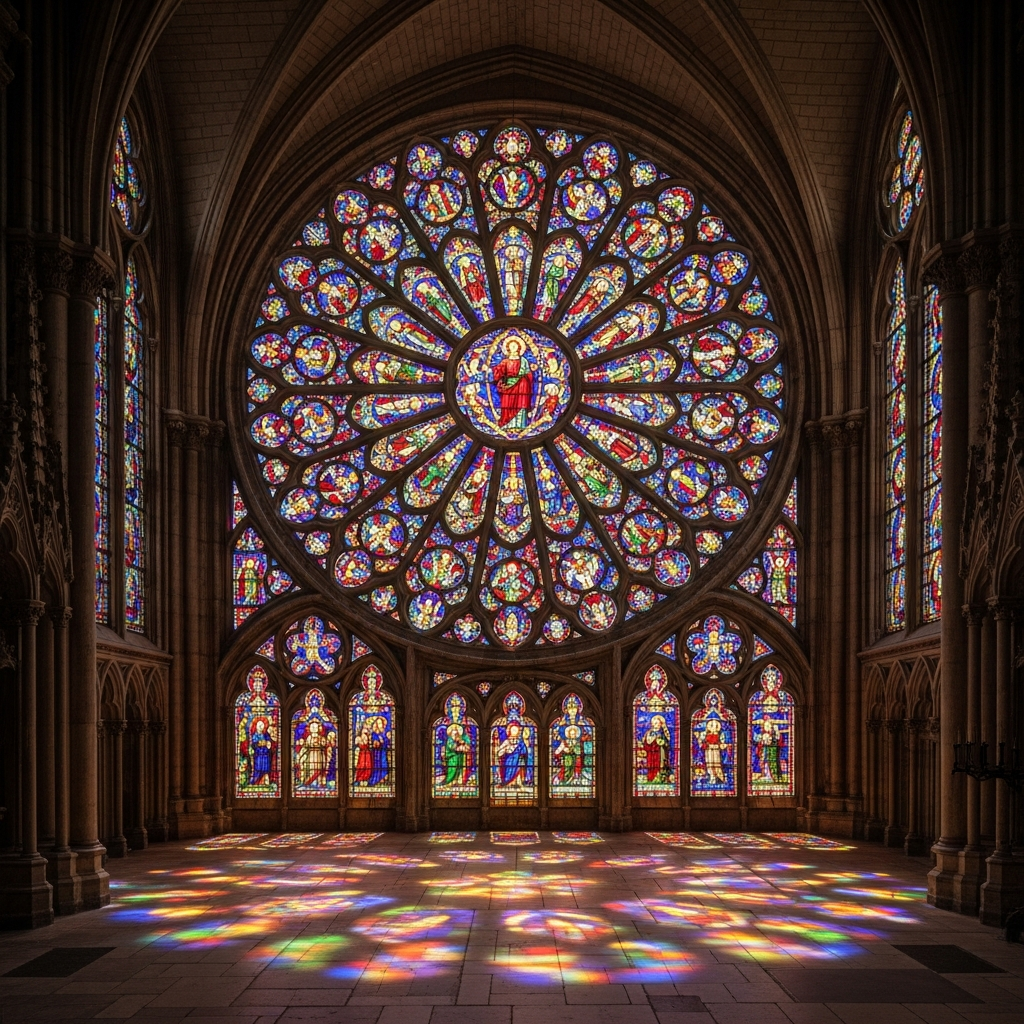
A Rose Window is a grand, circular window, particularly characteristic of Gothic architecture, renowned for its intricate stone framework—known as tracery—and its dazzling stained-glass panels. This architectural element is not merely a hole in a wall but a masterful fusion of art and structure. It serves as both a primary source of light and a visual sermon, radiating outward from a central point, mirroring the shape and delicacy of a blooming rose, hence its name. Often placed above the main entrances or at the transepts of cathedrals, the Rose Window profoundly transforms interior spaces, bathing them in a kaleidoscope of divine light.

The Enduring Legacy of the Rose Window in Architecture
The journey of the Rose Window from a simple circular opening to a complex artistic triumph is a sweeping narrative that spans centuries of architectural innovation. This powerful feature is more than a decorative element; it represents a pinnacle of structural engineering and artistic expression achieved during the high medieval period.
The development of the Rose Window is intrinsically linked to the technological leaps made by Gothic builders. Earlier structures relied on thick, load-bearing walls, limiting the size of windows. However, innovations like the pointed arch, rib vault, and flying buttress liberated the walls, transforming them into skeletal frameworks. This breakthrough allowed for the creation of vast, vertical expanses of glass, with the circular Rose Window becoming the quintessential complement to the tall, lancet windows. The increased surface area for the Rose Window meant that the internal light quality within cathedrals was entirely revolutionized, creating a sense of ethereal illumination and spiritual awe that remains unmatched.
The architectural function of the Rose Window goes beyond mere decoration. Structurally, it must withstand immense wind pressure due to its large size and often exposed position on the facade. The stone tracery, therefore, acts as a vital skeletal system, distributing the load of the glass and reinforcing the overall wall stability. Early examples of the Rose Window featured plate tracery, where openings were cut into a solid slab of stone, creating a heavy, thick feel. Later, as techniques advanced, bar tracery emerged, utilizing slender stone mullions that created a lighter, more intricate, and visually dynamic web. This evolution demonstrates a constant striving for lightness and height, a core tenet of Gothic design.
The Birth of the Rose: From Roman Oculi to Gothic Masterpiece
The concept of a circular opening is ancient, tracing its roots back to the Roman oculus—a simple, unglazed hole at the apex of a dome, famously seen in the Pantheon. These early circular forms provided light and ventilation but lacked the complexity and glasswork that define the modern Rose Window. Over time, this concept evolved, appearing in various forms throughout the Medieval period.
As the Romanesque period gave way to the Gothic, the circular window underwent a dramatic transformation. Early circular windows in Romanesque structures, sometimes called “wheel windows,” were simpler, featuring spokes radiating from a hub, much like a cartwheel. These windows often used plain glass or thin alabaster sheets. The real innovation began in the mid-12th century, particularly in France, which is considered the cradle of the Gothic style. The Basilica of St. Denis, under the direction of Abbot Suger, is credited with housing some of the earliest examples of the Rose Window proper, around 1144. Suger believed that light was a manifestation of the divine, and his architectural vision demanded windows that could capture and transform this light into a spiritual experience.
The key distinction of the Gothic Rose Window lies in its sophisticated geometric design and the complexity of its stained-glass artwork. It became a perfect sphere of intricate geometry, symbolizing the eternal and the cosmos. The designs moved beyond simple radiating spokes to incorporate cusps, quatrefoils, and sexfoils, creating dizzying, complex patterns. The sheer size of the western Rose Window at Chartres Cathedral, for example, is a testament to the architectural confidence and engineering skill of the time. These magnificent features were no longer mere openings; they were cosmological diagrams rendered in stone and jewel-toned glass, forever changing the nature of sacred space.
Regional Styles and Their Distinctive Rose Window Designs
While the Rose Window is universally recognized as a Gothic element, its appearance varies significantly across different regions, reflecting local artistic tastes and construction methods. The three primary phases—Early, High, and Late Gothic—also contributed to distinct stylistic differences in the Rose Window design.
In France, the birthplace of the style, Rose Window designs often reached colossal proportions and featured highly complex bar tracery. The French approach favored the integration of the window into the entire facade, often flanked by twin towers. Examples like the three famous Rose Windows of Notre-Dame de Paris (before the 2019 fire and its ongoing restoration) perfectly illustrate the French style’s commitment to scale and narrative detail. The radiating patterns are incredibly intricate, employing geometric precision to create a dizzying, starburst effect.
Conversely, in England, the use of the Rose Window was less common on the main western facade. English cathedrals, such as Lincoln and York Minster, typically placed their large circular windows on the transepts. The English Rose Window often employed variations of tracery patterns, including the ‘wheel’ and ‘Catherine Wheel’ types, and later adopted the ‘Perpendicular Gothic’ style, which favored straight vertical lines in the tracery, creating a more disciplined, grid-like appearance compared to the French radial explosion. The ‘Dean’s Eye’ and ‘Five Sisters’ windows at York Minster showcase this distinct English sensibility.
In Italy, the Rose Window retained a simpler, heavier aesthetic, more closely related to its Romanesque origins. Italian Gothic architecture did not push the limits of height and lightness as much as the French. As a result, Italian Rose Windows, such as those found in Siena Cathedral, often have thicker, heavier tracery and are sometimes decorated with sculptural reliefs rather than solely relying on stained glass for their impact. These regional variations demonstrate that the Rose Window was a flexible motif, adaptable to the unique structural and theological requirements of different cultures. The ongoing study of these regional forms provides valuable insight into the diverse architectural language of medieval Europe.
Decoding the Symbolism: More Than Just Colored Glass
The true brilliance of the Rose Window is not just its architectural finesse but its profound spiritual and symbolic meaning. Medieval cathedrals were built as visual encyclopedias for a largely illiterate population, and the Rose Window was one of their most powerful chapters. The window itself, perpetually fixed in a circular form, suggests the eternal, without beginning or end, and the order of the cosmos.
The circular shape of the Rose Window naturally lends itself to cosmological interpretation. The central oculus often represents God or Christ, the stable center of the universe. The radiating spokes and panels, then, represent the different aspects of creation, the apostles, or the progression of time. The shifting colors of light—from the deep blues and reds of the morning to the golden hues of the afternoon—create a dynamic visual metaphor for the divine presence, constantly interacting with the human world. This transformation of plain sunlight into a sacred, colored radiance was a deliberate theological statement: the divine light penetrates the darkness and illuminates the spiritual path.
Furthermore, the geometry embedded within every Rose Window holds deep significance. The consistent use of the number twelve, for instance—often represented by twelve spokes, twelve lobes, or a pattern based on twelve—symbolizes the twelve Apostles, the twelve tribes of Israel, and the months of the year, connecting the earthly passage of time with the eternal structure of the heavens. This symbolic density means that contemplating a Rose Window was an act of both aesthetic appreciation and theological meditation, making it central to the devotional life of the medieval Christian.
The Virgin Mary and the Mystical Rose Window
Perhaps the most potent symbolism attached to the Rose Window is its connection to the Virgin Mary. During the High Gothic period, the cult of the Virgin Mary, often referred to as the Mystical Rose (Rosa Mystica), gained immense popularity. This title, used in hymns and litanies, directly influenced the placement and naming of the circular windows.
The rose, in Christian iconography, has long symbolized Mary’s purity, grace, and her role as the mother of Christ. As the most beautiful of flowers, the rose was a metaphor for the Queen of Heaven. By placing a massive, gorgeously detailed Rose Window on the western, northern, and southern faces of a cathedral—as seen in Chartres and Notre-Dame—architects dedicated the entire structure and its illumination to the Virgin. The typical color palette found in these magnificent windows often leans heavily on blues and reds, colors traditionally associated with royalty and the Virgin Mary, further cementing this connection. The great North Rose Window of Notre-Dame de Paris, for example, is dedicated to the Old Testament, centered on the Virgin, holding the infant Jesus.
The specific location of the Rose Window also plays into this Marian symbolism. The western facade, which receives the setting sun, often represents the Last Judgment and salvation, with Mary interceding on behalf of humanity. The northern transept, which receives the least direct sunlight, is sometimes associated with the Old Testament or the hidden nature of God’s grace, with the Rose Window serving as a reminder of Mary’s role as the vessel for the Incarnation. Through these elaborate compositions, the Rose Window became a majestic, jewel-like prayer, a permanent monument to the veneration of the Virgin Mary.
Biblical Narratives and the Rose Window as a Teaching Tool
Beyond Marian devotion, the Rose Window functioned as a monumental picture book, narrating complex biblical stories and theological concepts to a congregation that could not read. This pedagogical role was crucial in the medieval era. The stained glass panels were meticulously arranged to present a coherent narrative, often radiating outward in a chronological or thematic progression.
In many cathedrals, the Rose Window depicts the figures of Christ, the Virgin, the Prophets, the Apostles, or scenes from the Apocalypse. For instance, a common design would place Christ in the central medallion, with the twelve apostles surrounding him in the next circle, followed by scenes of their ministries or martyrdoms in the outer ring. This structured arrangement guided the viewer’s eye and mind from the center of divine truth outward to its earthly dissemination. The complexity of the storytelling required the congregation to “read” the window sequentially, following the visual path established by the stonework.
The vibrancy of the colors in the Rose Window further enhanced its role as a teaching instrument. The light filtering through the intense blues, reds, and golds created an otherworldly atmosphere, suggesting the splendor of the heavenly realm. When the light was right, the colored patterns were projected onto the stone floor and pillars, causing the entire interior to shimmer and transform. This dynamic, immersive experience reinforced the theological message—that the divine word, like the light, permeates and transforms the earthly space. Every segment of the Rose Window was thus a carefully considered piece of an overarching sacred narrative, illuminating history and prophecy for all who gazed upon it.
A Masterclass in Construction: Anatomy of a Rose Window
The construction of a single Rose Window was a monumental undertaking, requiring the coordinated efforts of stonemasons, carpenters, glassblowers, and painters. It was an interdisciplinary project that fused advanced mathematics and geometry with complex craftsmanship, resulting in a structure that is simultaneously delicate and immense.
The sheer scale of the largest Rose Windows, some exceeding forty feet in diameter, presented formidable structural challenges. The process began with the architect meticulously drawing the geometrical plan on a large wooden board or a level plaster floor, known as a tracery floor. This plan had to be mathematically precise, as any small error in the radial symmetry would be amplified across the large diameter, resulting in a visual distortion. Once the geometric layout was finalized, the stonemasons, or lapi-cides, would meticulously cut and shape the individual stone pieces of the tracery.
The construction of the tracery for the Rose Window was a highly specialized task. Each segment of the tracery needed to be cut with incredible accuracy, often incorporating complex curves, cusps, and foils. These stones were then assembled on the ground before being hoisted into place high up in the cathedral wall. The joints between the stone pieces were typically secured with iron dowels and molten lead, ensuring stability and longevity. The finished stonework of the Rose Window had to be structurally sound enough to resist the immense outward pressures of wind loading while simultaneously holding the weight of thousands of individual pieces of stained glass, an engineering feat in itself. The structural integrity of the entire building often hinged on the precise execution of the Rose Window frame.

The Intricacies of Stone Tracery and its Structural Role
The defining structural characteristic of the Rose Window is its tracery. Tracery is the ornamental stonework that holds the pieces of glass in place. As mentioned, it evolved from the heavier plate tracery to the lighter, more elegant bar tracery.
Bar tracery, the dominant style in high Gothic Rose Windows, is fundamentally a stone skeleton. This skeleton is composed of slender, molded stone members, called mullions, which divide the window into many segments. The intricacy of the tracery is not solely artistic; it is a critical structural mechanism. By dividing the large circular area into smaller, manageable sections, the tracery minimizes the unsupported span of the glass, preventing its failure under wind or thermal stress. The radial arrangement of the mullions acts like a tensile structure, distributing forces outward and downward into the main wall structure.
The tracery patterns themselves became increasingly elaborate over the Gothic period, showcasing the skill of the masons. Early Gothic Rose Windows featured simple circles and foils. Later, Rayonnant Gothic tracery, characterized by its reliance on thin, spoke-like mullions radiating from a central point, maximized the glass area and minimized the stone. This style, perfected in cathedrals like Reims and the later additions to Notre-Dame, gave the Rose Window its signature ethereal appearance. Furthermore, Flamboyant Gothic tracery introduced flame-like, undulating curves, giving the Rose Window a dynamic, swirling motion. The different styles of tracery are essential for dating and classifying a particular Rose Window, revealing not only the date of construction but also the precise architectural philosophy guiding its creation.
The Art of Stained Glass and the Alchemical Process of Color
The glasswork within the Rose Window is the soul of the structure, converting raw sunlight into radiant, spiritual color. Stained glass fabrication in the medieval era was a complex and closely guarded artisanal secret, almost an alchemical process.
The glass itself was made by mixing silica (sand) with metallic oxides to achieve specific colors. For example, copper oxide was used for rich ruby reds and greens, while cobalt oxide yielded the famous Gothic blue, often described as bleu de Chartres because of its exceptional depth. The glass was not always perfectly uniform or clear; the imperfections and tiny bubbles inherent in the medieval process actually helped to scatter the light, enhancing the luminosity and creating a jewel-like shimmer. This handmade quality is a significant factor in the enduring beauty of every genuine Rose Window.
Once the glass was created, the master glazier would cut the individual pieces according to the tracery design. The pieces were then painted with grisaille, a dark, opaque enamel paint made from ground copper, iron oxide, and ground glass. This paint was used to define features, folds of drapery, and contours of faces. The painted glass pieces were then fired in a kiln to fuse the grisaille permanently to the glass. Finally, the hundreds or thousands of pieces of glass for the Rose Window were painstakingly joined together with H-shaped strips of lead, known as cames. This lead matrix not only held the glass together but also created the thick, dark outline that defines the figures and narratives, lending them a striking graphic quality when backlit. The whole assemblage was then secured into the stone tracery with metal tie-bars and grooving, completing the breathtaking majesty of the Rose Window.
Iconic Rose Windows: Case Studies in Divine Light
Certain Rose Windows stand out in the architectural canon, not just for their size but for their historical significance, technical mastery, and sheer aesthetic impact. These windows are pilgrimage sites for art historians and architecture lovers alike, representing the apex of medieval craftsmanship.
Chartres Cathedral: The Apex of Gothic Rose Window Design
The Rose Windows of Chartres Cathedral in France are often cited as the most magnificent examples of High Gothic stained glass surviving in their original form. Chartres is famous for retaining almost all of its original 12th and 13th-century glass, making its Rose Windows an unparalleled testament to medieval art.
The cathedral features three major Rose Windows: the Great West Rose, the North Rose, and the South Rose. The Great West Rose Window (c. 1215) depicts the Last Judgment, with Christ at the center and the signs of the Zodiac and Labors of the Months radiating outward, connecting celestial time with earthly work. This intricate design, based on a twelve-fold geometry, visually articulates the entirety of the created universe under Christ’s eternal dominion.
However, the North and South transept Rose Windows (c. 1220-1230) are perhaps even more breathtaking. The North Rose Window is dedicated to the Glorification of the Virgin Mary, and its central panel features the Virgin and Child. The surrounding quatrefoils and lobes contain Old Testament figures, creating a theological lineage for Christ. The South Rose Window, in contrast, is dedicated to Christ, showing Him enthroned as the judge, surrounded by the four apocalyptic beasts (symbols of the Evangelists) and the twenty-four Elders of the Apocalypse. The colors in these windows, especially the deep, resonant blues, have a unique luminosity that has never been fully replicated, establishing the Chartres Rose Window as the gold standard of the medium.
Notre-Dame de Paris: A Tale of Two Magnificent Rose Windows (and their restoration)
The three Rose Windows of Notre-Dame de Paris—the West, North, and South—are among the most famous in the world, renowned for their immense size and the complexity of their Rayonnant Gothic tracery. Their story is one of enduring beauty, catastrophic destruction, and hopeful resurrection.
The West Rose Window, the oldest, is a more modest example, but the North and South transept Rose Windows are true masterpieces, dating from the mid-13th century. The North Rose Window (c. 1250), with a diameter of nearly 43 feet, is the largest, centered on the Virgin Mary and featuring Old Testament figures. The South Rose Window (c. 1260) is dedicated to Christ, with figures representing the New Testament, creating a balanced theological dialogue across the transept. The beauty of these windows lies in their sheer scale and the illusion of near-weightlessness created by the thin bar tracery, which allows the glass to dominate the view.
The devastating fire of 2019 brought the vulnerability of these treasures into sharp focus. While the great medieval stone frames of the North and South Rose Windows survived the collapse of the roof and spire, they suffered damage from heat, water, and exposure. The extensive ongoing restoration efforts are a testament to the enduring cultural value of the Rose Window. Specialized conservationists and glaziers are meticulously cleaning and repairing the thousands of glass panels and stone tracery fragments. The resurrection of the Notre-Dame Rose Window has become a modern symbol of resilience, confirming that the spiritual power contained within the colored light of a great Rose Window transcends even disaster.
Modern Interpretations and the Rose Window’s Contemporary Echo
The aesthetic and structural power of the Rose Window did not end with the Gothic era. Its influence has persisted through centuries, inspiring artists and architects well into the modern age. The circular form, the radial symmetry, and the use of colored light remain potent elements in contemporary design.
Revivals and Replicas: Rose Windows in the 19th and 20th Centuries
The 19th century witnessed a widespread Gothic Revival movement, particularly in England and the United States, which led to a resurgence in the construction of churches and cathedrals styled after their medieval forebears. Consequently, the Rose Window was resurrected as a key component of ecclesiastical architecture.
During this revival period, architects sought to replicate the grandeur of the original Gothic masters, often referencing specific, famous examples of the Rose Window, such as those in Chartres and Westminster Abbey. While the building techniques employed in the 19th century—including the use of machine-cut stone and more chemically stable glass—differed from the medieval process, the intent was to capture the same spiritual ambiance. The Rose Window became a necessary feature for conveying a sense of historical gravitas and spiritual transcendence in new buildings. The Cathedrals of St. John the Divine and St. Patrick’s in New York City are prime examples, each featuring impressive Rose Windows that pay homage to their French prototypes while employing contemporary structural engineering.
In the 20th century, the Rose Window took on a more abstract and modernist form. While still circular, many contemporary designs abandoned the figurative biblical narratives for abstract patterns, focusing on color fields and geometric abstraction. This shift allowed the Rose Window to evolve, moving beyond its purely Christian origins to become a universal symbol of convergence, light, and symmetry. Architects like Frank Lloyd Wright, while not using the term “Rose Window,” incorporated circular, symmetrical openings and geometric stained glass in a way that clearly references the emotional impact of the medieval form, demonstrating the adaptability and enduring appeal of the circular, radiating motif.
The Rose Window’s Influence on Modern Art and Design
The visual vocabulary established by the Rose Window—radial symmetry, geometric division, and the use of color to define form—has profoundly influenced modern artistic movements, extending far beyond religious architecture.
The concept of the Rose Window heavily impacted the development of geometric abstraction in painting and sculpture. Artists were fascinated by how the medieval masters could create complex compositions using purely geometric shapes like the circle, the quatrefoil, and the cusp. The intense, saturated colors of the stained glass found in the great Rose Windows are mirrored in the palettes of Abstract Expressionists and color field painters. The way the lead cames structure the composition is analogous to the hard-edge lines used by many 20th-century graphic artists, demonstrating a clear line of aesthetic descent.
Furthermore, the design of the Rose Window has been adopted in secular and civic architecture. Circular, patterned windows are often used in libraries, university buildings, and public institutions to convey a sense of gravitas and order. The radial pattern is highly effective in branding and design, symbolizing a central source of energy or knowledge radiating outward. Even in engineering, the structural principles of the Rose Window‘s bar tracery, which efficiently distributes stress in a complex circular frame, continue to inform contemporary design problems. Ultimately, the Rose Window stands as a timeless motif, its simple yet perfect circularity symbolizing order and eternity, a powerful influence that continues to shape our visual and structural world.
Frequently Asked Questions (FAQ)
What is the primary purpose of a Rose Window?
The primary purpose of a Rose Window is twofold: structurally, it is a complex circular stone and glass framework that reinforces the upper walls of a building, and aesthetically/theologically, it serves to illuminate the cathedral interior with colored, sacred light and to depict complex biblical or cosmological narratives for the congregation.
Why is it called a Rose Window?
It is called a Rose Window because its intricate stone tracery and radiating glass panels strongly resemble the petals of a blooming rose flower. This name is also linked to the symbolic association with the Virgin Mary, who is often referred to as the “Mystical Rose” in Christian tradition.
Where are the most famous Rose Windows located?
Some of the most famous and historically significant Rose Windows are located in Gothic cathedrals in France, including the three immense Rose Windows at Chartres Cathedral, the two massive transept windows at Notre-Dame de Paris, and the stunning circular windows found at Reims Cathedral and the Basilica of St. Denis.
What is the difference between plate tracery and bar tracery in a Rose Window?
Plate tracery, typical of earlier Gothic Rose Windows, involves thick stone walls where openings are cut out to hold the glass, giving a heavy appearance. Bar tracery, used in later, High Gothic Rose Windows, uses slender stone mullions (bars) to create a delicate, intricate web that maximizes the glass area and minimizes the stonework, making the window appear lighter and more luminous.
How are Rose Windows built to be so large and stable?
The stability of a large Rose Window is achieved through its precise geometric design and the use of stone tracery. The tracery acts as a skeletal structure, distributing the weight of the glass and the stress from wind pressure radially into the surrounding wall. Advanced techniques like flying buttresses also relieved the wall’s load, allowing the Rose Window to reach monumental sizes while remaining secure.
—
The Rose Window is much more than an ornamental detail; it is a profound synthesis of architecture, art, and theology. Its enduring presence in the world’s most significant structures, from the towering French cathedrals to modern interpretations, confirms its timeless appeal. This circular portal of colored light—the magnificent Rose Window—continues to draw the eye upward and the spirit inward, a permanent reminder of the power of beauty and the pursuit of the divine. The restoration of every damaged Rose Window ensures that this incredible form of architectural storytelling will continue to inspire for centuries to come.