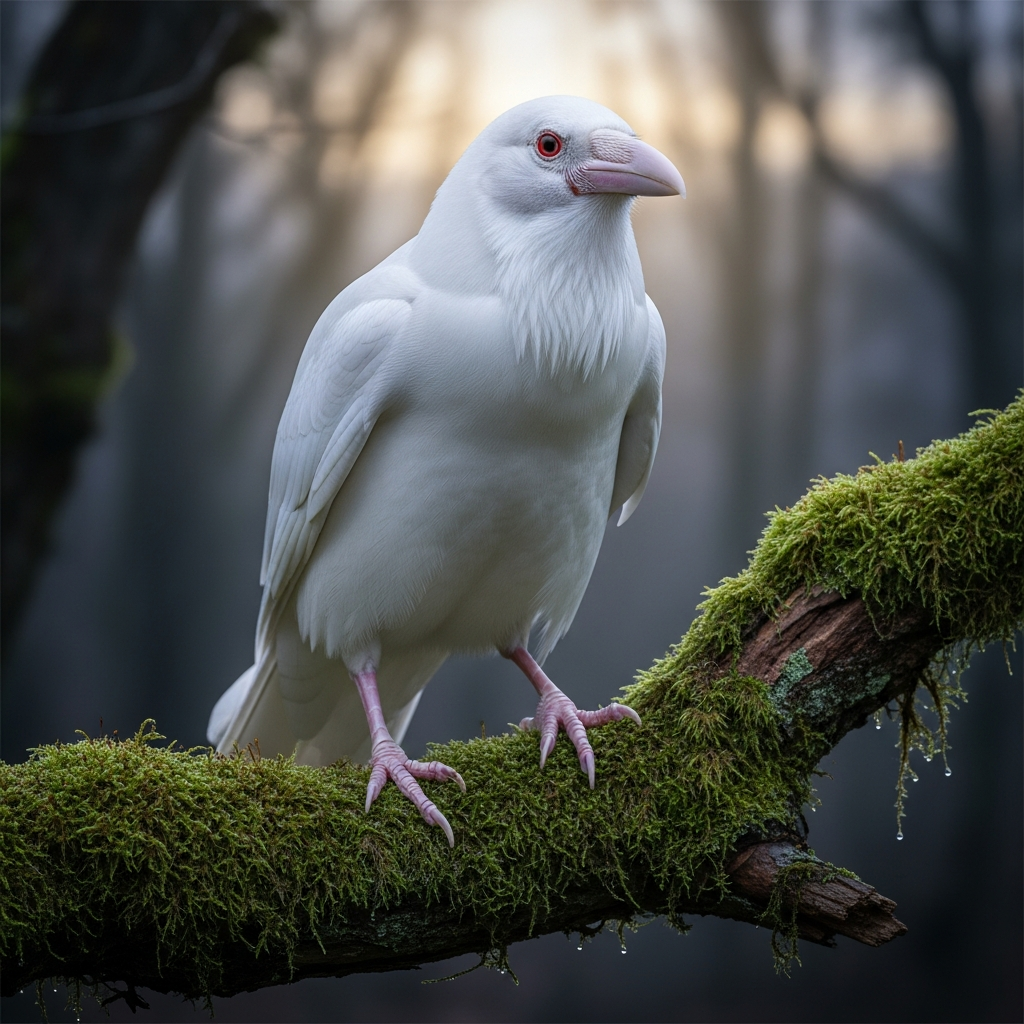
The sudden appearance of a creature that defies all expectations of its species can be truly breathtaking. For millennia, the image of the raven has been synonymous with a deep, glossy black, but what happens when this shade is stripped away? The result is the stunning and often misunderstood White Raven. This striking bird is not a separate species but is typically a Common Raven (Corvus corax) that exhibits a genetic condition causing its lack of dark pigment. The White Raven is an extremely rare sighting, and its pale plumage is usually caused by leucism, a condition distinct from albinism.

What Exactly is a White Raven? Decoding the Science of Color
The White Raven is perhaps one of nature’s most dazzling paradoxes, challenging our fundamental assumptions about the natural world. If you encounter one, you are witnessing a profound biological anomaly in action.
The simple, direct answer to what a White Raven is lies in its genetics:
The White Raven is a Common Raven (Corvus corax) that lacks the normal black pigmentation. The condition is overwhelmingly caused by leucism, which is an inherited inability to deposit melanin in the feathers and skin. Unlike a true albino bird, a leucistic White Raven typically retains pigment in the soft tissues of its eyes, beak, and legs. This rarity makes the White Raven a phenomenal subject of ornithological study and a source of wonder for casual observers.
I remember my own first encounter with a creature displaying a severe pigmentation anomaly. It wasn’t a White Raven—I had to wait many years for that—but a completely white squirrel darting across a wooded path in a city park. It was a fleeting, ghost-like apparition that completely disrupted my expectation of what a squirrel should look like. That moment crystallized for me the profound impact that a simple color change can have on how we perceive an animal’s existence. When I finally saw a photograph of a leucistic White Raven years later, that same sense of wonder returned tenfold. Its stark contrast against a dark forest or a winter sky makes the White Raven an instant, unforgettable legend. It looks less like a bird and more like a symbol given form.
Leucism vs. True Albinism: A Critical Distinction
The single most important fact to understand about the White Raven is the difference between leucism and albinism. This distinction clarifies the bird’s physical appearance, health, and survival prospects.
Leucism is a condition caused by a defect in pigment cells (melanoblasts) differentiating and moving from the neural crest to the final locations in the skin, feathers, or scales during development. This process causes a partial, patchy, or overall reduction in color.
- Eyes: A leucistic White Raven generally has normal eye color—typically dark brown or black—because the pigment-producing cells in the eyes are derived from a different developmental pathway.
- Feathers: The lack of pigment in the feathers can range from a few white patches to being completely white. The striking, all-white White Raven is the most dramatic example.
- Beak and Legs: These parts usually maintain their normal dark color, a key visual cue for identification.
Albinism, on the other hand, is a condition resulting from an inherited genetic mutation that prevents the production of melanin entirely. The pigment-producing cells (melanocytes) are present, but they cannot manufacture the melanin.
- Eyes: True albinos lack pigment in the iris, which makes the blood vessels at the back of the eye visible. This is what gives the eyes a characteristic pink or red appearance.
- Vision: Albinism often leads to severe vision problems, including photosensitivity, which significantly hampers the ability of an albino White Raven to hunt and survive in bright sunlight.
- Plumage: The plumage is a uniform, milky white, and the beak and legs are often pale pink.
In almost all documented cases, the beautiful creature you see is a leucistic White Raven, benefiting from better vision and, therefore, better odds of survival than a fully albino individual. This makes the White Raven a more resilient, though still vulnerable, anomaly.
The Genetic Lottery: How Leucism Occurs
The occurrence of a White Raven is a true stroke of the genetic lottery, a rare event dependent on a specific, often recessive, genetic trait being expressed. The inheritance pattern of leucism is complex and not fully understood across all corvid species, but it fundamentally comes down to the machinery for color deposition.
In many cases, the leucistic trait that produces the White Raven is inherited when two normally pigmented parents—who are both carriers of the recessive leucism gene—mate. When this happens, there is a one-in-four chance that the offspring will express the all-white plumage. In other instances, it can be a non-inherited condition resulting from environmental factors, although this is less common for a full-body White Raven display.
The rarity of the fully white phenotype among Common Ravens is precisely what makes the White Raven so captivating to birdwatchers and scientists alike. The Common Raven population is vast and widespread across the Northern Hemisphere, yet the appearance of a White Raven is a once-in-a-lifetime occurrence for most people. The gene responsible for leucism is not only rare, but its expression can also be detrimental to survival, meaning fewer of these pale birds reach reproductive maturity to pass the trait on.
The ability of a White Raven to survive long enough to be sighted is an impressive testament to its resilience, despite the handicap of its plumage. Most birds that are born leucistic or albino do not survive their first year due to the numerous challenges their altered appearance presents.
The Rarity and The Risk: Life as a White Raven
The stark, pale beauty of the White Raven is simultaneously its greatest advantage in attracting human attention and its greatest disadvantage in the wild. Life in a world built for black feathered birds is fraught with danger for a magnificent White Raven.
The statistical probability of finding a White Raven is incredibly low, largely because of the high mortality rate. In typical populations of Common Ravens, the percentage of individuals exhibiting leucism is minuscule—far less than one percent. This makes every sighting of a healthy, mature White Raven an invaluable piece of data for ornithologists studying population genetics and survivability.
Survival Challenges: Camouflage and Social Dynamics
For a species like the raven, whose ecological success is heavily reliant on intelligence, flock dynamics, and excellent camouflage, the lack of black pigment presents significant hurdles. A White Raven faces continuous threats that its black counterparts do not.
Camouflage Failure: The raven’s deep black color is a phenomenal evolutionary adaptation. It allows the bird to blend seamlessly into the shadows of forests, against dark tree bark, and in the twilight hours when they are most active. A pure White Raven, however, stands out against virtually every natural background except deep snow. This makes the White Raven an easy target for larger raptors like owls and eagles, and highly visible to terrestrial predators that might raid its nest. The difficulty of remaining hidden is a primary reason why few White Raven chicks survive their first flight.
Social Exclusion and Communication: Ravens are highly social and intelligent birds, communicating through a complex array of calls and visual cues. Their black plumage is integral to their body language, helping to absorb and reflect light in ways that signal dominance or submission to other birds. The anomalous coloring of a White Raven can disrupt this social cohesion. It is known that leucistic animals, including the White Raven, can sometimes be ostracized or struggle to find a mate because their unusual appearance is interpreted as a sign of ill health or a genetic flaw by their peers. A successful White Raven must overcome not just environmental threats, but also social hurdles.
Recent White Raven Sightings: Alaskan and Vancouver Island Phenomena (2023-2024 Case Study)
Despite the overwhelming odds, sightings of the White Raven do occur, and recent reports highlight specific regions that seem to have a higher incidence of the leucistic gene. These hotspots offer valuable insight into the geographical distribution of the trait.
A notable and well-documented recent phenomenon involved a leucistic White Raven in Anchorage, Alaska, in the 2023-2024 period. This particular bird became a local celebrity, captivating residents and offering a rare, extended opportunity for observation. This bird’s presence confirmed that even in harsh, heavily-populated areas, a lucky White Raven can not only survive but thrive for a considerable period. The Anchorage sighting suggests a localized concentration of the leucism gene within the Common Raven population in that region.
Historically, another famous population of White Raven sightings occurs around Vancouver Island and other coastal areas of British Columbia. This area is so well-known for its sightings that the local Indigenous cultures have deep, long-standing legends about the pale birds. Though the reasons for this localized prevalence are not definitively known, scientists hypothesize it could be due to:
- Genetic Bottleneck: A small, isolated population where the recessive gene became concentrated.
- Environmental Factors: Specific dietary deficiencies or environmental contaminants, though this is a less common cause for the fully white appearance of a mature White Raven.
- Founder Effect: A few individuals carrying the leucism gene may have colonized the area, passing the trait to a disproportionately large percentage of the subsequent generation.
Each sighting of a White Raven, whether in the frozen landscapes of Alaska or the misty forests of the Pacific Northwest, serves as a poignant reminder of nature’s capacity for surprise. These sightings are crucial, providing ornithologists with precious data points on the movement, longevity, and reproductive success of the White Raven.
Mythology and Symbolism: Why the White Raven Captures Our Imagination
Long before modern science explained the mechanism of leucism, the appearance of the White Raven was interpreted through the lens of myth, prophecy, and divine intervention. Its existence, so contrary to the blackness of its kin, has cemented its place as a powerful cultural and spiritual symbol across the globe.
The reason the White Raven holds such a powerful place in human mythology is precisely because of its contradiction. Ravens are universally linked to mystery, darkness, foresight, and the boundary between worlds. A white version of this creature inherently signifies a reversal, a purification, or a powerful change in fate. It is the visual embodiment of ‘the exception to the rule.’
The White Raven in Indigenous American Cultures
In the rich tapestries of Indigenous American mythology, the raven is often a trickster god, a creator, and a pivotal figure in cosmogony. Within many Pacific Northwest cultures, where White Raven sightings are more common, the lore surrounding the bird is particularly vibrant.
The most famous of these stories, often told by the Tlingit, Haida, and Tsimshian people, explains how the raven, originally a White Raven, brought light to the world. In one version of the myth, the world was entirely dark, and the Raven stole the Sun, Moon, and Stars from a powerful, selfish chief who kept them locked in boxes. In the process of bringing these celestial bodies to humanity, the Raven was scorched by the smoke and soot that escaped, permanently turning its once glorious white feathers to the familiar black. The rare White Raven seen today is thus a direct, fleeting memory of the creature’s original, divine form—a sign of the ancient world or a return to purity.

This cultural perspective imbues the White Raven not with the danger or vulnerability that science suggests, but with profound significance and spiritual power. Seeing a White Raven is not just a biological observation; it is an experience rich with cultural history and spiritual weight, connecting the viewer to the oldest stories of the land.
European Folklore and the Legend of Apollo
European mythology also features tales of a primordial White Raven, most famously within the Greek traditions involving the god Apollo. In these ancient stories, the raven was initially a beautiful bird of pure white plumage, considered sacred to Apollo, the god of prophecy and the sun.
The tale often recounts a moment of betrayal or bad news. The White Raven was tasked with keeping watch over Apollo’s love interest. When the bird brought Apollo news of infidelity, Apollo’s famous temper caused him to curse the bird. In a fit of rage, Apollo condemned the raven for bringing him the unwelcome truth and—in some versions—scorched the bird with his divine fire or cursed its color to be the color of night and ill-omen. Thus, the raven was changed from a pristine White Raven to the black bird we know today, doomed to forever carry the message of darkness.
The theme is consistent across continents: the White Raven represents a state of innocence, a divine connection, or a past glory that was lost due to a catastrophic event or failure. Whether viewed as an ancestor, a trickster, or a cursed messenger, the mythical White Raven acts as a powerful omen, marking a moment of transition or prophecy for those who are fortunate enough to witness it.
Where Can You Find a White Raven? Geography of Leucism
Given the global range of the Common Raven (Corvus corax), a White Raven could theoretically appear almost anywhere in the Northern Hemisphere. However, the geographic distribution of reported sightings is highly concentrated, suggesting specific environmental or genetic factors at play in certain locations.
The pursuit of spotting a White Raven is a lifelong quest for many bird enthusiasts, a kind of Holy Grail of ornithology. The extreme rarity of a fully leucistic White Raven means that there are no reliable ‘guarantees,’ but historical trends certainly point towards a few key regions.
Famous Hotspots: From Vancouver Island to Specific North American Regions
While the gene for leucism is randomly distributed, the cumulative effect of a high concentration of ravens and, potentially, an isolated gene pool has created a few regions famous for their White Raven heritage.
- Vancouver Island and the Pacific Northwest (BC, Canada): This is arguably the most famous historical location for White Raven sightings. The town of Qualicum Beach and nearby areas in British Columbia have reported leucistic ravens with surprising regularity for decades. The prevalence here is so noteworthy that it ties directly into the Indigenous legends of the area. A visitor to this region has perhaps the highest statistical chance of spotting a fully or partially white specimen.
- Coastal Alaska (e.g., Anchorage, Juneau): As evidenced by the 2023-2024 sighting, coastal Alaska is a key location. The immense, healthy raven population here is frequently observed, and a local concentration of the leucism trait periodically surfaces a majestic White Raven. The harsh, snowy environment also paradoxically aids the White Raven‘s initial survival by offering better seasonal camouflage than a dark, dense forest.
- The Faroe Islands: A specific sub-species of Common Raven, the Pied Raven (Corvus corax varius), was historically found here. While not a pure White Raven, this bird was striking with large patches of white and black feathers, a stable, genetically distinct form of partial leucism. Though the Pied Raven is now extinct, the islands illustrate how geographic isolation can stabilize a unique color mutation like that found in the White Raven.
A traveler hoping to spot a White Raven should always focus on areas with dense, established Common Raven populations, particularly in coastal or temperate regions where they are a familiar part of the local ecosystem. The search for a White Raven is as much about patience and luck as it is about geography.
Protecting the Pale: Conservation and the Future of the White Raven
The White Raven is not a species needing formal conservation status; rather, it is an individual manifestation of a genetic anomaly within a common species. However, the challenges faced by the individual White Raven highlight broader ecological concerns.
The true conservation focus regarding the White Raven lies in protecting the habitat of the Common Raven itself. A healthy, robust Common Raven population is essential for the sporadic, beautiful appearance of a White Raven to continue. Threats to the parent population—such as habitat loss, pesticide use, and human persecution—are ultimately threats to the genetic diversity that allows for the emergence of the rare, white-feathered bird.
Furthermore, human interaction poses a unique risk to the White Raven. Because the bird is so startling and memorable, it can easily become habituated to human presence, especially when people are trying to capture photos or provide food. While well-meaning, this can lead to:
- Reliance on Human Feeding: Affecting natural foraging instincts.
- Increased Risk of Traffic or Human Conflict: Drawing the bird into dangerous urban areas.
- Stress: Constant observation can stress the already vulnerable White Raven.
The best approach to supporting the continuation of this extraordinary natural phenomenon is one of respectful, distant observation. The continued, healthy existence of a rare White Raven in the wild is the most eloquent statement on the overall health of its local environment. When a White Raven is sighted, it should be viewed not as a personal trophy, but as a public indicator of a thriving local ecosystem, a ghost of an ancient myth made suddenly, vividly real. The future of the White Raven is entirely dependent on the future of its black-feathered brethren and the environments they share.
Final Thoughts on the Enigmatic White Raven
To encounter a White Raven is to receive a rare gift from nature. It is a moment of cognitive dissonance, forcing us to pause and question everything we thought we knew about a familiar, ubiquitous bird. This startling creature is a confluence of complex biology, deep-seated mythology, and sheer, random chance.
The scientific reality of the White Raven as a leucistic individual only enhances its mystique. It is a fragile survivor, overcoming the odds of camouflage failure, social ostracization, and the inherent difficulties of a genetic mutation. The recent sightings, particularly the leucistic White Raven in Alaska in 2023-2024, confirm that this anomaly continues to grace our skies, preserving its place in legend.
Whether you choose to view the White Raven as a scientific marvel of mutation, a reminder of the Raven’s original form in ancient tales, or simply as one of the most beautiful and unexpected birds you will ever see, its impact is undeniable. The legend of the White Raven will endure because its visual contrast is a profound metaphor for the unexpected beauty that lies just beneath the surface of the ordinary world. The White Raven is a testament to nature’s endless creativity and resilience.
—
—
Frequently Asked Questions (FAQ) About the White Raven
Is the White Raven a completely different species?
No. The White Raven is not a distinct species. It is nearly always an individual Common Raven (Corvus corax) that exhibits a genetic condition called leucism, which causes the lack of normal black pigmentation in its feathers. The physical structure and intelligence of the White Raven are identical to those of a normal black raven.
What is the primary difference between a leucistic White Raven and an albino raven?
The key difference lies in the eyes. A leucistic White Raven has dark, normally pigmented eyes, because the condition affects only the pigment cells in the feathers and skin. A truly albino raven, on the other hand, lacks all melanin production, resulting in pink or red eyes and often poor eyesight. The vast majority of White Raven sightings are leucistic.
How rare is a White Raven?
The White Raven is extremely rare. While exact statistics are difficult to pinpoint due to the transient nature of the sightings, the incidence of full leucism in the Common Raven population is estimated to be well below one percent. Sighting a mature, healthy White Raven is considered a once-in-a-lifetime event for most birdwatchers.
Are there any specific regions where White Ravens are more commonly sighted?
Yes, certain geographical areas show a higher incidence of White Raven sightings, suggesting a localized gene pool or ‘founder effect.’ The coastal regions of the Pacific Northwest, particularly Vancouver Island in British Columbia, and parts of Coastal Alaska are historically and currently the most famous regions for observing the White Raven.
Do White Ravens have a harder time surviving in the wild?
Unfortunately, yes. The lack of black pigment in the White Raven severely compromises its camouflage, making it highly visible to both predators and prey. This dramatically increases the risk of predation. Additionally, a White Raven may face challenges in social dynamics, potentially struggling to find a mate or being excluded from flocks due to its unusual appearance.
—
—