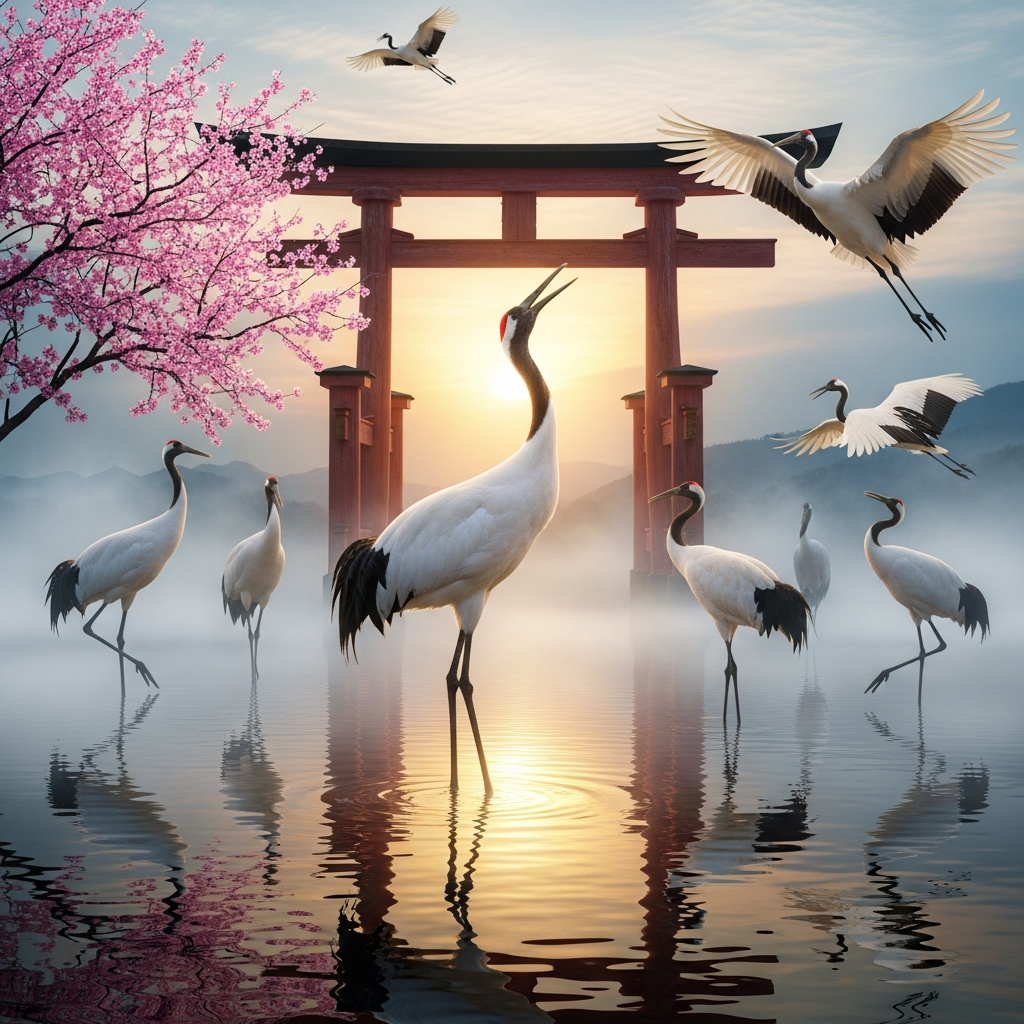
Cranes in Japanese Mythology: The Divine Birds of Longevity, Fidelity, and the Gods
In the vast tapestry of Japanese folklore and spiritual tradition, few creatures command as much reverence as the crane. Known as the Tsuru, this elegant bird is not merely a part of the natural landscape but a cornerstone of the Japanese soul. For centuries, the crane has been depicted as a companion to the gods, a symbol of a thousand-year life, and a testament to the virtues of gratitude and fidelity.
If you have ever wondered why the crane appears so frequently on Japanese kimonos, wedding invitations, or even the tail fins of national airlines, you are about to embark on a journey through thousands of years of mythic history. This guide explores the deep-seated connection between cranes in Japanese mythology, their association with the divine, and their enduring legacy in modern culture.
The Biological Inspiration: The Red-Crowned Crane (Tancho)
Before diving into the celestial realms, it is essential to understand the physical bird that inspired these legends. The Red-Crowned Crane (Grus japonensis), or Tancho in Japanese, is one of the rarest cranes in the world.
Standing nearly five feet tall with a striking white body, black neck, and a distinctive patch of red skin on its crown, the bird possesses an ethereal beauty. Their elaborate “dancing” rituals—leaping, bowing, and tossing sticks—were interpreted by ancient observers as a form of communication with the heavens.
For the ancient Japanese, seeing these birds emerge from the morning mist of Hokkaido’s marshes was a religious experience. It was easy to believe that such majestic creatures were not entirely of this world, but rather emissaries from the Land of the Immortals.
The Crane as a Symbol of Longevity and Immortality
One of the most pervasive beliefs in Japanese culture is that the crane lives for 1,000 years. While biologically they live roughly 30 to 40 years in the wild, their mythological lifespan is a metaphor for endurance and the eternal spirit.
The Influence of Taoist Immortals
The association of cranes with longevity largely stems from ancient Chinese Taoist influences that crossed the sea to Japan. In Taoist iconography, cranes are often the “steeds” of the Xian (Immortals). These enlightened beings would ride on the backs of cranes to travel between the earthly realm and the celestial peaks.
In Japanese mythology, this transitioned into the crane being a companion to Jurojin and Fukurokuju, two of the Seven Lucky Gods (Shichifukujin). Jurojin, the god of longevity, is almost always depicted accompanied by a crane and a deer, signifying a life that stretches beyond the boundaries of time.
The “Crane and Turtle” (Tsuru-Kame)
You will often see the crane paired with the turtle (Kame) in Japanese art. An old Japanese proverb says: “Tsuru sen-nen, Kame man-nen” (The crane lives for 1,000 years, the turtle for 10,000 years). Together, they represent the ultimate wish for a long, healthy life and are foundational symbols at Japanese weddings and New Year celebrations.
The Crane in Shintoism: Messengers of the Kami
In Shinto, the indigenous spirituality of Japan, the natural world is inhabited by spirits known as Kami. Certain animals are considered Shinme (divine messengers) or servants of specific deities.
The crane is frequently associated with the sun goddess, Amaterasu Omikami. Because cranes fly high toward the sun and possess a “crown” of red (resembling the rising sun), they are seen as solar symbols. Their loud, resonant calls, which can be heard from miles away, were believed to be capable of reaching the ears of the gods in the High Celestial Plane (Takama-ga-hara).
Shrines and Sacred Spaces
Several Shinto shrines across Japan feature crane motifs. The bird is seen as a guardian of purity. In ancient times, it was believed that cranes could carry the souls of the deceased to the heavens on their wings, acting as a bridge between the physical and spiritual worlds.
The Legend of Tsuru no Ongaeshi (The Crane’s Return of a Favor)
No exploration of cranes in Japanese mythology is complete without the story of Tsuru no Ongaeshi. This folktale is taught to every child in Japan and encapsulates the crane’s symbolic connection to gratitude and the mystical.
The Act of Mercy
The story begins with a poor man who finds a crane struggling in a hunter’s trap. Moved by pity, he frees the bird. Shortly after, a beautiful woman appears at his door, and they eventually marry.
The Mystical Weaving
To help her husband earn money, the woman offers to weave a special cloth, but with one condition: he must never look at her while she works. She produces a fabric of unparalleled beauty, woven with intricate crane feathers.
The Broken Taboo
Driven by curiosity and greed, the husband eventually peeks into the room. To his horror, he sees not his wife, but a crane plucking its own feathers to weave into the loom. Having been discovered, the crane—which was the same bird he had saved—must leave. She flies away into the sunset, leaving the man with his regret.
Key Lessons from the Myth:
- Gratitude: The crane represents the idea that kindness is always remembered.
- Sacrifice: The act of plucking feathers symbolizes the pain of selfless love.
- The Sacred Boundary: Humans must respect the mysteries of the divine and the natural world.
Senbazuru: The Power of One Thousand Paper Cranes
The crane’s role in Japanese culture extends into the physical act of Origami. The tradition of Senbazuru (folding 1,000 paper cranes) is one of the most poignant practices in the modern world.
The Ancient Tradition
Originally, folding 1,000 cranes was a religious ritual. It was believed that if a person folded 1,000 cranes, the gods would grant them a single wish—usually for health, recovery from illness, or a long life. The cranes are typically strung together on threads and offered to shrines.
Sadako Sasaki and the Message of Peace
In the 20th century, the meaning of Senbazuru expanded to include global peace. This shift was largely due to Sadako Sasaki, a young girl who developed leukemia following the atomic bombing of Hiroshima.
Inspired by the legend, Sadako set out to fold 1,000 cranes. While she passed away before finishing her goal (though some accounts say she finished and continued), her classmates completed the task for her. Today, the Children’s Peace Monument in Hiroshima is constantly adorned with millions of paper cranes sent from around the world, transforming the crane from a symbol of personal longevity to a global icon of hope and healing.
The Crane in Japanese Art and Iconography
The aesthetic of the crane is deeply embedded in the “Japanese look.” Its silhouette is synonymous with elegance and high status.
Kimonos and Weddings
Because cranes mate for life, they are the primary symbol of fidelity and marital harmony. You will find embroidered cranes on the Uchikake (heavy bridal kimono). The presence of the crane serves as a prayer for the couple to remain together for “a thousand years,” much like the bird’s mythical lifespan.
The Kamon (Family Crests)
Many samurai families and noble houses adopted the crane as their Kamon. The most famous is the Tsuru-mon, which often depicts the crane with its wings forming a perfect circle. This represents protection, strength, and the cyclical nature of life.
Modern Branding: Japan Airlines (JAL)
Even in a high-tech era, the crane remains vital. The logo of Japan Airlines, known as the Tsurumaru, features a red-crowned crane with outstretched wings. It was chosen to represent the Japanese spirit of hospitality, reliability, and the ability to soar to great heights.
How the Crane Connects to Different Japanese Gods
While we have touched on the Seven Lucky Gods, the crane’s divine associations are multifaceted:
- Hachiman: The god of war and protector of the Minamoto clan. While the pigeon is his primary messenger, the crane is often associated with the nobility and victory of the samurai who worshipped him.
- Mount Horai (Penglai): In Japanese myth, this is the island of the immortals. The crane is the primary inhabitant of this mystical land, where the trees bear jewels and no one knows sorrow or death.
- Kannon (Goddess of Mercy): In some Zen interpretations, the crane’s grace is seen as an earthly manifestation of Kannon’s compassion.
Why the Crane Still Matters Today
You might ask why an ancient bird remains so relevant in the age of smartphones and robotics. The answer lies in the Japanese concept of Kansha (Gratitude) and Nature Harmony.
- Environmental Conservation: The Red-Crowned Crane was once nearly extinct in Japan. Its miraculous recovery, aided by local farmers in Kushiro, is seen as a modern-day “return of a favor” between humans and nature.
- Cultural Identity: The crane provides a visual bridge between Japan’s mythological past and its modern aspirations.
- Spiritual Comfort: In times of tragedy, the folding of cranes remains a primary way for the Japanese people to process grief and express solidarity.
Step-by-Step: How to Honor the Crane Symbolism in Your Life
If you are inspired by the cranes in Japanese mythology, you can incorporate their positive energy into your own space:
- Display Crane Art: Placing a crane painting or figurine in the East or Southeast area of your home is believed to promote health and longevity according to Feng Shui principles (which share roots with Japanese tradition).
- Practice Origami: Learning to fold a crane is a meditative practice. It requires focus and patience, mirroring the Zen qualities the bird represents.
- Gift a Senbazuru: If a friend is facing a difficult time or illness, a string of paper cranes is one of the most meaningful and respectful gifts you can provide in Japanese culture.
- Use Crane Motifs for Anniversaries: Celebrate long-term relationships with crane-themed gifts to symbolize “eternal fidelity.”
Conclusion: The Eternal Flight of the Tsuru
The cranes in Japanese mythology are more than just characters in old stories. They are the guardians of the Japanese spirit. They remind us that life is precious, that gratitude is a divine virtue, and that even the smallest act of kindness—like freeing a bird from a trap—can change the course of destiny.
Whether as a messenger of the gods, a companion to the immortals, or a symbol of world peace, the crane continues to fly high in the collective imagination. By understanding the depth of its history, you gain a deeper appreciation for the beauty and resilience of Japanese culture itself.
Frequently Asked Questions (FAQ)
1. Why is the crane so important in Japanese culture?
The crane is considered a “treasure of the nation.” It represents longevity (living 1,000 years), fidelity (mating for life), and is a messenger of the gods. It is a symbol of luck and high status.
2. What does 1,000 paper cranes represent?
The Senbazuru (1,000 cranes) represents a prayer for healing, a wish for luck, or a plea for peace. It is based on the belief that the gods will grant a wish to anyone who completes the task.
3. Is the crane related to any specific Shinto god?
Yes, it is often associated with Amaterasu (the Sun Goddess) due to its solar symbolism, and it is a companion to Jurojin and Fukurokuju, the gods of longevity.
4. What is the meaning of a crane at a Japanese wedding?
At a wedding, cranes symbolize a long and happy marriage. Since cranes are monogamous, they represent the couple’s vow to stay together forever.
5. What is the legend of the “Crane Wife”?
Known as Tsuru no Ongaeshi, it is a story about a crane who transforms into a human to repay a man’s kindness by weaving beautiful cloth from her own feathers. It highlights the themes of gratitude and the consequences of broken trust.