What Does Jackalope Mean? The Ultimate Guide to America’s Favorite Mythical Creature
If you have ever traveled through the American West, specifically through the dusty plains of Wyoming or South Dakota, you have likely encountered a peculiar sight in gift shops and diners: a rabbit with antlers. This creature is known as the Jackalope. But what does Jackalope mean, and where did this bizarre hybrid originate?
The term “Jackalope” is more than just a name for a souvenir; it represents a fascinating intersection of North American folklore, 1930s taxidermy, and a surprising biological reality. In this comprehensive guide, you will learn about the etymology, the history, the scientific explanations, and the cultural impact of this legendary “fearsome critter.”
The Etymology: What Does the Word “Jackalope” Mean?
To understand the literal meaning of the word, you must look at its linguistic construction. The word “Jackalope” is a portmanteau—a linguistic blend of words in which parts of multiple words are combined into a new one.
- Jackrabbit: A large hare native to North America, known for its long ears and powerful hind legs.
- Antelope: Specifically referring to the Pronghorn (which is technically not a true antelope but is commonly called one in North America), from which the creature supposedly gets its antlers.
Therefore, the Jackalope meaning is quite literally a “Jackrabbit-Antelope hybrid.” While the creature is physically depicted as a rabbit with deer-like antlers, the name specifically draws from the local fauna of the Western United States. This naming convention follows a long tradition of “cryptid” naming where physical traits define the identity of the beast.
The Origin Story: Douglas, Wyoming, and the Herrick Brothers
While legends of horned rabbits have existed in European folklore for centuries, the modern American Jackalope has a very specific “birthplace.” If you visit Douglas, Wyoming, you are visiting the self-proclaimed “Jackalope Capital of the World.”
The creation of the Jackalope as we know it today is attributed to Douglas Herrick and his brother Ralph in the early 1930s. The brothers were teenagers with an interest in taxidermy. According to local history, after a hunting trip, they tossed a jackrabbit carcass into their shop. The rabbit landed next to a pair of deer antlers, and Douglas Herrick had a flash of inspiration.
He decided to graft the antlers onto the rabbit’s head, creating the first Jackalope mount. They sold the creation to a local hotel owner for $10, and a legend was born. From that single taxidermy project, an entire industry of tall tales and postcards emerged, cementing the Jackalope’s place in the American consciousness.
The Science Behind the Myth: The Shope Papilloma Virus
You might wonder if there is any grain of truth to the sightings of “horned rabbits” throughout history. Surprisingly, there is a biological explanation that likely fueled the legend long before the Herrick brothers picked up their taxidermy tools.
The Shope Papilloma Virus (SPV) is a virus that affects rabbits, causing keratinous tumors to grow on their heads and necks. These tumors can become hard, elongated, and dark, often resembling horns or antlers. To an observer in the wild, a rabbit suffering from this virus would appear to have actual horns growing from its skull.
Scientists believe that historical accounts of the “Wolpertinger” in Germany or the “Lepus Cornutus” in medieval encyclopedias were actually sightings of rabbits infected with SPV. While the modern Jackalope is a deliberate artistic creation, its roots may be tied to this tragic biological reality. Understanding this virus provides a bridge between the “Jackalope meaning” as a myth and its potential as a misinterpreted biological fact.
Jackalope Folklore: Powers, Habits, and How to Catch One
Like any good tall tale, the Jackalope comes with a set of elaborate myths regarding its behavior. In the tradition of the American frontier, these stories were often told to “greenhorns” (newcomers) to test their gullibility. If you are to believe the folklore, the Jackalope is much more than a rabbit with horns.
1. The Ability to Mimic Human Speech
One of the most famous legends is that the Jackalope can mimic human voices. Cowboy lore suggests that as men sat around campfires singing songs at night, Jackalopes would sit in the darkness and sing back, often in a perfect tenor voice. It was said they could mimic the calls of hunters or the shouts of cowboys to lead them astray.
2. The Rarity of Jackalope Milk
According to legend, the milk of a female Jackalope is highly medicinal and possesses incredible healing properties. However, obtaining it is nearly impossible because the Jackalope is notoriously aggressive. It is often called the “warrior rabbit,” and milking one requires you to approach it while it is sleeping—a feat few have accomplished.
3. Catching a Jackalope with Whiskey
If you intend to catch a Jackalope, folklore suggests you should use whiskey as bait. The creature is said to have a fondness for alcohol. By leaving a bowl of whiskey out, the Jackalope will drink until it becomes intoxicated, making it easy to apprehend. Without the whiskey, the Jackalope is reportedly too fast to be caught by any hound or hunter.
4. Breeding Only During Lightning Storms
Some versions of the myth claim that Jackalopes only mate during lightning storms. This adds an elemental, almost supernatural quality to the creature, suggesting it is a being born of the wild Western weather rather than standard biology.
The Cultural Significance of the Jackalope in America
The Jackalope has transcended its origins as a taxidermy prank to become a cultural icon. Its meaning has shifted from a joke to a symbol of Western identity and the American tradition of the “Tall Tale.”
In Douglas, Wyoming, the Jackalope is a serious matter. The city issues official Jackalope Hunting Licenses to tourists, though the “season” is strictly limited to June 31st (a date that does not exist). There is a massive Jackalope statue in the town square, and the creature appears on official city documents and even police patches.
Furthermore, the Jackalope serves as a mascot for various businesses, sports teams, and even software. In the tech world, “Jackalope” was the codename for Ubuntu 9.04 (Jaunty Jackalope). This demonstrates how the creature’s name has become synonymous with something unique, hybrid, and quintessentially quirky.
Global Cousins: The Jackalope’s Relatives Around the World
The “Jackalope meaning” is part of a broader global phenomenon of hybrid cryptids. Humans have a long history of imagining “chimera” creatures that blend the traits of familiar animals.
- The Wolpertinger (Germany): Found in the forests of Bavaria, this creature is even more complex than the Jackalope. It typically has the body of a rabbit, the antlers of a deer, the wings of a duck, and sometimes the fangs of a predator.
- The Skvader (Sweden): Created in the early 20th century, this creature is a mix between a hare and a wood grouse (bird). Like the Jackalope, it originated from a taxidermy joke.
- The Rasselbock (Germany): A creature very similar to the Jackalope, specifically a hare with roe deer antlers, featured in Thuringian folklore.
These creatures suggest that the human imagination is consistently drawn to the idea of the “horned hare,” perhaps because the rabbit is seen as vulnerable, and the addition of horns gives it a sense of power and mystery.
Taxidermy as Art and Hoax
You cannot discuss what a Jackalope means without addressing the art of taxidermy. The Jackalope is perhaps the most successful “gaff” in taxidermy history. A “gaff” is a fake creature created for sideshows or curiosities. While some might see this as deceptive, in the context of the American West, it is viewed as a form of performance art.
The Herrick brothers didn’t just create a mount; they created a narrative. This narrative fits into the American Tall Tale tradition alongside figures like Paul Bunyan and Pecos Bill. These stories weren’t necessarily meant to be believed as literal truth, but rather to be enjoyed as part of a shared cultural humor.
Why Does the Jackalope Persist Today?
In an age of high-definition cameras and GPS, why does the Jackalope still capture our imagination? The answer lies in our desire for wonder and whimsy. The Jackalope represents a time when the world felt larger and more mysterious.
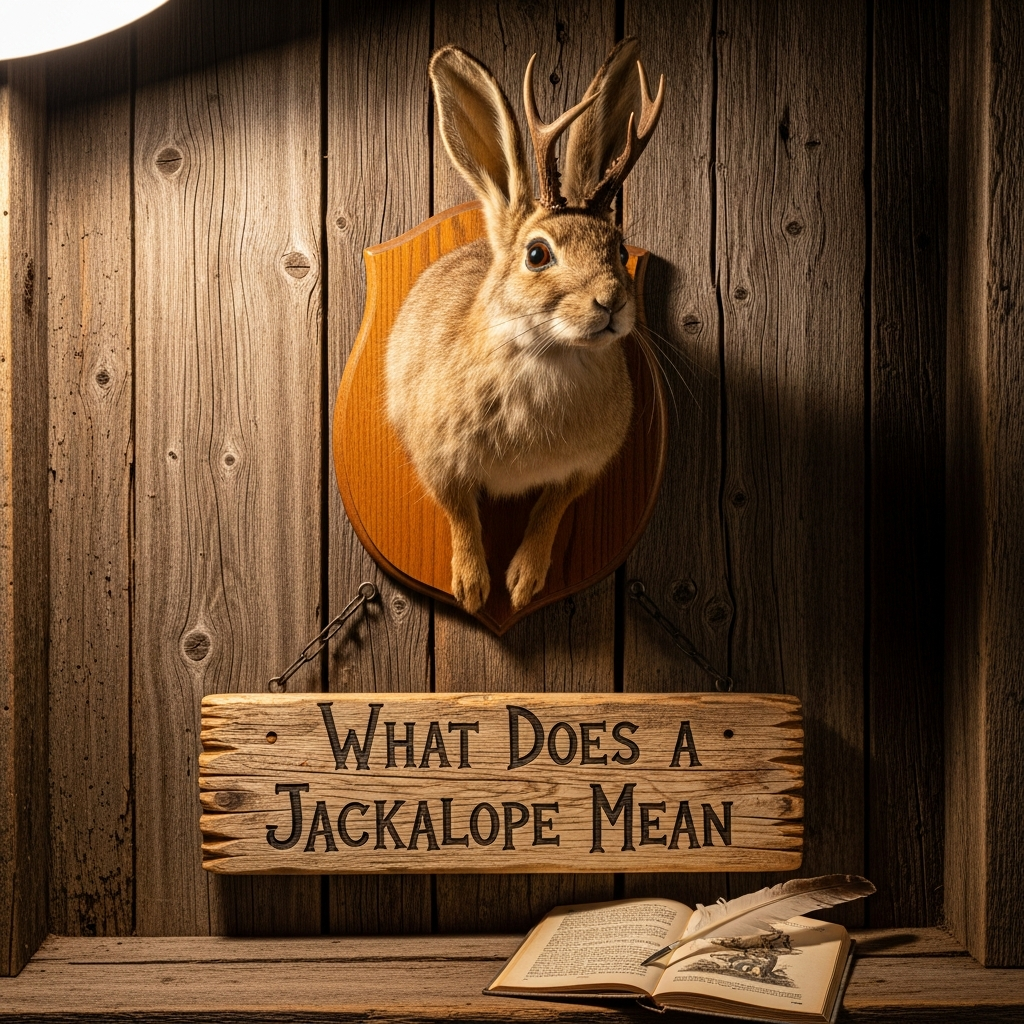
For the modern traveler, the Jackalope is a reminder not to take life too seriously. It is a symbol of the “trickster” spirit. When you see a Jackalope head mounted on a wall, it invites you to participate in the joke. It challenges you to question what is real and what is myth, all while maintaining a sense of humor.
Furthermore, the Jackalope has become a favorite in modern pop culture. From appearances in Pixar shorts (like “Boundin'”) to being a mount in video games like Red Dead Redemption, the creature continues to evolve. Its meaning today is one of nostalgia for the “Wild West” and a celebration of creative storytelling.
Summary: Defining the Jackalope
To summarize, if someone asks you “What does Jackalope mean?”, you can provide a multi-layered answer:
- Linguistically: It is a portmanteau of Jackrabbit and Antelope.
- Historically: It is a 1930s taxidermy creation from Douglas, Wyoming.
- Scientifically: It is likely inspired by rabbits with the Shope Papilloma Virus.
- Culturally: It is a symbol of American folklore and the tradition of the tall tale.
Whether it is a “warrior rabbit” or a clever piece of art, the Jackalope remains one of the most enduring and beloved myths in North America. It reminds us that sometimes, the most interesting things in life are the ones we imagine together.
Frequently Asked Questions About Jackalopes
Are Jackalopes real animals?
No, the Jackalope is a mythical creature. While real rabbits can grow horn-like tumors due to a virus, the “Jackalope” as a rabbit with deer antlers is a product of taxidermy and folklore.
Can you actually hunt Jackalopes in Wyoming?
You can purchase a souvenir “Jackalope Hunting License” in Douglas, Wyoming. However, these are for entertainment purposes only, as the animal does not exist in the wild.
What do Jackalopes eat?
According to legend, they eat typical rabbit fare like grass and shrubs, but they have a mythical preference for whiskey and are said to be attracted to the smell of sagebrush after a rainstorm.
Why is Douglas, Wyoming famous for them?
Douglas is the home of the Herrick brothers, who created the first Jackalope taxidermy mount in 1932. The town has since embraced the creature as its official mascot.
Is the Jackalope dangerous?
In folklore, yes. They are described as “fearsome critters” that can use their antlers to defend themselves and are surprisingly aggressive if provoked. In reality, they are harmless statues and wall mounts.