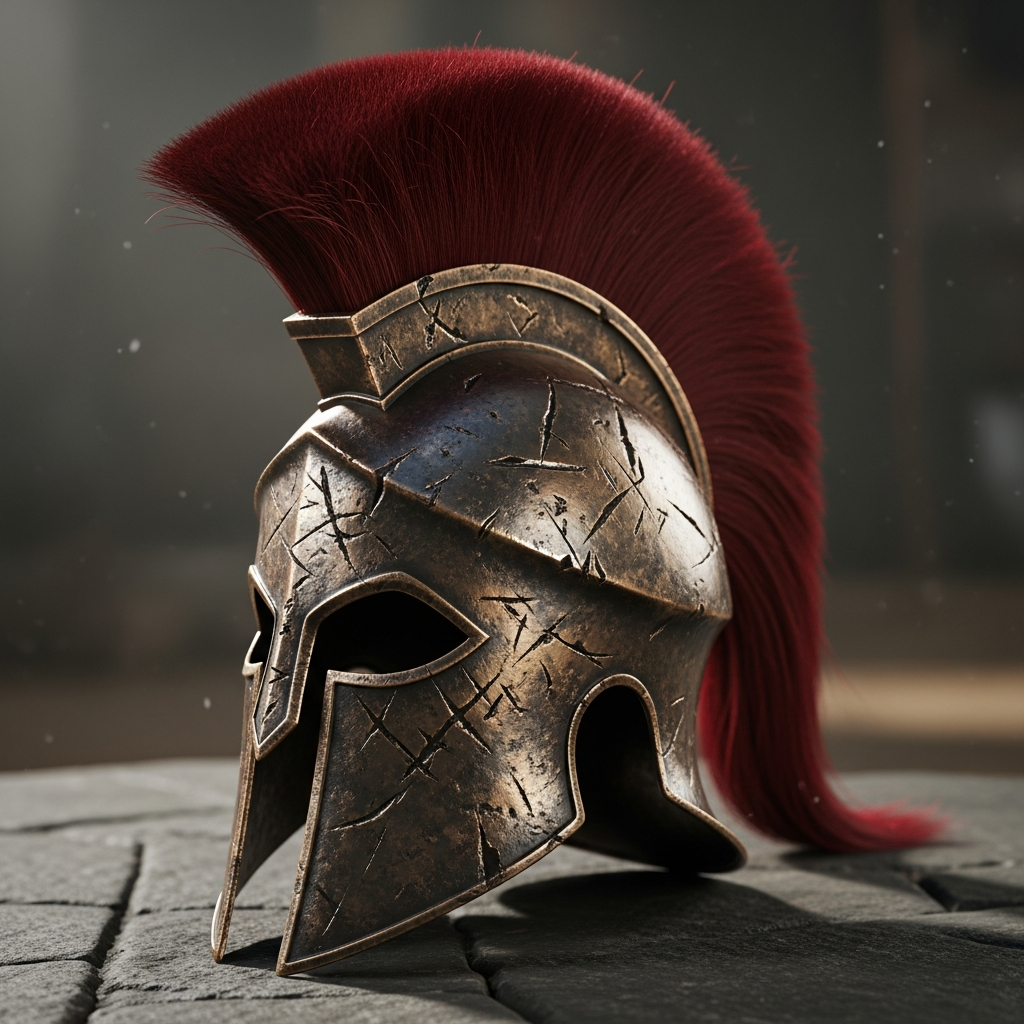
The Spartan Helmet, in its most recognizable form, is an emblem of unwavering courage, martial discipline, and the formidable spirit of one of history’s most celebrated warrior societies. It is more than just a piece of ancient protective gear; it represents an entire civilization’s ethos, instantly conjuring images of hoplites standing shoulder-to-shoulder in the heat of battle. This iconic headgear, specifically the Corinthian type, became the defining feature of the classical Greek heavy infantry, utilized not only by the famous soldiers of Sparta but across the Hellenic world. Its deep cultural resonance and fierce aesthetic ensure that the Spartan Helmet remains a potent symbol of resilience and strength even today, millennia after it first shielded a soldier’s face.

The enduring popularity of the Spartan Helmet is a testament to its powerful visual and symbolic impact, making it a favorite motif in modern design, military insignia, and cinematic depictions of ancient warfare. Understanding the full scope of the Spartan Helmet requires delving into its design evolution, its psychological role on the battlefield, and its transformation into a timeless icon.
The Anatomy and Legacy of the Spartan Helmet
While many ancient Greek city-states adopted the Corinthian style, the association with Sparta is particularly strong because of their legendary military prowess. The design of the original Spartan Helmet was remarkably innovative for its time, providing maximum protection with minimal visual obstruction, though it was not without its drawbacks.
The classic design of the Spartan Helmet evolved from earlier forms, characterized by a one-piece bronze construction that fully encased the head. This full-face protection was revolutionary, turning the wearer’s head into a near-impenetrable surface that could deflect sword blows, spear thrusts, and arrows. However, this level of defense came at a cost to the wearer’s sensory input, a trade-off Spartan warriors were willing to make for the safety of their formation. The helmet essentially enforced the rigid, collective nature of the Spartan polis itself.
The Corinthian Type: A Symbol of Invincibility
The Corinthian helmet, the type most commonly associated with the image of a Spartan Helmet, was the standard defensive gear for Greek hoplites from the 7th to the 5th centuries BCE. Its design was both functional and terrifying, covering the entire head, including the face and neck, with slits for the eyes and a flared section to protect the nose and mouth.
The key features of the classic Corinthian Spartan Helmet include:
- Full Bronze Sheet Construction: Forged from a single sheet of bronze, ensuring exceptional structural integrity.
The Exomis* (Brow Guard): A prominent rim above the eye slits designed to deflect downward blows away from the face.
- Minimalistic Eye and Mouth Openings: The narrow slits and limited breathing space contributed to the helmet’s menacing appearance, but also focused the wearer’s gaze straight ahead.
- The Crest (Lophos) Channel: A fixed channel or slot along the top to secure a horsehair crest, adding height and distinction.
Featured Snippet Answer:
The Corinthian type is the Spartan Helmet most recognized today. It was primarily forged from a single sheet of bronze, offering superior protection. Key characteristics were the full-face coverage, narrow eye slits, and a prominent nose guard. Its design, dominant from the 7th to 5th centuries BCE, prioritized physical defense and psychological intimidation, turning the wearer into a fearsome, nearly anonymous fighting machine.
Despite its iconic status, the earliest versions of the Corinthian Spartan Helmet posed significant practical challenges in prolonged combat. Because the helmet was a full enclosure, it drastically limited the wearer’s peripheral vision and made communication difficult in the noise of battle. When the hoplites were not actively engaged in close-quarters fighting, they would often tilt the helmet back on their head, resting the face portion on their neck. This action gave rise to the secondary image often seen in Greek art: a warrior with the imposing bronze shell pushed up, revealing his face, but with the distinctive contours of the Spartan Helmet still visible.
The heavy, heat-retaining bronze of the Spartan Helmet demanded extraordinary physical endurance from the warriors, particularly in the hot Mediterranean climate. This perfectly complemented the rigorous, lifelong training regimen of the Spartan army, known as the Agoge. Only those conditioned to the extreme could comfortably wear and fight effectively in this demanding gear for extended periods. Thus, the helmet itself became a symbol of the harsh, unyielding commitment to physical supremacy that defined Spartan culture.
Beyond Corinth: Other Spartan Headgear Styles
It is a common misconception that the Corinthian helmet was the only Spartan Helmet worn throughout the city-state’s entire history. As warfare evolved, so too did the protective gear of the hoplites. The shift in helmet design was largely driven by the need for better situational awareness and reduced weight, signaling a move away from the claustrophobic protection of the Corinthian.
The next major iteration was the Ilyrian Helmet, which emerged slightly later. This style offered an open face, providing better visibility and breathability, though it maintained prominent cheek guards. This allowed the warrior to see and hear more effectively, which became increasingly important as battles became more maneuverable. The design was simpler, often featuring parallel ridges running up the back of the helmet, which gave it a slightly less fearsome, but far more practical, appearance for the evolving tactics of the phalanx.
Later still, and perhaps the most pragmatic evolution of the Spartan Helmet, was the Pilos Helmet. This simple, cone-shaped helmet, often made of felt or leather initially before being cast in bronze, became popular in the 4th century BCE. The Pilos offered excellent overhead protection, was lightweight, and, crucially, left the entire face open for maximum vision and communication. The Spartans, known for their focus on functional efficiency, embraced the Pilos helmet later in their history. While the Corinthian remains the iconic Spartan Helmet of myth and legend, the Pilos was the more realistic choice for the later, more mobile Spartan forces. The Pilos symbolized a practical, no-nonsense military that prioritized speed and command clarity over sheer visual terror.
The existence of these varying types demonstrates that the Spartans, contrary to the monolithic image often presented, were pragmatic innovators. They recognized that the most effective Spartan Helmet was not necessarily the most imposing, but the one that best supported the current military strategy.
Materials and Craftsmanship: The Bronze Age Mastery
The true genius of the Spartan Helmet lies in the ancient metalworking skill required to produce it. The helmets were predominantly made of bronze, an alloy of copper and tin. Bronze was the superior metal for armor in the early Iron Age because it was strong, relatively easy to work, and could be polished to a menacing shine.
Crafting a Corinthian Spartan Helmet from a single sheet of bronze was a labor-intensive process, demanding expert repoussé and planishing techniques. The smith would hammer the metal over a wooden or stone form, slowly shaping the flat sheet into the desired curved dome and facial contours. This cold working hardened the metal, increasing its durability and protective qualities. The seamless construction was vital; a single piece minimized weak points where the helmet might split upon impact. The quality of the bronze used in the classic Spartan Helmet was often excellent, offering protection against all but the most powerful, direct strikes.
Analogously, think of modern high-end motorsports like Formula 1. Teams invest millions in single-piece carbon fiber monocoques for their cars. This single-piece construction, much like the bronze of the Spartan Helmet, ensures maximum energy dissipation and structural integrity upon impact. The ancient craftsman, without the aid of modern metallurgy, achieved a similar engineering goal: creating a shell that could uniformly absorb and redirect kinetic energy.
Even though iron and steel became more common later in Greek history, bronze remained a preferred material for the Spartan Helmet and general hoplite armor for a considerable time. Bronze did not rust as easily as early iron alloys, making it more practical for long campaigns. The gleaming surface of a polished Spartan Helmet also served a psychological purpose, reflecting light and dazzling the enemy, turning a practical necessity into a psychological weapon.
More Than Metal: The Cultural and Historical Significance
The power of the Spartan Helmet extends far beyond its physical protection. It was a potent cultural artifact that served as a psychological tool for both the wearer and their enemies. In a society where individual identity was subsumed by the collective identity of the state, the helmet represented the ultimate expression of that unity.
The helmet obscured the individual’s face, transforming the man into a faceless component of an unyielding, bronze wall. This anonymity was crucial; a Spartan warrior was not fighting for personal glory, but for the good of Sparta. By wearing the full-faced Spartan Helmet, the warrior physically embodied the collective, disciplined ferocity that defined their military.
The Phalanx and the Psychology of Fear
The Spartan Helmet played a critical role in the infamous Phalanx formation. The Phalanx was a tightly packed, rectangular mass of hoplites, typically eight ranks deep. The effectiveness of this formation depended entirely on the hoplites’ ability to remain unified, maintaining their position shoulder-to-shoulder, despite the chaos of battle.
The design of the Corinthian Spartan Helmet was perfectly suited for the Phalanx:
- Fixed Gaze: The narrow eye slits forced the wearer to look only forward, reducing distraction and focusing the gaze on the immediate threat. This reinforced the need to push forward and maintain the line.
- A Wall of Bronze: When hundreds of men stood together, their polished Spartan Helmets formed an intimidating, reflective wall. The sight of this monolithic, faceless bronze wave charging toward an enemy was often enough to shatter morale before the first spear was thrown.
- Auditory Muffling: While a practical detriment, the muffled hearing inside the full-faced Spartan Helmet minimized the noise of surrounding screams and the chaos of the battle. The warrior could only hear the immediate commands of his file leader, further enhancing unit cohesion and discipline over individual reaction.
This psychological impact was meticulously engineered. The helmet was designed not just to protect the skull, but to project an image of relentless, emotionless force. The fearsome visage of the Spartan Helmet was arguably as effective a weapon as the Dory (spear) itself.
Crests and Plumes: The Visual Terrors
The most visually striking element of the classic Spartan Helmet was the lophos, or crest. These were typically made of horsehair, dyed red (the Spartan color), and fixed atop the helmet. The size and shape of the crest were often significant, differentiating officers and commanders from regular soldiers.
For the common hoplite, the crest served several purposes. First, it added several inches of perceived height, making the warrior appear larger and more formidable. Second, it acted as a rudimentary indicator of rank and status. In the tight confines of the Phalanx, the higher, more elaborate crests of the officers were easier to spot above the melee, allowing men to orient themselves and follow critical commands. The most famous crests, often running transversely (side-to-side) rather than longitudinally (front-to-back), were reserved for the Polemarchs (high-ranking officers) and, most famously, the two Spartan Kings, differentiating them instantly on the battlefield.
Consider the example of King Leonidas at the Battle of Thermopylae. While historical details vary, the sheer visual impact of a small force of elite Spartan warriors, topped with magnificent red crests, must have been demoralizing to the massive Persian army. The Spartan Helmet with its towering plume was a standard bearer, a highly visible point of reference that symbolized the very fighting spirit of the Hellenes.
The horsehair crests, swaying in the wind, also added a dynamic, almost bestial quality to the warrior’s silhouette. This deliberate psychological design enhanced the helmet’s function from mere protective gear into a piece of ceremonial, terror-inducing military art.
Spartan Helmet in Ancient Greek Art and Mythology
The Spartan Helmet became an instant favorite subject for ancient Greek artists, particularly those working in vase painting and sculpture. Its distinctive shape provided an easily recognizable shorthand for ‘warrior’ or ‘hero’ in their visual narratives.

The artistic depiction of the Corinthian Spartan Helmet is frequently found on Attic Black-Figure and Red-Figure pottery, often gracing scenes of mythological battles, duels, and heroic endeavors. The helmet’s strong geometric lines and pronounced silhouette were ideal for the structured compositions of vase painting. Statues, too, often featured heroes or generals wearing the full-faced helmet, symbolizing their unwavering commitment to duty and the state. Even after the helmet fell out of widespread military use, its image persisted in art, cementing its legendary status.
In the world of mythology, the Spartan Helmet became inextricably linked with the very concept of arete, or excellence. It was the armor of the steadfast, the disciplined, and the ultimately heroic. While the legendary heroes like Achilles and Hector wore armor befitting their individual status, the anonymous, powerful look of the Spartan Helmet represented the later, more organized, and politically focused military hero—the citizen-soldier. This enduring artistic representation helped ensure that the image of the Spartan Helmet would never fade, even when the Bronze Age technology was surpassed.
Spartan Helmets in the Modern Era: Pop Culture and Reproduction
The enduring mystique of the Spartan Helmet has transitioned seamlessly into the modern era, becoming a powerful icon in popular culture, art, and the world of military and fitness symbolism. The helmet is arguably more recognized globally today than it was in ancient times.
The modern cultural significance of the Spartan Helmet is rooted in concepts like warrior strength, loyalty, courage, honor, and power. These are universal virtues that resonate across different cultures and military traditions. It is this powerful, condensed symbolism that fuels its popularity in everything from corporate logos to personal tattoos.
From Thermopylae to Hollywood: The 300 Phenomenon
The single greatest catalyst for the modern resurgence of the Spartan Helmet was the release of Frank Miller’s graphic novel and the subsequent 2007 film adaptation, 300. This production, while highly stylized and historically inaccurate in many respects, transformed the image of the helmet into a global phenomenon.
The film’s visual language centered almost entirely on the iconic headgear. The Spartan Helmet featured in the movie was an exaggerated version of the Corinthian type, designed to maximize the terror and fierce aesthetic. It was instantly recognizable, making the Spartan warrior a cultural brand. This exposure led to a massive increase in the demand for Spartan Helmet replicas, merchandise, and inspired countless works of art and design.
Following the 300 movie’s success, the image of the Spartan Helmet became shorthand for ‘ultimate resistance’ and ‘fighting against impossible odds’. This narrative power is why the symbol is frequently co-opted by various modern groups, from sports teams seeking to embody a tough mentality to military units symbolizing their unwavering commitment to duty. Even in modern trends for 2024, there is a renewed interest in Greek Spartan motifs in identity design, proving its staying power.
Collecting and Replicating: The Modern Craft
The market for Spartan Helmet replicas and collectible art is vibrant and diverse, ranging from inexpensive mass-produced models to high-end, historically accurate museum-quality pieces. The demand stems from two main groups: history enthusiasts (reenactors and collectors) and pop culture fans.
For collectors, the value of a Spartan Helmet replica is determined by several factors:
- Material Authenticity: Replicas made from hand-hammered bronze, sometimes aged to achieve a patina, command the highest prices.
Craftsmanship: Historically accurate thickness and shaping, including the correct lophos* attachment, significantly increase the value.
Pop Culture Branding: Helmets explicitly branded as movie replicas (e.g., the 300* King Leonidas style) often fetch premium prices in the collectibles market.
The range in prices is enormous. Simple, mass-produced steel or fiberglass replicas of a Spartan Helmet can be found online for as low as $36 USD. Conversely, high-quality, handmade bronze Corinthian Spartan Helmets with genuine horsehair crests, intended for serious collectors or museum display, can easily sell for hundreds or even thousands of dollars. The continuing interest in this historical gear in 2024 confirms that the popularity of the Spartan Helmet is not a passing fad, but a sustained cultural appreciation for its historical and symbolic weight.
The Spartan Helmet as a Symbol of Fitness, Resilience, and Military Honor
Perhaps the most potent modern manifestation of the Spartan Helmet is its adoption as a symbol of personal resilience and physical training. The helmet is the icon for numerous global obstacle course races, military insignia, and fitness brands.
The logic behind this adoption is clear. Spartan warriors were the epitome of physical and mental toughness, trained from childhood to endure pain, hunger, and extreme physical duress. By adopting the Spartan Helmet as a symbol, modern fitness enthusiasts invoke the spirit of discipline and unwavering commitment. The image represents the mental battle required to overcome a physical challenge, making the wearer feel connected to the legacy of the hoplites who held the line at Thermopylae.
Furthermore, the Spartan Helmet is widely used unofficially within military and law enforcement communities as a badge of honor and a nod to martial tradition. It stands for the warrior mentality—the dedication to duty, the bond with one’s comrades, and the refusal to surrender, embodying the full meaning of the Spartan Helmet in a contemporary context.
Modern Interpretations and Artistic Evolution
The fierce, clean lines of the Spartan Helmet make it an ideal canvas for modern artistic interpretation. Today, artists, graphic designers, and tattooists continually reimagine the ancient gear, keeping its aesthetic fresh and relevant.
The evolution of the Spartan Helmet in modern art often takes two paths: ultra-realistic historical accuracy and highly stylized graphic abstraction. In the latter, the focus is often reduced to the essential elements: the brow, the nasal guard, and the outline of the cheek pieces. This creates a powerful, minimal logo that conveys aggression and strength instantly. For instance, the red Spartan Helmet symbol is used to unlock insights into culture, identity, and strategy, underscoring its continued role as an iconic piece of iconography.
Tattoos, Logos, and Graphic Art: The Modern Iconography
The Spartan Helmet is one of the most popular historical motifs in tattoo culture. People choose this image to permanently symbolize a variety of personal struggles and triumphs:
- Overcoming Illness: It is sometimes used by individuals to show they faced a challenge, like cancer, head-on, embodying the warrior spirit.
- Military Service: A symbol of dedication, loyalty, and the bond between soldiers.
- Personal Endurance: A reminder of overcoming significant personal obstacles, reflecting the legendary resilience of the hoplites.
In corporate and brand identity, the Spartan Helmet is frequently deployed to imbue a product or service with perceived strength, reliability, and an elite status. Financial services, security firms, and, most frequently, fitness brands use the stylized helmet to project an image of unyielding market presence. Its inherent connection to discipline and power makes the Spartan Helmet a highly effective visual tool for brand messaging.
This contemporary usage of the Spartan Helmet ensures that its visual legacy is constantly renewed and reinterpreted, maintaining its status as a timeless symbol of human strength and perseverance. The very essence of the Spartan Helmet continues to inspire visual artists across the globe.
Legal and Ethical Considerations of Reproductions
The widespread creation and sale of Spartan Helmet replicas raise interesting legal and ethical questions, particularly concerning cultural heritage and intellectual property. Since the original design is centuries old, it is in the public domain, allowing anyone to reproduce a classic Corinthian Spartan Helmet.
However, the line is blurred when it comes to specific interpretations, such as the stylized designs from films or graphic novels. Movie-accurate replicas are protected by copyright and licensing agreements. A replica of King Leonidas’s Spartan Helmet from the 300 film must adhere to these agreements, making branded items significantly different from generic, historically-based Spartan Helmet models.
Ethically, the conversation centers on responsible replication. High-end crafters often strive for maximum historical accuracy, consulting archaeological texts and museum pieces to create a replica Spartan Helmet that honors the original craftsmanship. This form of replication contributes to the preservation of cultural history, making the armor accessible to educational institutions and collectors. On the other hand, poor-quality or highly fictionalized versions, while commercially successful, can distort the public’s understanding of what an authentic Spartan Helmet truly looked like. The market today is a mix of both, reflecting the dual appeal of the Spartan Helmet as both a historical artifact and a pop culture icon.
In conclusion, the Spartan Helmet, particularly the formidable Corinthian type, is one of the most powerful and recognizable pieces of military equipment in history. It began as a practical piece of bronze armor, engineered for maximum protection and perfectly suited for the rigid tactics of the Phalanx. Over time, the Spartan Helmet transformed from a simple piece of equipment into a potent cultural symbol, representing the ideals of courage, strength, and collective discipline. Its modern life in film, collectibles, and as a symbol of physical endurance ensures that the legend of the Spartan Helmet will continue to inspire for generations to come. The enduring appeal of the Spartan Helmet lies in the human fascination with unbreakable resolve and the ultimate warrior spirit.
*
FAQ (Frequently Asked Questions)
What material was the original Spartan Helmet made from?
The original and most iconic Spartan Helmet, specifically the Corinthian type, was predominantly made from bronze, an alloy of copper and tin. This choice was dictated by the metal’s strength, workability, and ability to be forged into a single, seamless, highly protective shell. Bronze was the ideal material for the heavy infantry armor of the early Greek city-states.
Did only Spartans wear the Corinthian Helmet?
No, the Corinthian helmet was a standard piece of equipment for most heavy infantry (hoplites) across the ancient Greek world, including city-states like Corinth, Argos, and Athens. However, its fierce, imposing design has become most famously associated with the Spartans due to their legendary military reputation and their prominent depiction in art and history, cementing its title as the classic Spartan Helmet.
How heavy was a Spartan Helmet?
The weight of an authentic bronze Spartan Helmet (Corinthian type) varied, but estimates suggest they weighed between 6 to 10 pounds (approximately 2.7 to 4.5 kilograms). This was a considerable weight, especially for prolonged periods under the Mediterranean sun, further highlighting the endurance required of a Spartan warrior.
Why did the Spartans stop using the full-faced helmet?
The Spartans, known for their military pragmatism, gradually shifted away from the full-faced Corinthian helmet to open-faced designs like the Pilos helmet around the 4th century BCE. The change was driven by the need for better situational awareness, improved communication, and reduced weight, which were better suited for the evolving, more flexible tactics that replaced the static Phalanx. The new helmet style of the later Spartan forces was far more practical.
What does the Spartan Helmet symbolize today?
Today, the Spartan Helmet is a powerful global symbol. It represents strength, courage, loyalty, discipline, resilience, and honor. Its modern uses are widespread, featuring in military insignia, fitness branding (like obstacle course races), graphic art, and personal tattoos, signifying a person’s determination to overcome challenges and embody the spirit of the ancient warrior.