Inukshuks and Their Meanings: The Ultimate Guide to the Arctic’s Silent Sentinels
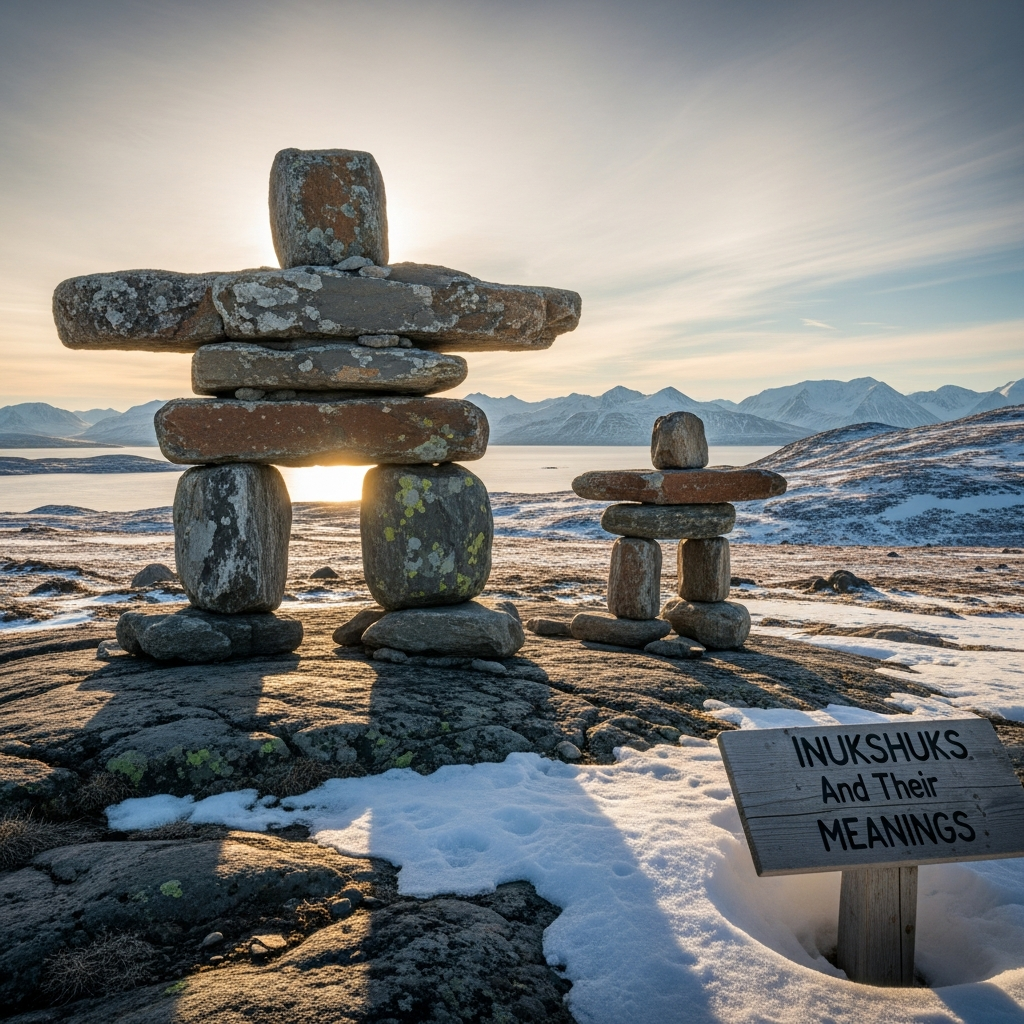
When you gaze across the vast, treeless landscapes of the Arctic, you may encounter solitary stone structures standing defiantly against the horizon. These are Inukshuks (singular: Inuksuk). More than just piles of rocks, these ancient icons serve as the “voice” of the Inuit people, communicating vital messages across generations and miles of frozen tundra.
In this comprehensive guide, you will explore the deep Inukshuk meanings, the cultural history of the Inuit people, and the practical functions of these stone landmarks. Whether you are a student of history, a traveler, or someone moved by their aesthetic beauty, understanding the significance of these structures is essential to appreciating the resilience of Arctic civilization.
What is an Inukshuk? Understanding the Basics
The word “Inuksuk” (often spelled Inukshuk) originates from the Inuktitut language. It is a compound of two words: inuk (person) and suk (substitute or acting in the capacity of). Therefore, the literal translation is “that which acts in the capacity of a human.”
Historically, these structures were built by the Inuit, the Inupiat, and other indigenous peoples of the Arctic regions of North America, including Alaska, Arctic Canada, and Greenland. Because the Arctic landscape can be disorienting—lacking trees and featuring repetitive snowy horizons—the Inukshuk became a vital tool for survival.
The Distinction Between Inuksuk and Inunguak
It is a common misconception that all stone structures in the Arctic are Inukshuks.
- Inuksuk: A traditional stone marker used for navigation or survival. It does not necessarily look like a person.
- Inunguak: A structure specifically built to resemble a human being (with a head, torso, arms, and legs). While these are popular in modern art and tourism, they were historically less common than the functional Inuksuk.
The Historical Context: Survival in the Frozen North
To understand Inukshuk meanings, you must first understand the environment that birthed them. The Arctic is one of the most unforgiving climates on Earth. For thousands of years, the Inuit relied on traditional knowledge to navigate thousands of kilometers of ice and rock.
In a land where a blizzard can erase all landmarks in minutes, the Inuksuk stood as a permanent record. They were built using the “natural geometry” of the land—utilizing the rocks available in the immediate vicinity. Because they were built to withstand the harshest winds, their construction was a feat of primitive engineering, relying on balance and gravity rather than mortar or glue.
5 Major Types of Inukshuks and Their Meanings
The Inuit utilized different configurations of stones to communicate specific messages. If you were traveling through the Arctic centuries ago, knowing these distinctions could mean the difference between life and death.
1. The Tikkuuti (The Pointer)
The Tikkuuti is perhaps the most practical form. These are often smaller structures or even simple stones laid in a specific direction.
- Meaning: They act as directional pointers.
- Function: If you see a Tikkuuti, it is pointing toward a significant location, such as a productive hunting ground, a nearby camp, or a safe travel route.
2. Niungvaliruluit (The Window)
These structures are unique because they contain a “window” or a hole created by the arrangement of the stones.
- Meaning: Alignment and focus.
- Function: When you look through the “window” of a Niungvaliruluit, it aligns with a distant point of interest, such as a mountain peak or another Inuksuk, helping travelers maintain a straight path over long distances.
3. Tupqujaq (The Doorway)
Resembling a literal doorway or a tall arch, the Tupqujaq is rare but highly significant.
- Meaning: Entrance or threshold.
- Function: These were often used to mark the entrance to a spiritual area or a particularly rich fishing spot.
4. Inuksummarik (The Great Inuksuk)
These are much larger than the average marker and are often placed on high ground.
- Meaning: Major landmark.
- Function: Because of their size, they are visible from many miles away. They serve as primary navigation hubs, signaling to travelers that they are on a major “highway” of the Arctic.
5. Inunguak (The Human Likeness)
As mentioned earlier, the Inunguak looks like a person.
- Meaning: Symbol of presence and remembrance.
- Function: Historically, they might have been used to mark the site of a significant event or a death. Today, they have become the universal symbol of Northern hospitality and the “spirit of the North.”
The Practical Functions: More Than Just Navigation
While navigation is the most cited reason for their existence, the meaning of Inukshuks extends into the logistics of Arctic life.
Hunting and Caribou Drives
The Inuit were master hunters. They used Inukshuks to assist in “caribou drives.” By placing a series of stone markers in a V-formation, they could trick caribou into thinking the stones were humans. The caribou would then move toward a specific area where hunters were waiting. In this context, the Inuksuk acted as a “decoy.”
Food Caches (Qimatulivik)
Finding food is difficult; storing it safely is even harder. Inukshuks often marked the location of a Qimatulivik, a stone-covered cache where meat (such as seal or walrus) was stored to protect it from scavengers like polar bears and foxes.
Messaging and Communication
An Inuksuk could tell you if a camp was recently occupied or if a certain area was dangerous. For example, an Inuksuk with an arm pointing toward the sea might indicate a good place for seal hunting, while one with a broken arm might warn of thin ice.
The Spiritual and Philosophical Meaning
Beyond survival, the Inukshuk carries a heavy spiritual weight. For the Inuit, these stones are a link to their ancestors. When you encounter an Inuksuk, you are encountering the work of someone who stood in that exact spot hundreds of years ago.
“You Are on the Right Path”
One of the most beautiful Inukshuk meanings is the message: “I was here, and you are on the right path.” It is a symbol of the interconnectedness of humanity. Even in the most isolated places on the planet, the Inuksuk reminds you that you are not alone. Someone has gone before you and has left a sign to ensure your safety.
Respect for the Land
The construction of an Inuksuk is a lesson in balance. It requires the builder to understand the weight, texture, and center of gravity of each stone. This reflects the Inuit philosophy of living in harmony with the environment—taking only what is needed and respecting the natural order.
The Inukshuk in Modern Culture
In the 21st century, the Inukshuk has moved beyond the Arctic and into the global consciousness. It is now a recognized symbol of Canada and indigenous pride.
- The 2010 Winter Olympics: The logo for the Vancouver 2010 Olympics, named “Ilanaaq” (meaning friend), was based on the Inukshuk. This brought the symbol to billions of viewers worldwide.
- The Flag of Nunavut: A red Inuksuk is the centerpiece of the flag of Nunavut, Canada’s largest and northernmost territory. It represents the guidance and direction provided by elders in the community.
- Global Art: You can now find Inukshuks in gardens, parks, and art galleries across the globe. However, this popularity comes with a responsibility to understand their origins.
How to Build an Inukshuk (The Ethical Way)
Many people are inspired to build their own stone structures. If you choose to do so, you should follow these guidelines to honor the tradition and the environment.
- Select Your Site Carefully: Never build an Inukshuk in a sensitive ecological area or a national park where “Leave No Trace” principles are in effect. Moving rocks can disrupt the habitats of small insects and plants.
- Find the Foundation: Start with a large, flat, and heavy base stone. The stability of the entire structure depends on this first choice.
- Find the Center of Gravity: As you stack stones, do not use glue or mortar. The beauty of an Inukshuk lies in its balance. Each stone must “find its place.”
- Consider the Purpose: Are you building it to mark a trail? To remember a loved one? Or simply as art? Keep that intention in mind as you work.
- Respect Indigenous Ownership: Always acknowledge that the Inukshuk is a gift of Inuit culture. It is not merely a “rock stack” but a sacred cultural expression.
Expert Tips for Understanding Inukshuks
- Look for Lichen: If you see an Inuksuk covered in thick, orange or black lichen, it is likely very old. Lichen grows extremely slowly in the Arctic, so its presence is a sign of an ancient “elder” of the stone world.
- Study the Arms: In traditional navigation, the length of the arms or the direction they point often correlates to specific landmarks. A longer right arm might point to a specific village.
- Don’t Knock Them Down: In Inuit culture, destroying an Inuksuk is considered a grave offense. It is akin to destroying a road sign or a historical monument.
Common Misconceptions About Inukshuks
To truly understand Inukshuk meanings, you must look past the tourist souvenirs.
- Misconception 1: They are all religious. While they have spiritual significance, most Inukshuks were highly practical tools for hunting and navigation.
- Misconception 2: They are just “Inuit Art.” While they are artistic, their primary identity is that of a communication system.
- Misconception 3: Anyone can build them anywhere. While stone stacking is a global hobby, the specific form of the Inuksuk belongs to the Arctic indigenous peoples. Building them in non-Arctic environments is often seen as “cairn building” rather than creating a true Inuksuk.
Frequently Asked Questions (FAQ)
What does an Inukshuk symbolize?
An Inukshuk symbolizes safety, hope, friendship, and the presence of a human spirit in a vast landscape. It communicates that “you are on the right path.”
Is it Inuksuk or Inukshuk?
Both are used, but “Inuksuk” is the more accurate spelling in the Inuktitut language. “Inukshuk” is the common English phonetic spelling.
Why do some Inukshuks look like people?
These are called Inunguak. They were often built to represent a person who died or to mark a place of great significance. They became more popular as symbols of friendship in modern times.
Are Inukshuks only found in Canada?
No. While they are a national symbol of Canada, they are found across the entire Arctic Circle, including Alaska (USA), Greenland, and parts of Northern Russia.
What is the difference between a cairn and an Inukshuk?
A cairn is a general term for a man-made pile of stones found worldwide. An Inukshuk is a specific type of stone structure unique to Arctic indigenous cultures, possessing specific meanings and functions.
Conclusion: The Legacy of the Stones
The Inukshuk is a testament to human ingenuity. It proves that even in the most barren and difficult environments, humans will find a way to communicate, to help one another, and to leave a lasting mark.
By understanding Inukshuk meanings, you gain a deeper appreciation for the Inuit culture and the universal human desire to guide those who follow in our footsteps. The next time you see one of these silent sentinels—whether in the high Arctic or in a local park—remember the message it carries: You are not alone, and the path ahead is marked for you.