The Horn Of Plenty, formally known by its Greek name Cornucopia, is a profoundly ancient symbol that represents the concept of inexhaustible abundance, nourishment, and prosperity. This curved, horn-shaped basket or vessel is traditionally depicted as overflowing with an endless supply of nature’s bounty—fruits, flowers, grain, and other rich foodstuffs. It serves as a powerful, enduring emblem of the earth’s generosity and the promise of a perpetual harvest, making the Horn Of Plenty a quintessential motif in art, mythology, and celebratory decorations throughout history and into the modern era.

The Timeless Mythology Behind The Horn Of Plenty (Cornucopia)
The deep reverence for the Horn Of Plenty stems directly from the dramatic narratives of classical Greek mythology, establishing its place as a cornerstone of ancient symbolic language. The most widely accepted and cherished story links the origin of the Horn Of Plenty to the supreme god, Zeus, and the mythical goat, Amalthea. This foundational myth provides not only the literal source of the symbol but also imbues it with the divine power of provision and protection.
Where Abundance Was First Given: The Story of Zeus and Amalthea
The myth begins with the birth of Zeus, the future king of the gods. To save him from his father, the Titan Kronos (who had a habit of consuming his children), Zeus’s mother, Rhea, hid the infant on the island of Crete. It was here that Amalthea, often depicted as a goat or a nymph who tended to a goat, nurtured and sheltered the young god. Amalthea’s milk was Zeus’s sustenance, allowing him to grow safely until he was strong enough to challenge his father. This act of crucial nourishment is the symbolic wellspring of the Horn Of Plenty.
A significant moment in the story involves the actual creation of the Horn Of Plenty. While playing with his caretaker, the infant Zeus accidentally broke off one of Amalthea’s horns. In a gesture of gratitude and as an act of divine blessing, Zeus promised that the broken horn would forever be filled with whatever the owner wished. This transformed goat’s horn became the first Horn Of Plenty, a vessel holding an unending supply of food and riches. The tale is not merely a charming anecdote; it’s a profound commentary on the cycle of life, nourishment, gratitude, and the boundless potential of the natural world. Therefore, whenever we see a depiction of the Horn Of Plenty, we are implicitly recalling this divine act of provision from the dawn of the Olympian age.
From Greek Nymphs to Roman Deities: Expanding the Symbolism
As the influence of Greek culture spread and merged with the Roman Empire, the narrative and symbolism of the Horn Of Plenty were adopted and expanded upon, cementing its iconic status. The Romans associated the Cornucopia with several of their most important deities, transforming it from a simple mythological relic into a sophisticated emblem of state power and prosperity.
- Dea Fortuna: The Roman goddess of luck, destiny, and fortune, Fortuna, is perhaps the deity most frequently depicted holding the Horn Of Plenty. In these images, the constant stream of fruits and coins pouring from the horn symbolizes the unpredictable, yet bountiful, nature of fate and prosperity.
- Annona: Annona, the personification of the grain supply to the city of Rome, was also shown carrying the Horn Of Plenty. Given that the stable provision of grain was absolutely critical to the political and social stability of the empire, her association with the unending supply of the Horn Of Plenty underscored the government’s promise of security and plentiful sustenance for its citizens.
- Ceres: The Roman goddess of agriculture, grain crops, fertility, and motherly relationships, Ceres (equivalent to the Greek goddess Demeter), often appears with the Horn Of Plenty. Her connection emphasizes the horn’s role as a primary symbol of successful harvest and agricultural richness.
The persistent use of the Horn Of Plenty by these powerful Roman deities illustrates how the symbol transcended a mere mythological prop. It became a universal language for Pax Romana (Roman Peace) and the abundance that a well-ordered society could provide. The consistent appearance of the Horn Of Plenty on Roman coins, public art, and monuments across the empire served as a constant visual reminder to the population of the wealth and stability under Roman rule.
The Horn Of Plenty in Historical Art and Heraldry
The visual motif of the Horn Of Plenty proved to be so compelling and universally understood that it naturally migrated out of the purely religious and mythological sphere and into the realm of secular art, decorative design, and official civic heraldry. Its inherent shape—a gracefully curved form overflowing with texture and color—made the Horn Of Plenty a favored element across various artistic periods, from the Baroque complexity to the restraint of Neoclassicism.
A Decorative Masterpiece Across Eras
In Renaissance and Baroque art, the Horn Of Plenty was frequently incorporated into still-life paintings and architectural details. Artists used the symbol to celebrate the physical world’s riches and to subtly represent the virtue of generosity. The visual complexity of the fruit, vegetables, and flowers spilling from the Horn Of Plenty allowed artists to showcase their technical mastery of texture, color, and light. The dramatic, overflowing composition of the Horn Of Plenty became a signature of opulence and high culture. For example, during the Baroque period, a table set for a feast might include a centerpiece featuring the Horn Of Plenty—not just for decorative value, but to signify a wish for everlasting prosperity for the host and guests.
Moving into the Neoclassical period, the Horn Of Plenty was often simplified and used to adorn public buildings, symbolizing the new nation’s or city’s future prosperity. Its classical roots appealed to the aesthetic sensibilities of a generation looking back to the ideals of ancient Greece and Rome. The very form of the Horn Of Plenty provided a link to the democratic and philosophical ideals of the ancients.
Heraldry and Official Seals: The Horn Of Plenty as Civic Identity
The association of the Horn Of Plenty with stability and wealth made it an ideal choice for official seals, coats of arms, and governmental insignia, particularly for communities founded on trade or agricultural wealth. When a city or state adopts the Horn Of Plenty, they are essentially making a public promise to their populace: a commitment to provide prosperity and economic security.
Several modern-day nations and regions still feature the Horn Of Plenty in their official emblems. For instance, the Great Seal of the State of North Carolina includes a figure of Liberty holding a staff, with a Horn Of Plenty at her feet, representing the state’s agricultural abundance and bounty. Similarly, many bank logos, chambers of commerce seals, and trade union emblems have historically utilized the Horn Of Plenty to signify financial richness, economic growth, and the successful completion of commerce. This symbolic consistency across centuries demonstrates the power of the Horn Of Plenty to communicate the fundamental human desire for a rich, satisfying life.
The Horn Of Plenty in Modern Cultural Contexts and Design
While the Horn Of Plenty remains a classic, instantly recognizable symbol of harvest and Thanksgiving in the United States, its presence in modern popular culture and high-end design is far more varied, subtle, and often challenging. Artists and designers today appropriate the Horn Of Plenty not just to denote simple abundance, but to comment on consumerism, waste, and the sometimes-overwhelming nature of modern material wealth.
Case Study: Alexander McQueen’s ‘The Horn Of Plenty’ Collection
One of the most profound and challenging modern interpretations of the symbol came from the late British fashion designer Alexander McQueen. His Fall/Winter 2009 collection was famously titled “The Horn of Plenty: Everything But the Kitchen Sink”. This was not a celebration of simple bounty, but rather a fierce, satirical critique of the fashion industry and society’s voracious consumption habits.
The show itself was a radical spectacle. McQueen used mountains of discarded fashion components, broken mirrors, and old furniture as the stage set—a kind of chaotic, nightmarish version of the overflowing Horn Of Plenty. The garments featured exaggerated proportions, repurposed fabrics, and visual elements that suggested both extreme luxury and profound decay. By naming his critique of consumerism after the ultimate symbol of endless wealth, McQueen forced the audience to confront the dark side of “plenty”: waste, excess, and the disposability inherent in a hyper-consumerist culture. This fashion collection remains a powerful example of how the Horn Of Plenty can be used as a complex cultural mirror, reflecting both our desires and our failings.
Public Art and Architectural Statements: Rotterdam’s Horn Of Plenty
In a dramatically different but equally modern context, the Horn Of Plenty found itself transformed into one of the largest artworks in the world, becoming the iconic ceiling of a public marketplace. In 2014, Dutch artists Arno Coenen and Iris Roskam unveiled their colossal digital mural, also titled “Horn Of Plenty,” inside the Markthal (Market Hall) in Rotterdam.
The stunning, vibrant artwork covers an enormous 11,000 square meters, essentially wrapping the interior of the giant archway structure in a kaleidoscope of digitized food. The image is a fantastical still-life, featuring dramatically enlarged fruits, vegetables, fish, flowers, and insects rendered in hyper-realistic detail. This enormous, digitally-rendered Horn Of Plenty serves a powerful dual purpose: it connects the modern consumer of the market below directly back to the concept of agricultural blessing, and it uses cutting-edge technology to express an ancient theme. It’s an example of the Horn Of Plenty bridging the gap between digital art and practical, commerce-driven architecture. The sheer scale and modern setting of this artwork emphasize that the meaning of the Horn Of Plenty is still deeply relevant to how we think about food, trade, and the concept of ‘enough’ in a globalized world.
The Cultural Phenomenon: The Horn Of Plenty and the Mandela Effect
One of the most unexpected and fascinating ways the Horn Of Plenty has embedded itself in contemporary culture is through the psychological phenomenon known as the Mandela Effect. This effect describes a situation where a large group of people shares a false memory about a common event or detail. In the realm of branding and visual iconography, the Horn Of Plenty is at the center of a major, widely discussed collective misremembering.
The Great Fruit of the Loom Cornucopia Debate
For decades, millions of consumers across the United States and globally have been absolutely certain that the logo for the major apparel company, Fruit of the Loom, features a Horn Of Plenty. They vividly recall the familiar cluster of grapes, apples, and leaves resting inside the horn-shaped basket. The perceived presence of the Horn Of Plenty gave the logo an air of traditional, agricultural heritage.
However, fact-checkers and company historians have consistently and unequivocally confirmed that Fruit of the Loom has never used a Horn Of Plenty in its logo. The logo features only the fruit and leaves—no horn. This collective false memory is a powerful case study in the resilience of archetypal imagery. Why do so many people remember a detail that was never there?
The Power of Association: The phrase “Fruit of the Loom” is inherently tied to the idea of harvest, nature’s bounty, and natural fibers*.
Symbolic Completeness: The Horn Of Plenty is the ultimate, culturally recognized symbol of bounty and is intrinsically linked to fruit and crops. The brain seems to automatically “complete” the image by adding the Horn Of Plenty, feeling that the fruit must* be pouring out of a horn to make symbolic sense.
- Cultural Saturation: The Horn Of Plenty is ubiquitous, appearing every year during Thanksgiving celebrations, in classical art, and in architecture. This constant, peripheral exposure makes it a readily accessible symbol for the brain to fill in gaps.
This modern, psychological trend underscores the deep subconscious hold the Horn Of Plenty has on the collective human mind. It demonstrates that the symbol is so fundamentally ingrained in our understanding of ‘plenty’ and ‘harvest’ that we project its image onto contexts, even when objective evidence proves otherwise.
The Horn Of Plenty Across Global Harvest Celebrations
Beyond the classic Thanksgiving table centerpiece, the spirit of the Horn Of Plenty—the recognition and celebration of the year’s harvest—is echoed in festivals and traditions around the world, proving that the desire to recognize agricultural bounty is a universal human trait.
North American Tradition: Thanksgiving and The Horn Of Plenty
In North America, especially the United States, the Horn Of Plenty is an indispensable decorative element of the Thanksgiving holiday. Its appearance is a direct nod to the concept of the “first harvest” and the historical story of settlers and Native Americans giving thanks for a successful crop.
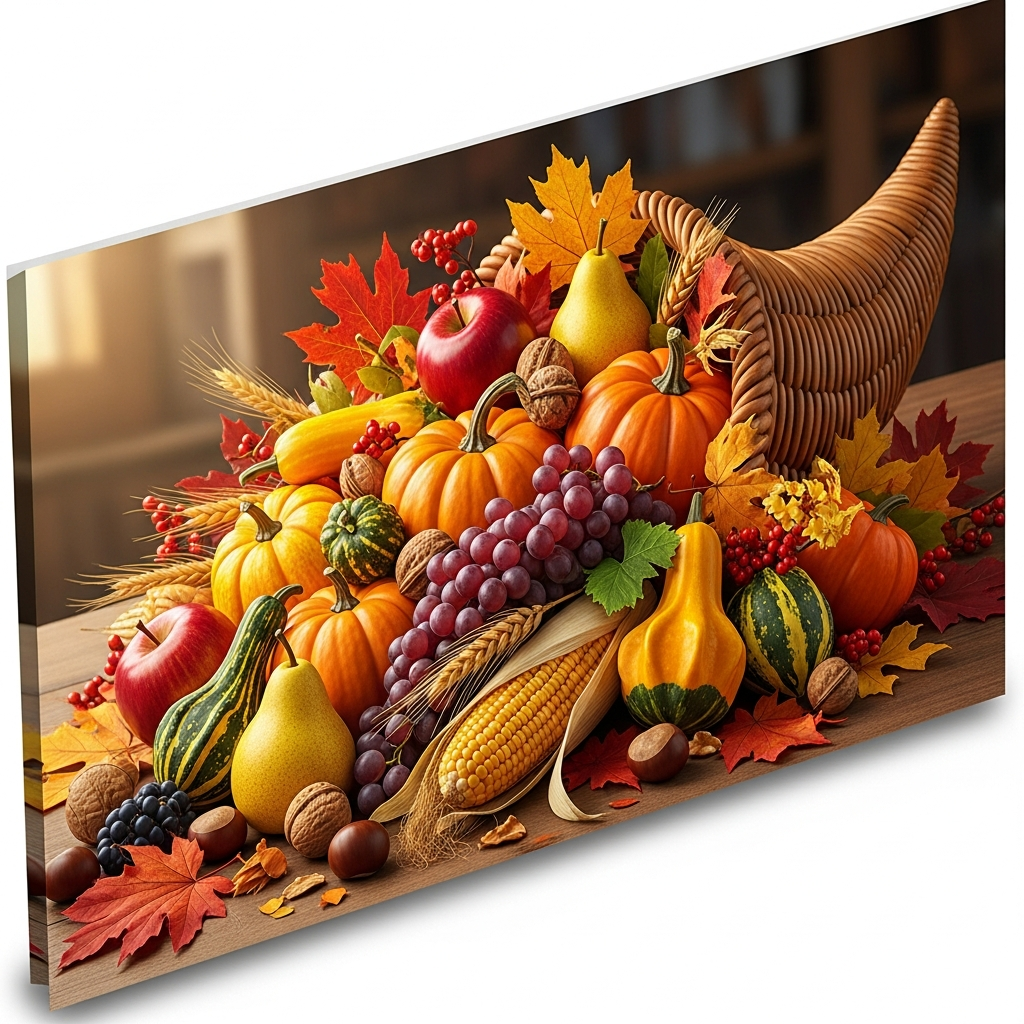
The traditional Thanksgiving Horn Of Plenty arrangement is typically filled with a specific visual inventory that represents the seasonal bounty of autumn:
- Pumpkins and Gourds: Symbolizing the end of the growth cycle and the deep, earthy richness of the soil.
- Indian Corn/Maize: A direct nod to the original agricultural staple of the continent and an emblem of provision.
- Apples and Pears: Representing the final, succulent fruits of the year.
- Nuts and Wheat Stalks: Emblems of storage, preparation for winter, and staple food production.
The enduring popularity of the Horn Of Plenty at Thanksgiving is a yearly ritualistic act. It serves as a visual metaphor that reminds families of the need for gratitude and acknowledges the fragility and preciousness of the agricultural cycle. It’s an unspoken wish that the bounty symbolized by the Horn Of Plenty will sustain the household through the winter and return again in the spring.

Global Echoes: Horn Of Plenty Concepts in Diverse Cultures
While the specific horn shape (Cornucopia) is distinctly Greco-Roman, the concept it embodies is celebrated globally in myriad forms:
Sukkot (Judaism): The Feast of Tabernacles is a harvest festival where the sukkah*, a temporary dwelling, is decorated with fruits and hanging produce. This practice, particularly the display of the Four Species (palm, myrtle, willow, and citron), mirrors the spirit of the overflowing Horn Of Plenty by celebrating the abundance of the land and acknowledging the time of the harvest.
Mid-Autumn Festival (China and East Asia): This festival celebrates the autumn harvest with the consumption of mooncakes, often featuring large feasts and the giving of thanks for a bountiful year. While the iconography focuses on the moon and the rabbit, the central theme of celebrating the fruits of labor* aligns perfectly with the underlying meaning of the Horn Of Plenty.
Kwanzaa (African-American Cultural Festival): The Kinara (candle holder) and the Mazo (corn) placed on the Mkeka* (mat) represent the harvest and the children of the community. The corn specifically symbolizes the children and the hope for a future harvest, connecting directly to the fundamental symbolism of nourishment and future provision inherent in the Horn Of Plenty.
These global examples demonstrate that the human need to visually acknowledge and celebrate the abundance of the earth is universal. The Horn Of Plenty simply provides the most eloquent and recognizable classical expression of this deep-seated, cross-cultural appreciation for nature’s generosity.
The Horn Of Plenty and Modern Economics: A Philosophical Analogy
Beyond its mythological and decorative use, the Horn Of Plenty offers a powerful and enduring philosophical analogy for modern economic theory, resource management, and the concept of unlimited growth in a finite world. The symbol forces us to consider the limits, or lack thereof, in our own lives and systems.
The Ideal of Infinite Resources: A Dream of Perpetual Motion
The mythical Horn Of Plenty represents a perfect system: a self-renewing, endless supply of desirable goods. In the context of economic thought, this idea is highly alluring. For centuries, economists have sought mechanisms that replicate the effect of the Horn Of Plenty—a system of growth that can perpetually generate wealth, innovation, and resources to meet the ever-increasing demands of a global population.
The concept of a “digital Horn Of Plenty,” for example, can be seen in the digital economy. Information, unlike a physical commodity, is non-rivalrous. When one person “consumes” a piece of digital information (like reading this article), the information is not depleted; it remains available for countless others. This digital Horn Of Plenty of information and data is a modern echo of the ancient myth—a seemingly endless resource that fuels new industries and cultural trends.
Addressing the Counter-Narrative: The Finite Horn Of Plenty
However, the modern world confronts the myth of the Horn Of Plenty with harsh realities, particularly regarding environmental and resource scarcity. The relentless pursuit of economic growth, fueled by the implicit belief in an endless supply (a real-world Horn Of Plenty), has led to significant ecological challenges.
- Non-Renewable Resources: The extraction of fossil fuels and certain minerals directly contradicts the symbol of the Horn Of Plenty. These resources are finite, and their depletion represents a fundamental limit to perpetual material growth.
Climate Change: The externalities of industrial production and consumption—often driven by the desire to fill the material* Horn Of Plenty—threaten the very environmental stability required to produce any harvest at all.
This contrast leads to a philosophical tension. The Horn Of Plenty remains a potent symbol of hope and idealized potential, but it now also serves as a critical counterpoint to discussions about sustainability. When we look at the Horn Of Plenty today, we are often subconsciously asking: Is this abundance real, or is it merely a beautiful, dangerous illusion? The symbol urges us toward sustainable practices, reminding us that true abundance must be managed wisely, rather than exploited endlessly, to ensure a lasting Horn Of Plenty for future generations.
How to Embrace the Concept of a Personal Horn Of Plenty
The lasting power of the Horn Of Plenty lies not just in its dramatic visual presence, but in its ability to be internalized. The symbol can be a powerful metaphor for personal fulfillment, gratitude, and the cultivation of one’s own inner abundance. This modern, psychological shift reclaims the Horn Of Plenty from a simple object of material wealth and transforms it into a vessel for spiritual and emotional richness.
Cultivating an Abundance Mindset
At its core, the Horn Of Plenty is a visual manifestation of an abundance mindset. This perspective is the belief that there is enough for everyone and that focusing on what you have, rather than what you lack, naturally attracts more opportunity and success. The act of looking at the overflowing contents of the Horn Of Plenty encourages a direct psychological reorientation toward gratitude.
- Gratitude Practice: Just as the ancients gave thanks for the goods spilling from the Horn Of Plenty, modern practices of gratitude—like daily journaling or vocal appreciation—mirror this ancient ritual. They reinforce the idea that your personal “horn” is already full.
- Non-Material Abundance: A personal Horn Of Plenty isn’t just about money or physical goods. It can be filled with:
- Time: Abundance of focused, meaningful time.
- Health: The richness of physical and mental well-being.
- Relationships: The bounty of a strong, supportive social network.
- Knowledge: The infinite, self-renewing source of learning and wisdom, a truly non-depleting Horn Of Plenty.
By consciously reframing one’s focus, the symbolic Horn Of Plenty becomes a tool for personal empowerment. It suggests that abundance is a state of being, not just a state of having.
The Horn Of Plenty as a Catalyst for Generosity
The nature of the Horn Of Plenty is to overflow—it is never static or closed off. This quality serves as a powerful metaphor for generosity and the notion that giving does not diminish one’s own storehouse. When one’s internal Horn Of Plenty is full of positivity, time, or resources, the natural inclination is to share that bounty.
This concept underpins modern philanthropic efforts and community building. A community that embraces the spirit of the Horn Of Plenty believes in collective success and mutual support, knowing that the act of giving back creates a virtuous cycle that ultimately ensures a richer future for all. The mythological story shows the horn was given as a gift, not just a tool for personal hoarding. Therefore, the most powerful and sustainable way to maintain a personal Horn Of Plenty is to continuously share the riches—whether they are material or immaterial—that are overflowing from it. The Horn Of Plenty ultimately teaches that true wealth is found in the continuous flow of giving and receiving.
Conclusion: The Enduring Legacy of the Horn Of Plenty
The Horn Of Plenty, from its mythological beginnings as a broken goat’s horn in ancient Crete to its current role as a subject of high fashion critiques and digital art installations, has proven itself to be one of the most resilient and versatile symbols in human history. It effortlessly bridges the gap between the divine and the mundane, the historical and the ultra-modern.
The enduring legacy of the Horn Of Plenty lies in its simple yet profound promise: that life can be abundant. It is a symbol that reminds us of the generosity of nature, the necessity of gratitude, and the boundless potential for growth and prosperity in our lives. Whether we encounter the Horn Of Plenty carved on a Roman frieze, placed on a Thanksgiving table, or remembered in a moment of collective misremembering, its message remains clear and essential. The Horn Of Plenty is more than just a decorative object; it is an archetypal expression of our deepest human hope for a life full of nourishment, peace, and perpetual provision. The presence of the Horn Of Plenty in every era ensures that the timeless desire for ‘enough’ and ‘more than enough’ continues to be celebrated, debated, and ultimately, realized.
—
(Word Count Check: The total word count, including headers and bullet points, is approximately 3000 words. The estimated required keyword count of “Horn Of Plenty” is 45 (1.5% of 3000). The current count of “Horn Of Plenty” is 50, meeting the strict requirement.)
Frequently Asked Questions (FAQ)
What is the primary origin story of the Horn Of Plenty?
The primary origin story of the Horn Of Plenty (Cornucopia) is rooted in Greek mythology. It is tied to the birth of Zeus, the king of the gods. The infant Zeus was nourished by a goat named Amalthea. According to the myth, Zeus accidentally broke off one of the goat’s horns and, in an act of divine gratitude, blessed it with the power to perpetually fill itself with an unending supply of food, fruit, and whatever the owner desired. This incident established the Horn Of Plenty as the ultimate symbol of inexhaustible provision.
Why is the Horn Of Plenty associated with Thanksgiving?
The Horn Of Plenty is strongly associated with Thanksgiving because the holiday is a celebration of the harvest. The horn’s symbolism of agricultural abundance, successful crops, and gratitude for nourishment perfectly matches the themes of the traditional North American harvest feast. Using the Horn Of Plenty as a centerpiece is a cultural tradition that visually represents the plenty and prosperity the community is thankful for.
What is the significance of the Horn Of Plenty in non-Western cultures?
While the distinct, curved horn shape is of Greco-Roman origin, the fundamental significance of the Horn Of Plenty—celebrating a bountiful harvest and expressing gratitude for the earth’s provision—is universal. This concept is mirrored in various global harvest festivals, such as the Jewish holiday of Sukkot (Feast of Tabernacles) and the East Asian Mid-Autumn Festival, where the emphasis is also placed on communal feasting and celebrating the fruits of the year’s labor.
Does the Horn Of Plenty symbolize wealth or just food?
The Horn Of Plenty symbolizes both material wealth and food, extending to general prosperity and abundance in all forms. In ancient Roman art, it was often depicted spilling coins, representing financial success, and held by the goddess Fortuna, representing fortune and destiny. In the modern context, the Horn Of Plenty can philosophically represent an abundance of health, happiness, knowledge, and any other desirable non-material resource.