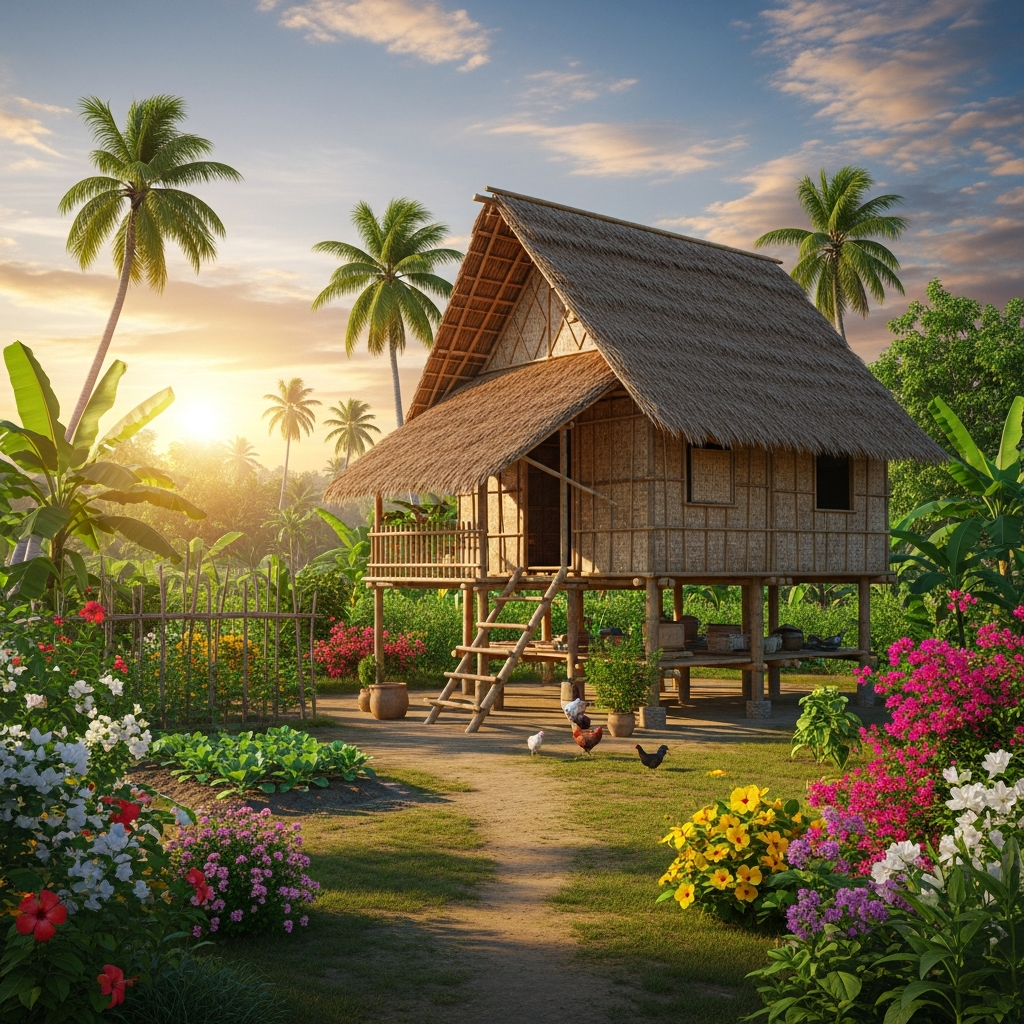
The Bahay Kubo is the undisputed national house of the Philippines, an architectural masterpiece that embodies the Filipino spirit of resilience, community, and harmony with nature. More than just a simple hut, the Bahay Kubo is a profound cultural icon, a testament to ingenious vernacular design perfectly adapted to the tropical climate and environmental challenges of the archipelago. This traditional dwelling, often built from readily available and highly sustainable materials like bamboo and nipa palm, stands elevated on stilts, a crucial feature designed to mitigate the risks of flooding and to provide natural ventilation.
*
What is a Bahay Kubo?
A Bahay Kubo, literally translating to “cube house” or “country house,” is the quintessential traditional Filipino dwelling. It is recognized by its lightweight materials, raised flooring, and characteristic pyramid-shaped roof, all designed for maximum airflow and comfort in a hot, humid environment.
The genius of the traditional Bahay Kubo lies in its sophisticated simplicity. For generations, this design has been the standard dwelling among nearly all lowlanders across the entire Philippines, serving not merely as a structure but as a central figure in Filipino identity. Its widespread presence and timeless design solidify the Bahay Kubo as a cultural anchor, providing a tangible link to the country’s rich pre-colonial history and architectural heritage. The fundamental structure of the Bahay Kubo demonstrates an intimate understanding of tropical weather patterns, a knowledge passed down through centuries.
The typical traditional Bahay Kubo utilizes a handful of specific natural components, ensuring the structure is easy to build, maintain, and replace after calamities. These houses are generally elevated from the ground, sometimes by a meter or more, and employ a simple, rectangular floor plan. Crucially, the roof is traditionally steeply pitched, covered with thick layers of nipa or cogon grass, which acts as a phenomenal natural insulator, effectively absorbing the day’s heat and keeping the interior of the Bahay Kubo cool. This design principle minimizes the need for modern cooling systems.
Furthermore, the materials used for building a Bahay Kubo are overwhelmingly biodegradable and sourced locally, making the home intrinsically eco-friendly. Unlike modern houses that rely heavily on energy-intensive concrete and steel, a classic Bahay Kubo is an example of pure, sustainable living. The flexibility of bamboo, the primary load-bearing material, also gives the Bahay Kubo a degree of seismic resilience, allowing it to sway rather than snap during minor earthquakes—a necessary feature in a tectonically active region. The aesthetic of the simple Bahay Kubo also fosters a certain lifestyle, encouraging communal interaction and a close relationship with the surrounding natural landscape.
*
The Unbeatable Tropical Architecture of the Bahay Kubo
The architectural elements of the Bahay Kubo are not arbitrary but are carefully calibrated responses to the tropical climate, a model of bio-climatic design long before the term became popular in contemporary architecture.
Raised Floor (The Silong)
The most distinctive feature of the Bahay Kubo is its elevation, resting on sturdy posts or stilts, creating a void underneath known as the silong. The purpose of this elevated design is multifaceted and critical for survival and comfort in the Philippines.
Benefits of the Elevated Bahay Kubo Structure:
- Flood Protection: The primary function is to protect the house and its inhabitants from rising floodwaters, a frequent occurrence during the monsoon and typhoon seasons. By raising the living area, the Bahay Kubo remains habitable even when the ground below is inundated.
Natural Air Conditioning: The silong* creates an open space where air can freely circulate. This continuous airflow beneath the house cools the floorboards, which in turn cools the entire main living area, acting as a natural buffer against ground heat. This mechanism is a key component of the Bahay Kubo’s renowned natural ventilation.
Storage and Utility Area: The shaded silong* is an invaluable utility space. It is traditionally used to shelter livestock, store farming tools, dry harvests, or even serve as an informal communal area for social gatherings. This dual-purpose use highlights the ingenuity of the Bahay Kubo design, making every part functional.
This foundation design teaches a powerful lesson in climate-responsive building. A modern home attempting the same cooling effect would rely on costly, high-energy mechanical systems, whereas the traditional Bahay Kubo achieves it purely through passive design and the physics of air convection. The difference in environmental impact and operating cost over a year is staggering, proving that the ancient design of the Bahay Kubo is a truly energy-efficient blueprint.
Openness and Ventilation (The Dingding and Bintana)
Ventilation in a Bahay Kubo is achieved through generous, well-placed openings and permeable walls, designed to maximize cross-ventilation.
The walls, or dingding, are traditionally made from woven bamboo strips (sawali) or nipa palm, which are lightweight and somewhat permeable. The windows, or bintana, are the true marvel of the Bahay Kubo when it comes to regulating airflow and light. These are often massive, allowing for a substantial amount of daylight and breeze to enter. The traditional bintana often features:
- Sliding or Swing-Out Panels: Unlike fixed-pane windows, these can be opened fully to welcome the slightest breeze, and just as quickly closed during strong rains or at night.
- A “Ventilation Strip”: Many older Bahay Kubo designs include a permanent gap near the roofline, a small but essential feature that allows hot air—which naturally rises—to escape continuously, preventing the living area from becoming stifling.
This combination of permeable walls and adaptable, large windows ensures that the interior of the Bahay Kubo remains naturally cool and bright throughout the day, significantly reducing the reliance on electric lighting and air conditioning. A comparison to a typical contemporary concrete house reveals the Bahay Kubo’s superiority in passive cooling; a concrete box traps heat, requiring significant energy consumption, while the traditional Bahay Kubo is designed to breathe, effectively shedding heat as quickly as it absorbs it.
The Kitchen and Porch (The Batalan)
Another crucial component of the Bahay Kubo is the batalan, which serves as a utility extension, essentially the wash area and the traditional location for the kitchen. This area is often attached to the main structure but slightly separated, typically covered by the extended roof eaves.
The batalan is a prime example of hygiene and fire safety considered within the Bahay Kubo design. The separation of the kitchen, which involves cooking with open flame, reduces the risk of fire spreading to the main living quarters, which are constructed primarily of highly flammable materials like bamboo and thatch. Moreover, the batalan acts as a transitional space, where one can wash up before entering the main house, ensuring cleanliness. This thoughtful inclusion further illustrates how the design of the Bahay Kubo is a complete, holistic system, addressing not just structural integrity but also lifestyle and safety. The very presence of this separated, functional space contributes to the overall relaxed and easy flow of life within the traditional Bahay Kubo.
*
The Economic and Cultural Resilience of the Bahay Kubo
The Bahay Kubo is an economic marvel, offering a path to homeownership that is both accessible and environmentally conscious.
Cost-Effectiveness and Accessibility
One of the most compelling aspects of the traditional Bahay Kubo is its minimal economic barrier to entry. Because the materials are locally sourced and often collected from the immediate environment, the labor is frequently communal, a demonstration of the Bayanihan spirit.
Estimated Cost of a Simple Bahay Kubo:
The construction cost for a simple, traditional Bahay Kubo (approximately 50 square meters) can range from 250,000 Pesos to 350,000 Pesos. This range is remarkably affordable when compared to the starting costs of a similar-sized modern house built with concrete and steel, where foundation and material expenses alone can easily exceed this amount.
The affordability of the Bahay Kubo makes it a powerful model for solving housing needs in rural areas and among low-income families. Furthermore, the construction of a Bahay Kubo supports local economies and traditional craftsmanship. The skills required—such as working with bamboo, knotting, and weaving nipa—are indigenous knowledge, passed down through generations. Building a new Bahay Kubo is thus an act of cultural preservation, ensuring that these vital skills remain alive and relevant. The simplicity of construction also means that a basic Bahay Kubo can be built relatively quickly, providing rapid shelter solutions when needed.
The Bayanihan Spirit and the Bahay Kubo
The Bahay Kubo is intrinsically linked to the concept of Bayanihan, the Filipino value of communal unity and cooperation. The most famous depiction of Bayanihan is the act of literally moving a neighbor’s Bahay Kubo from one location to another.
In the past, when a family needed to relocate their home, the men of the community would gather to lift the entire Bahay Kubo structure—stilts and all—onto their shoulders and carry it to its new location. This incredible act of physical labor, performed purely out of goodwill and community support, illustrates the following:
- Lightweight Construction: The fact that an entire house could be physically carried demonstrates the intelligent use of lightweight materials in the traditional Bahay Kubo. This ease of movement was essential for a people who needed to adapt quickly to changing landscapes or escape danger.
- Cultural Fabric: The Bayanihan act surrounding the Bahay Kubo transformed the structure into a communal asset, not just a personal one. It reinforced social bonds and mutual responsibility, making the Bahay Kubo a living symbol of Filipino identity.
No other structure so perfectly embodies this core Filipino value. The Bahay Kubo is thus more than wood and thatch; it is a repository of shared heritage and a physical representation of profound social capital.
*
The Modern Revival of the Bahay Kubo
In the contemporary Philippines, there is a fascinating and accelerating trend of rediscovering and reimagining the Bahay Kubo for modern, urban, and sustainable living. Modern Filipino architects are not abandoning the Bahay Kubo, but rather elevating its core principles—sustainability, climate-responsiveness, and resourcefulness—to create “Tropical Modern” homes.
Fusing Tradition with Contemporary Design
The new wave of Bahay Kubo design retains the essential form and function of the original while integrating modern construction materials and sophisticated engineering.
Key Features of the Modern Bahay Kubo:
| Traditional Bahay Kubo Feature | Modern Bahay Kubo Adaptation |
| :— | :— |
| Nipa/Cogon Roof | Insulated metal roofing or green roofs; pitched roof form maintained for heat shedding. |
| Bamboo/Nipa Walls | Glass louvers, concrete siding mixed with bamboo elements, or sawali paneling for aesthetic. |
| Stilts (Silong) | Concrete or steel columns; the silong becomes an elevated first floor or car park. |
| Open Windows (Bintana) | Extensive sliding glass doors and operable louvers for enhanced airflow and hurricane resistance. |
Architects are finding creative ways to incorporate the traditional aesthetics and functional elements of the Bahay Kubo without sacrificing comfort, security, or longevity. For example, the use of locally sourced wood is often combined with elements like concrete or metal to improve the structural integrity of the modern Bahay Kubo and its ability to withstand extreme weather. The goal is to capture the airy, naturally lit environment of the traditional Bahay Kubo while meeting the durability demands of 21st-century construction.
A Focus on Sustainability and Permaculture
The revival of the Bahay Kubo is deeply rooted in a growing global and local movement toward sustainable architecture. The design of the Bahay Kubo is a natural fit for permaculture principles—a system of agricultural and social design focused on simulating or directly utilizing the patterns and resilient features observed in natural ecosystems.
The traditional Bahay Kubo design inherently embodies:
- Zero-Carbon Footprint: Its natural materials require minimal processing and emit very little carbon compared to cement production.
- Water Management: The raised structure and steep roof of the Bahay Kubo facilitate easy rainwater harvesting and management, an essential feature for both dry seasons and heavy monsoons.
- Reduced Energy Demand: The natural ventilation and insulation drastically lower the need for electricity for cooling, making a modern Bahay Kubo an incredibly low-energy home.
The contemporary push for building energy-efficient houses in the Philippines strongly favors the principles of the Bahay Kubo. Modern Bahay Kubo projects are often pioneering the use of renewable energy sources, such as solar panels integrated into the roof structure, creating homes that are completely off-grid or energy-positive. This modern iteration of the Bahay Kubo proves that indigenous architecture can be a blueprint for a healthier, more sustainable future for the nation. The enduring legacy of the Bahay Kubo is its ability to teach us how to live in harmony with our climate, rather than fighting against it.
The Future of the Bahay Kubo
The journey of the Bahay Kubo from a humble rural dwelling to a celebrated national symbol and a model for sustainable urban design is a story of powerful cultural endurance. The principles of the Bahay Kubo—simplicity, efficiency, and climatic adaptability—are now more relevant than ever in the face of environmental changes and urbanization. Whether simple and traditional, built for P250,000, or a sleek, multi-million-peso “Tropical Modern” mansion, the heart of the Bahay Kubo remains the same: a profound connection to the land and a resilient design built by the community, for the community. The Bahay Kubo stands as a timeless beacon of ingenious Filipino design, inspiring future generations to build smarter, lighter, and closer to nature.
*
Frequently Asked Questions (FAQ)
What is the primary difference between a traditional Bahay Kubo and a modern Bahay Kubo?
The primary difference lies in the materials and longevity. A traditional Bahay Kubo uses completely natural, perishable materials like nipa and bamboo, making it lightweight and affordable but requiring frequent maintenance. A modern Bahay Kubo retains the essential architectural form (raised floor, large windows, pitched roof) but integrates durable, contemporary materials like concrete, steel, and treated timber for increased lifespan and resistance to strong typhoons, while still prioritizing natural ventilation and sunlight.
Why is the Bahay Kubo built on stilts?
The Bahay Kubo is built on stilts for three crucial reasons: flood protection, natural ventilation, and utility space. The elevation keeps the living area safe from standing water during heavy rains. The open space underneath, called the silong, allows air to flow freely, cooling the house naturally. Finally, the silong serves as a protected area for storage, livestock, and community activities.
How much does it cost to build a simple Bahay Kubo?
The construction cost for a basic, traditional Bahay Kubo of about 50 square meters can typically range from 250,000 Pesos to 350,000 Pesos, though the final price depends heavily on the specific materials chosen and the geographical location of the build. This relatively low cost makes the Bahay Kubo an incredibly accessible housing option.
What materials are used to build a Bahay Kubo?
The authentic, traditional Bahay Kubo is constructed exclusively from readily available, indigenous, and natural materials. The primary materials include: bamboo (kawayan) for the structure, flooring, and walls; nipa palm or cogon grass for the roofing; and various ropes and bindings for joining the components. Modern interpretations of the Bahay Kubo will incorporate concrete, steel, and glass alongside these natural elements.
Is the Bahay Kubo a sustainable house design?
Yes, the Bahay Kubo is considered a highly sustainable design. It is intrinsically eco-friendly because its materials are natural, locally sourced, and biodegradable, minimizing environmental impact. Furthermore, its design is purely passive, using natural ventilation and insulation to keep the interior cool, drastically reducing or eliminating the need for energy-intensive air conditioning and electrical lighting.