The term Christmas Star refers to two distinct but related celestial phenomena: the legendary Star of Bethlehem mentioned in the Gospel of Matthew, which guided the Magi, and the much more recent, spectacular astronomical event known as the Great Conjunction of Jupiter and Saturn, most notably seen in December 2020. This modern Christmas Star appeared as a single, extraordinarily bright point of light in the night sky, capturing the imagination of millions around the globe. While the historical event remains a mystery debated by scholars, the recent Christmas Star was a scientifically verifiable alignment of the two largest planets in our solar system.

What Exactly Was the Historical Christmas Star?
The idea of the original Christmas Star is steeped in history, theology, and astronomy, making it one of the most enduring and captivating mysteries of the ancient world. When the Magi, or “wise men,” described a star that heralded the birth of a king, they were referencing an event so unique and brilliant that it broke the typical patterns of the night sky, offering a celestial roadmap. The search for a concrete, non-miraculous explanation for this guiding light has led astronomers and historians down several fascinating paths for centuries.
The challenge lies in aligning the biblical narrative—a star that appeared, moved, and then “stood over” a specific spot—with known astronomical events that occurred around the estimated time of Jesus’ birth, traditionally placed between 7 B.C.E. and 2 B.C.E. Many have searched historical records from ancient Babylon and China, known for their meticulous sky-watching, hoping to find a clear, definitive entry that says, “Aha! This was the Christmas Star.” Yet, the mystery persists, largely because different celestial events could have fit the description, depending on the observer’s interpretation and cultural context.
The theories explaining the original Christmas Star generally fall into three major astronomical categories: a planetary alignment (a conjunction), a sudden stellar flare-up (a nova or supernova), or the appearance of a temporary, streaking visitor (a comet). Each theory has its own merits and weaknesses, but they all attempt to bring a piece of scientific reality to a beautiful and powerful cultural symbol that is the Christmas Star. The discussion around the original Christmas Star is therefore less about finding a single truth and more about exploring the rich tapestry of ancient cosmology.
The Conjunction Theory: Planets in Alignment
The leading and most accepted scientific explanation for the original Christmas Star is the planetary conjunction theory. A conjunction is when two or more celestial bodies appear exceptionally close to one another in the sky as viewed from Earth, even though they remain millions of miles apart in space. Imagine two cars on a massive, circular racetrack; they might cross the finish line seconds apart, but from the perspective of a spectator in the grandstand, they momentarily appear almost side-by-side.
Astronomer Johannes Kepler, back in the 17th century, significantly boosted this theory after he observed a Great Conjunction of Jupiter and Saturn in 1603, followed by a supernova in 1604. He calculated that a similar, though not identical, alignment of Jupiter and Saturn had occurred in 7 B.C.E., and critically, this conjunction happened not just once, but three times in the same year. This rare phenomenon is known as a triple conjunction. Such a repeated event could have been highly significant to astrologers and wise men like the Magi, suggesting a persistent and important message from the heavens, which they would interpret as the Christmas Star.
Furthermore, some proponents of the conjunction theory suggest that a closer look at the 6 B.C.E. period may point to a conjunction of Jupiter and Mars, or perhaps a different arrangement involving Venus. Jupiter was associated with kingship, and Saturn was sometimes associated with the ancient lands of Israel and Judea, making their near-merging into a single, brilliant Christmas Star a profound sign of a great ruler being born in that specific region. This focus on planets, rather than a fleeting comet or a cataclysmic supernova, gives the Christmas Star a calculated, predictive quality, aligning better with the Magi’s systematic, scholarly approach to the skies.
The Nova or Supernova Hypothesis
Another captivating explanation suggests the Christmas Star was not an alignment of planets but a sudden, dramatic explosion of light from a distant star: either a nova or a supernova. A nova is a sudden, brief brightening of a star, while a supernova is the catastrophic death-explosion of a massive star, releasing as much energy as the sun will emit over its entire lifetime. Both events make a formerly invisible or faint star suddenly shine so brightly that it can be seen even during the day, creating a genuine, brand-new Christmas Star for a time.
This theory aligns well with the sheer brilliance often ascribed to the legendary Christmas Star. Supernovae are incredibly rare, but when they do occur, they are unmistakable. For instance, the famous Supernova of 1054, which created the Crab Nebula, was visible to the naked eye for months. If such an event had happened during the key time window, it would have certainly been recorded by ancient observers, especially the Chinese and Korean astronomers, who were meticulous chroniclers of transient celestial events.
The historical record offers a compelling, though not conclusive, hint. Ancient Chinese texts do reference a bright, temporary “guest star” appearing in the relevant time frame, around 5 or 4 B.C. However, the exact coordinates and duration of this event are difficult to pinpoint precisely enough to declare it the definitive Christmas Star. Some historical accounts describe a phenomenon that lingered in the sky for a prolonged period, which would be consistent with a long-lasting supernova, making it a powerful candidate for the guiding light of the Magi. The challenge for this theory, however, is explaining how a stationary star could appear to “move” or “stand over” a specific location.
The Comet Theory: A Sign in the Tail
The final major astronomical candidate for the original Christmas Star is a comet. Comets are essentially “dirty snowballs” of ice and dust that orbit the sun. As they near the sun, the ice vaporizes, forming a massive, glowing head and a spectacular tail that stretches across the night sky. Unlike the fixed lights of the stars or the predictable motion of the planets, a comet is a true celestial novelty—a rare, temporary, and often unsettling visitor.
In ancient times, comets were rarely seen as good omens; they were often viewed as signs of war, plague, or the death of a king. However, their physical appearance and motion align surprisingly well with certain aspects of the biblical description of the Christmas Star. Because a comet is a transient object, it can appear suddenly and then disappear, and its long tail could be interpreted as a directional pointer. Furthermore, its appearance would be startling and unique, fulfilling the requirement of a truly extraordinary sign that would capture the attention of distant scholars like the Magi.
Specifically, there are records suggesting a comet sighting around 5 B.C., possibly visible near the constellation Capricorn. While some scholars dismiss the comet theory due to the generally negative historical perception of comets, others argue that a comet’s unique movement across the sky could be the best fit for the biblical description of a star that led the wise men to a particular place. The distinctive, sweeping motion of a comet, its temporary presence, and its brilliant luminescence make it a strong, if controversial, candidate for the legendary Christmas Star. The discussion around this particular candidate reminds us that the meaning of the Christmas Star is often in the eye of the historical beholder.
The Modern Christmas Star: The Great Conjunction of 2020
While historians continue to debate the nature of the first Christmas Star, the world witnessed its own version of the celestial event in recent history. The most spectacular modern manifestation of the Christmas Star was the Great Conjunction of Jupiter and Saturn on December 21, 2020. This event captivated global attention because it was the closest these two gas giants had appeared in the night sky in nearly 400 years, making it the most visible Christmas Star event for living generations.
The 2020 event was perfectly timed just a few days before Christmas, solidifying its popular title as the Christmas Star. What made this conjunction so special was the extreme closeness of the two planets from our perspective on Earth. Though they were still hundreds of millions of miles apart in their actual orbits, their sightlines converged, creating the visual effect of a single, brilliant, double-planet. It was a truly profound experience for anyone watching the night sky, making the modern Christmas Star a landmark event in contemporary astronomy.
This closeness was measured to be only about 0.1 degrees apart, which is an astonishingly small separation. To put this visual proximity into perspective, 0.1 degrees is roughly one-fifth the diameter of a full moon. If you were to hold a dime at arm’s length, the two massive planets of the Christmas Star would have appeared closer together than the width of that dime. This visual merging into what looked like one incredibly powerful, glowing beacon is why the 2020 Great Conjunction was immediately recognized and celebrated as the closest thing to the legendary Christmas Star in modern times.
An Unprecedented Celestial Dance
The orbital mechanics behind the 2020 Christmas Star are fascinating. Jupiter, the largest planet, takes roughly 11.86 Earth years to complete one orbit around the Sun, while Saturn, the second largest, takes a more leisurely 29.4 Earth years. Because of these different orbital periods, Jupiter “catches up” to Saturn roughly every 20 years, creating a conjunction. However, not all conjunctions are “Great.” The term “Great Conjunction” is reserved for the most significant alignments of these two colossal worlds.
What made the 2020 alignment such an unprecedented Christmas Star event was not just the date, but the sheer orbital geometry. Every 20 years, the planets align, but often they are still separated by a degree or two, making them easily distinguishable as two separate objects. The 2020 event, however, was special because their orbits aligned nearly perfectly on the same visual plane. You had to look very closely or use a telescope to separate the two points of light of the magnificent Christmas Star.
The last time these two planets appeared so close was in 1623, just shortly after the invention of the telescope, making it largely unobserved by the naked eye. Even more distant in history, the planets had a very close alignment in 1226. Therefore, the 2020 Christmas Star was arguably the first easily and widely visible close Great Conjunction in nearly 800 years, making it a once-in-a-lifetime sky-watching opportunity for the public, solidifying its place in the history of the Christmas Star phenomena.
Why Jupiter and Saturn Matter
The fact that the Great Conjunction, the modern Christmas Star, involves Jupiter and Saturn is highly significant, both historically and astronomically. As the two largest planets in the solar system, their mass and size command respect, and their appearance together naturally creates an event of high visual magnitude. Their combined light made the Christmas Star a true powerhouse in the evening sky.

From a historical perspective, as mentioned earlier, both planets held enormous symbolic weight in ancient astrology and cosmology. Jupiter was seen as the King of the Gods, representing royalty, power, and fortune. Saturn, on the other hand, was associated with older ages, law, and in some traditions, the territory of Judea. The merging of these two powerful, symbolic planets into one shining Christmas Star would have been interpreted by the Magi as a clear, unmistakable sign of the birth of a King in the land of Judea, reinforcing the link between the modern event and the ancient legend of the Christmas Star.
Furthermore, the Great Conjunction provides the most scientifically plausible explanation for the original Christmas Star without resorting to a miracle. The very real, measurable, and predictable nature of the conjunction, as witnessed in 2020, allows modern science to offer a robust and satisfying solution to the ancient enigma of the guiding light. Watching the 2020 Christmas Star gave millions a profound, visceral connection to what the Magi might have seen thousands of years ago, making the experience of the Christmas Star an intergenerational one.
Looking Ahead: When Will We See the Next Close Christmas Star?
While the 2020 Great Conjunction offered the most spectacular modern view of the Christmas Star, the cosmic dance of Jupiter and Saturn continues, albeit with less drama for a while. Astronomers, always looking ahead, have calculated the dates and proximity of future conjunctions, allowing enthusiasts to mark their calendars for the next appearances of the Christmas Star. Although the next events won’t match the breathtaking closeness of 2020, they are still significant planetary alignments.
The good news is that the next Great Conjunctions, following the cycle of the Christmas Star, are not centuries away. The upcoming events are scheduled for:
- October 31, 2040: The first post-2020 Great Conjunction.
- April 7, 2060: The next Great Conjunction following the 2040 event.
However, there is a crucial caveat regarding the visibility of these future appearances of the Christmas Star. During both the 2040 and 2060 conjunctions, the minimum visual separation between Jupiter and Saturn will be significantly greater than the 0.1-degree separation we enjoyed in 2020. This means they will still be a beautiful pair, but they will not merge into the single, ultra-bright beacon that earned the “Star” moniker so dramatically in 2020. The 2040 and 2060 events will be easier to resolve as two separate planets, diminishing the “single-star” effect of the Christmas Star.
Looking even further out in time for a truly spectacular repeat of the 2020 Christmas Star, we have to wait quite a while. A similar, extremely close Great Conjunction—one that approaches the 2020 separation—is not slated to occur until March 15, 2080. Unfortunately, even this extremely close event comes with a viewing challenge: it is projected to happen when the Sun is already rising, making the sky too bright for a truly spectacular, dark-sky viewing. Therefore, the 2020 Christmas Star remains the benchmark for visually stunning, naked-eye conjunctions for the next several generations.
The cycle of the Christmas Star phenomena reminds us of the vast timescale of the universe. Though we can predict these planetary meetings with staggering precision, the perfect conditions for a visible, ultra-close Great Conjunction—like the one that appeared as the 2020 Christmas Star—are incredibly rare, a fluke of orbital timing that only occurs every few hundred years. This rarity is precisely what elevates the event from a simple astronomical occurrence to a cultural touchstone that deserves the magical name, Christmas Star.
Cultural and Artistic Depictions of the Christmas Star
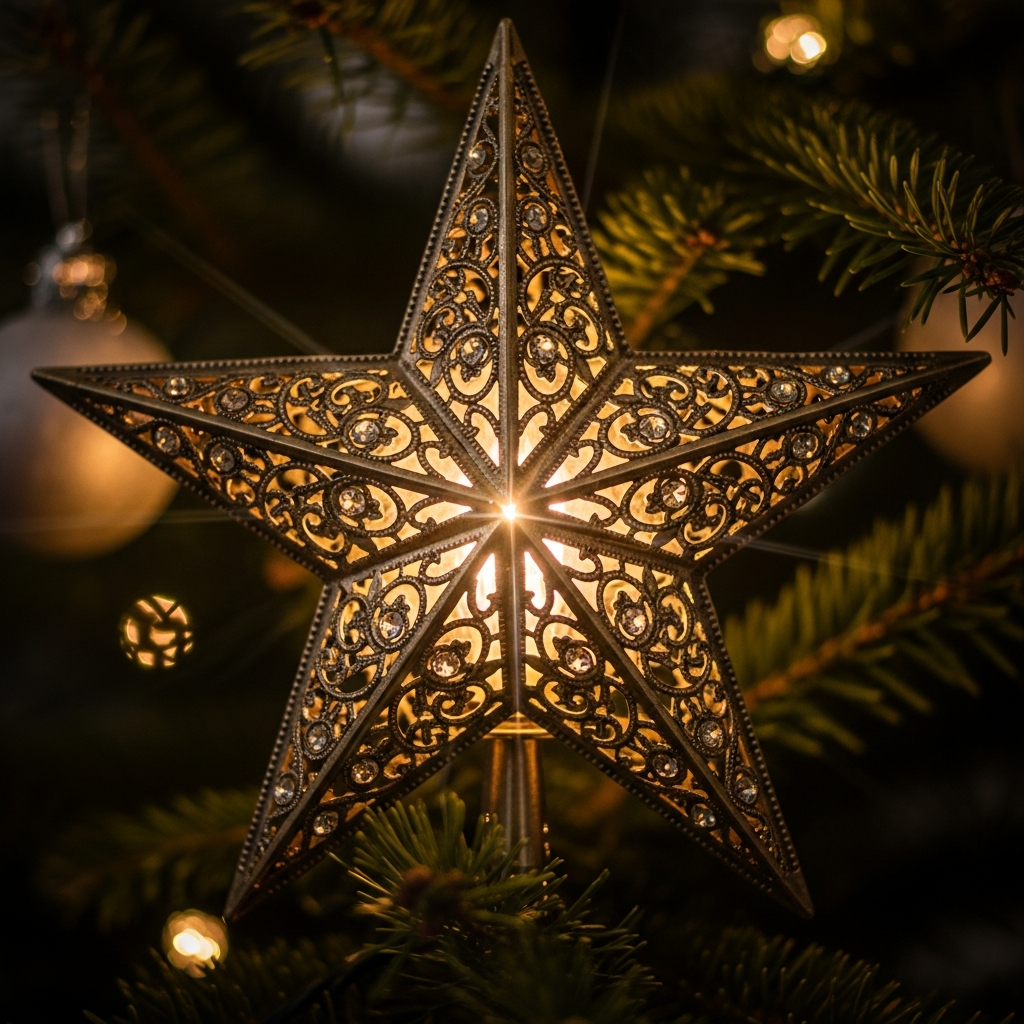
Beyond the science and the orbital calculations, the Christmas Star holds an immense and undeniable significance in global culture, art, and tradition. It is perhaps the single most recognized non-religious symbol of the holiday season, second only to the decorated tree. The image of a brilliant, five- or eight-pointed star, often with a streaming tail, has become a universal emblem of guidance, hope, and illumination. This symbolic Christmas Star is what truly endures year after year.
In art history, the depiction of the Christmas Star has evolved. Early Christian art often showed the star as a simple, oversized sun or a heavenly body leading the Magi. As astronomical knowledge progressed, especially following the work of figures like Kepler, artists began incorporating elements of the planetary or comet theories into their depictions of the Christmas Star. Regardless of the specific rendering, the star’s placement is almost always central and commanding, dominating the scene of the Adoration of the Magi and underscoring its role as a divine, guiding light.
The enduring cultural importance of the Christmas Star is most evident in holiday decorations. From simple paper stars taped to windows to elaborate light-up figures crowning outdoor displays, the Christmas Star is the ubiquitous finishing touch. It serves as a reminder of the original journey and the idea of following a sign to a place of wonder.
The concept of the Christmas Star has transcended religious contexts to become a universal metaphor:
- Symbol of Hope: The brightness cutting through the darkest time of the year (winter solstice) represents enduring hope.
- Beacon of Guidance: It signifies following a path or a dream, no matter how distant or difficult the journey.
- Sign of Destiny: Its unique nature suggests a pre-ordained, world-changing event.
Even the modern 2020 event cemented this cultural relevance. For many, seeing the conjunction—that spectacular modern Christmas Star—provided a much-needed moment of awe and wonder during a challenging global time. The sheer joy of watching two massive planets merge into one brilliant Christmas Star served as a powerful, unifying experience, linking science to ancient tradition.
In conclusion, the Christmas Star is a phenomenon as rich in scientific possibilities as it is in historical and cultural meaning. Whether it was a rare triple conjunction, a sudden supernova, or a temporary comet thousands of years ago, or the spectacular planetary alignment we witnessed recently, the power of the Christmas Star to inspire awe and signify a moment of profound change remains as bright as its light in the night sky. The legend of the Christmas Star will continue to shine, guiding both astronomers and dreamers alike.
—
Frequently Asked Questions (FAQ)
What is the Christmas Star scientifically?
The term Christmas Star today most accurately refers to a “Great Conjunction,” which is the close apparent meeting of the two largest planets, Jupiter and Saturn, in the night sky. The most recent and spectacular example of this modern Christmas Star occurred on December 21, 2020, when the two planets appeared closer than they had in nearly 800 years, creating the visual effect of a single, extremely bright star.
Was the Christmas Star a single star, a planet, or something else?
Astronomical and historical consensus suggests the original Christmas Star was not a single, ordinary star. The leading theories propose three main possibilities for what the Magi saw:
- Planetary Conjunction: A triple alignment of Jupiter and Saturn (around 7 B.C.E.).
- Nova/Supernova: The sudden, temporary brightening of an exploding star.
- Comet: A bright, moving celestial body with a tail (around 5 B.C.).
When was the last time the Christmas Star was visible?
The last widely visible and spectacular occurrence of the Christmas Star (the Great Conjunction of Jupiter and Saturn) was on December 21, 2020. During this event, the two planets were separated by only about 0.1 degrees, making them appear to the naked eye as one brilliant point of light.
When will the next Christmas Star (Great Conjunction) happen?
The next Great Conjunctions are predicted to occur on October 31, 2040, and again in April 7, 2060. However, astronomers predict that neither of these future events will have the extremely close visual separation that made the 2020 Christmas Star so spectacular.
Why is the Christmas Star so important in culture and religion?
The Christmas Star, also known as the Star of Bethlehem, is central to the Christian Nativity story as the celestial sign that guided the Magi to the birthplace of Jesus. Culturally, it has become a universal symbol of hope, guidance, and illumination, and its brilliant image is one of the most common and powerful decorations during the holiday season, representing light in the darkness.