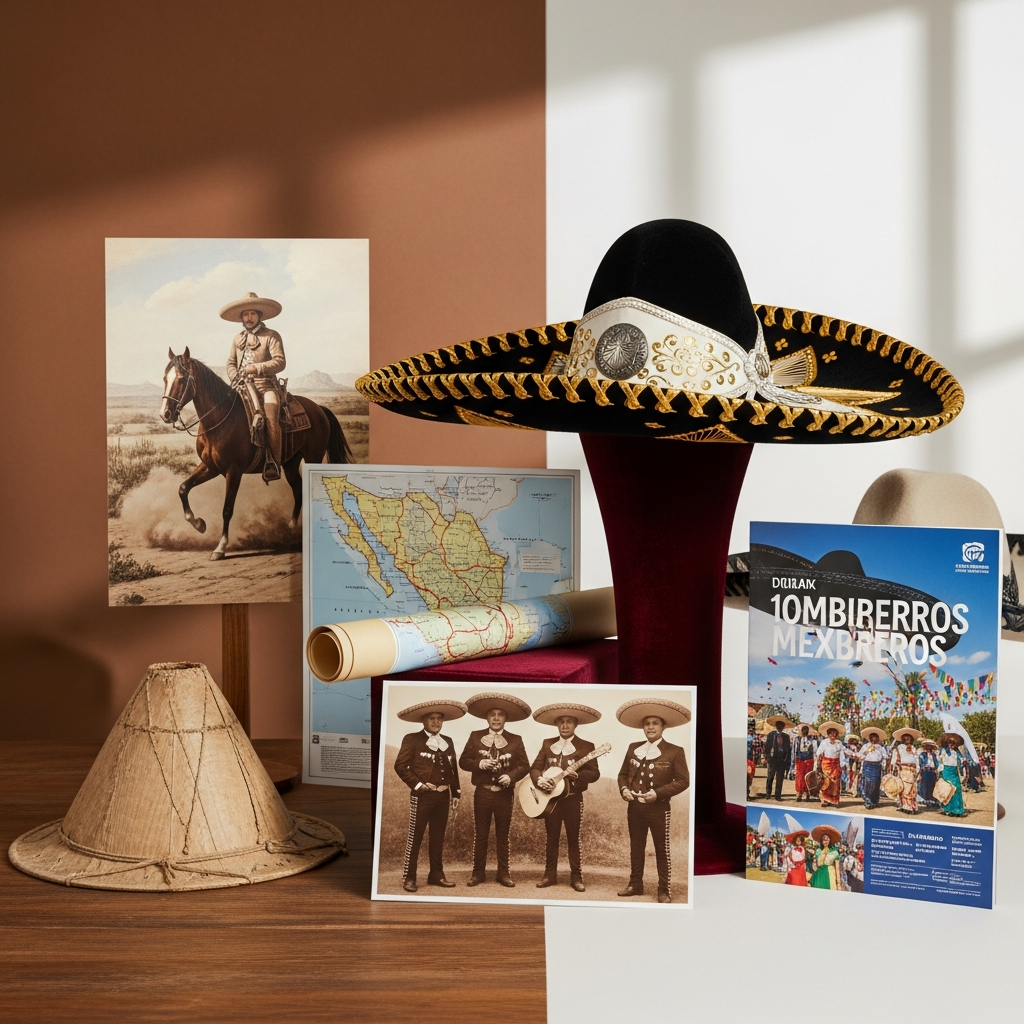
The Sombrero History is not just the story of a hat; it is a sweeping narrative of sun protection, social status, and a profound national identity that spans centuries and continents. This iconic headwear, instantly recognizable by its impossibly wide brim and high crown, embodies the spirit of the Mexican charro (horseman) and the resilience of a culture. Originally, the name sombrero is a straightforward Spanish term derived from the word sombra, which simply means “shade.”

The evolution of the sombrero—from its earliest conceptual ancestors to the highly decorated, emblematic sombrero de charro—shows how an essential piece of utility can be transformed into a powerful cultural artifact. The main types of sombreros include:
The Sombrero de Charro: The highly ornate, formal version worn by mariachis and charros*.
The Sombrero Jarano*: A slightly smaller, less-decorated version often associated with the Yucatan Peninsula.
The Sombrero de Palma*: A simple, practical hat woven from palm leaves, historically worn by farmers and laborers for maximum sun protection.
The Sombrero Quinciano*: A basic, light, and cheap straw hat designed for everyday work.
Understanding the Sombrero History is to trace the footsteps of horsemen, farmers, revolutionaries, and musicians across arid plains and festive city streets.
—
The Ancient Roots of Shade: Sombrero History Pre-Mexico
The concept of a broad-brimmed hat is universal in hot, sunny climates, but the thread of Sombrero History can be traced back to ancient equestrian cultures. The need for a wide brim to shield the face and shoulders from the sun while working or riding has existed for millennia. It is a fundamental design solution born from necessity.
From Mongolian Horsemen to the Spanish Peninsula
It might surprise many to learn that some historical accounts suggest the conceptual origin of the broad-brimmed riding hat could predate even the European term. Records indicate that Mongolian horsemen in the 13th century were known to wear wide-brimmed headwear suitable for long journeys on horseback across open, sun-drenched steppes. This design was pragmatic, allowing riders to maintain vision and prevent sunstroke during long days of travel and battle.
When we focus specifically on the word and its immediate context, the earliest definitive steps in Sombrero History lead us directly to Spain in the 15th century. The term sombrero, meaning “shader,” was already in use to describe any hat that offered significant protection from the elements. Spanish farmers and laborers frequently wore these hats, which were typically round, moderately broad-brimmed, and functional. The Spanish version was a simple, practical work accessory, often made of felt or leather, designed to withstand the rigors of rural life and the intense Iberian sun. This initial, purely functional phase of the Sombrero History set the stage for its dramatic transformation.
Anecdote: A Human Connection to the Sombrero History
I remember being on a dusty, remote farm outside Oaxaca a few years ago. The sun was absolutely brutal, the kind that burns through skin in minutes. I was trying to talk to an older farmer named Don Rafael, who was tending his maize. He paused, wiped the sweat from his brow, and adjusted the enormous, worn straw sombrero de palma he wore. It wasn’t the fancy, sequined hat of a mariachi; it was a pure workhorse of a hat. I commented on its size, and he simply said, “In this sun, my friend, this is my roof, my shelter, and my dignity.” That moment crystallized for me that the core of the Sombrero History is about survival and utility before it ever became about spectacle or fashion. It’s a testament to simple, brilliant design solving a serious problem, and that enduring purpose is why the sombrero remains so powerful today. It reminds you that the object has a life, a purpose, far beyond the souvenir shop.
—
The Great Transformation: Mexican Sombrero History
The true, unique narrative of the Sombrero History begins its distinct chapter with the arrival of the Spanish in the Americas. As Spanish culture, including its equestrian traditions, merged with the native and emerging mestizo cultures of New Spain (Mexico), the functional Spanish hat began to evolve radically. The environment, lifestyle, and burgeoning national identity demanded a bigger, bolder, and more specialized headpiece.
The Rise of the Charro and the Sombrero de Charro
The most critical turning point in Sombrero History is the emergence of the charro. These were the skilled horsemen—often landowners or ranch hands—who managed vast estates and cattle herds. They were the cowboys of Mexico, and their dress was a source of great pride and distinction. The original Spanish hats were simply not adequate for the demands of the vast, open plains and the intense sun of the Mexican plateau.
The charros—particularly those from the regions around Guadalajara and Jalisco—began to modify the design. They needed a hat that could:
- Provide Maximum Shade: The brims became significantly wider, extending out over the shoulders to provide shade not just for the face, but for the back of the neck and the shoulders as well.
- Offer Stability on Horseback: The crown was raised and often shaped to be more conical or domed, and the brim was gradually curved (or “saucer-shaped”) to help it stay on during rapid riding and protect against low-hanging branches.
Signal Status: As the charro became a symbol of Mexican landownership and skill, his attire, including his hat, became increasingly elaborate. The simplest straw gave way to felt, and felt was adorned with intricate embroidery, beadwork, and metallic thread (piteado*).
This specialized headwear became known as the Sombrero de Charro or sombrero jarano. Its distinctive wide brim and high, usually tapered crown cemented its place not just in fashion, but as the central, most recognizable symbol in the rich tapestry of Sombrero History. It was a hat that defined a man’s profession, his skill, and his social standing.
Craftsmanship and Materials: A Reflection of Status
The diverse nature of the Sombrero History is reflected in the materials used. The common worker’s sombrero remains a study in functional simplicity, typically woven from palm leaves (palma) or straw. These were lightweight, breathable, and easily replaceable.
However, the sombrero de charro is where true craftsmanship shone:
Felt and Velour: For formal occasions, the sombrero* was made from high-quality felt, often derived from rabbit or beaver fur, giving it a velvety, substantial texture. This material held the necessary stiffness for the elaborate shaping of the brim and crown.
Intricate Adornment: The decoration was a direct indicator of wealth and position. Rich charros* would commission sombreros adorned with gold or silver thread, intricate designs that could take master artisans weeks to complete. The most prestigious examples of Sombrero History were more expensive than a modest horse.
The Tardano: This is a lesser-known but historically significant detail in the development of the sombrero. The tardano (or toquilla) is the band that wraps around the base of the crown. Its material and decoration often served as a subtle, localized marker of where the charro* was from, providing yet another layer of fascinating detail to the broader Sombrero History.
The sheer scale and cost of the finest hats meant that the Sombrero History in the 19th century was very much a story of class distinction. The hat was both a necessary tool and a dazzling piece of portable wealth.
—
The Sombrero in the Crucible of the Mexican Revolution
The early 20th century marked a tumultuous, yet incredibly vital, period in Sombrero History. The Mexican Revolution (1910-1920) was a decade of intense upheaval, and the sombrero was suddenly thrust onto the international stage, becoming a powerful symbol of the revolutionary cause.
A Banner for the Campesino and the Rebel
Before the Revolution, the elaborate sombrero de charro was often a symbol of the landed elite. However, the vast majority of revolutionary fighters were poor campesinos (farmers) and ranch hands who, while they didn’t wear the ornate versions, wore the simpler, practical straw sombrero every day. When these men took up arms, their ubiquitous, wide-brimmed hats became the uniform of the insurgency.
The most enduring images from the Revolution feature its legendary leaders wearing these hats:
Emiliano Zapata: The leader of the Liberation Army of the South was frequently photographed in a striking, sometimes slightly frayed, but always broad-brimmed sombrero*. His hat embodied the southern agrarian movement he led.
- Pancho Villa: The charismatic general from the north also adopted the style. While Villa’s uniform was often more complex, the presence of a wide-brimmed hat in almost all his portraits cemented the connection between the sombrero and the defiant spirit of the Revolution.
The large, decorated sombreros that began to emerge during this era were sometimes worn by soldiers and rebels as a badge of honor and to express their political fervor. This moment in Sombrero History was crucial because it transformed the hat from a symbol of regional charro identity into a powerful, national emblem of freedom, defiance, and the common man’s struggle against oppression. The large sombreros of the era, sometimes featuring holes in the brim for a carrying strap, became iconic.
From Battleground to Cultural Institution
Following the Revolution, the need to unify the country and establish a strong national identity was paramount. The government looked to popular, distinctly Mexican symbols to achieve this, and the Sombrero History provided the perfect icon. The charro was elevated from a regional horseman to a national symbol of Mexican resilience and tradition.
The sombrero de charro was formally standardized as part of the traje de charro, the official suit of the national sport of charrería (Mexican rodeo). This institutionalization ensured the hat’s survival and its prominent place in cultural celebrations. The elaborate nature of the formal sombrero worn by mariachi bands—whose music gained national popularity during this time—further guaranteed its widespread recognition.
This post-revolutionary period is characterized by the sombreros’ transition from utilitarian wear to ceremonial attire. The elaborate, heavy, and structurally complex sombreros seen in performances and parades today are direct descendants of this cultural codification, signifying the enduring pride found within the rich Sombrero History. The level of detail in the hand-stitched silk and the intricate pita (agave fiber) embroidery on these ceremonial hats tells its own glorious chapter of the Sombrero History.
—
Modern Sombrero History: Global Icon and Cultural Challenge
In the 21st century, the Sombrero History continues to evolve, facing new challenges related to globalization, commercialization, and the need for cultural preservation. The hat is now a truly global icon, recognized everywhere from Hollywood films to international tourist markets.

The Sombrero in Global Commerce and Tourism
The modern economic landscape has broadened the consumer base for the sombrero. Tourists arriving in Mexico often seek a sombrero as the quintessential souvenir, a tangible piece of Mexican experience to take home. This demand fuels an industry that ranges from mass-produced, brightly colored, inexpensive straw versions to the finely crafted, expensive formal hats still made by master artisans.
The modern commercial trajectory in Sombrero History has two faces:
Mass Production: These hats are typically lightweight, synthetic, and often feature exaggerated sizes or colors, catering specifically to the tourist market and international party themes. While they spread the image of the sombrero*, they often lack the authentic materials and craftsmanship central to the deeper Sombrero History.
Artisanal Preservation: On the other hand, a dedicated community of master hatmakers maintains the ancient craft. These artisans use traditional methods, high-quality materials (like fine felt, natural palm, and genuine embroidery threads), and they uphold the strict standards required for the official charro* and mariachi ensembles. For these craftsmen, maintaining the integrity of Sombrero History is both a vocation and a cultural duty.
The economic impact is significant. Rising tourism is directly expanding the market, and the sombrero, in its various forms, remains a key product for local economies, especially in regions known for charrería or traditional weaving, such as Jalisco and various areas of Oaxaca.
Cultural Identity and Modern Trends
Beyond the economic sphere, the hat’s role in modern culture reflects its rich Sombrero History.
Status and Identity: Even today, the type of sombrero a person wears can subtly convey social and economic status. A fine, custom-made sombrero de charro is still a sign of respect and deep connection to Mexican heritage. The quality, the felt’s finish, the complexity of the piteado* work—all speak to the wearer’s standing.
- Multiculturalism: As Mexican culture has spread globally, particularly in areas with large Mexican diaspora communities, the sombrero maintains its role as a cultural anchor. It is a visible, celebrated symbol of heritage at festivals, parades, and cultural events across the world. The increasing multiculturalism globally ensures a persistent demand for authentic and representative symbols of Mexican identity.
Modern Reinterpretation: Contemporary designers and artists sometimes incorporate elements of the sombrero* design into modern fashion, paying homage to the form while recontextualizing it. This willingness to adapt and celebrate the classic shape ensures that the Sombrero History is not confined to museums but remains a living, breathing part of style.
One interesting modern trend, though not strictly Mexican, is the focus on preserving the cultural heritage of similar broad-brimmed hats, as seen with the Colombian Sombrero Vueltiao. This highlights a broader, contemporary interest across Latin America in protecting the traditional craftsmanship of iconic headwear from the pressures of mass production. The same spirit of preservation is alive for the Mexican sombrero.
—
Deeper Dives: Sombrero History Through Types and Symbolism
To fully appreciate the scope of the Sombrero History, one must examine the specific types of hats and the profound symbolism each holds. The differences are not arbitrary; they reflect centuries of regional differentiation, class structure, and occupational necessity.
The Formal Charro Sombrero: An Emblem of Elegance
The quintessential sombrero—the one most people visualize—is the sombrero de charro. This is the apex of the formal line in Sombrero History.
The Falda* (Brim): It is extremely wide, often exceeding 18 inches in diameter. The brim is typically upturned at the edges, helping the hat maintain its structure and providing a ceremonial flair.
The Copa (Crown): High and usually conical or slightly domed, sometimes featuring four deep indentations, known as pedradas* (stone strikes), which are believed to have been introduced to make the hat easier to handle and secure in the saddle.
The Decoration (Piteado): The most distinctive feature. Piteado* is an intricate embroidery using fine silver, gold, or agave fiber threads, stitched onto the felt in elaborate patterns of flora, fauna, or geometric designs. This level of detailing defines the most luxurious examples in Sombrero History.
This formal hat is the required accessory for charrería competitions and for mariachi musicians, symbolizing the highest respect for tradition and a connection to the national heritage of horsemanship.
The Utilitarian Sombrero: The Quinciano and Palma
Far from the glamorous image of the charro, the backbone of Sombrero History is the humble work hat. These hats embody the everyday life of the majority of Mexicans throughout the centuries.
The Sombrero Quinciano*: As noted, this was a simple, light, and cheaply made straw hat. Its primary function was to provide maximum shade for minimum cost. These are the most common historical artifacts, representing the vast, unsung contribution of the working class to the Sombrero History.
The Sombrero de Palma: Woven from palm leaves, the palma hat is a testament to sustainable and regional craftsmanship. Depending on the weave’s tightness and the quality of the palm, these hats can be incredibly durable and breathable. Different regions of Mexico developed unique weaving styles, offering a fascinating regional diversity within the larger Sombrero History. For example, the sombrero of the Yucatán Peninsula (often called a jarano*) is typically woven with a different technique than those from the highlands of Chiapas.
These work sombreros perfectly illustrate the original, practical purpose of the headwear—to protect the body and allow for long, arduous work under the unforgiving sun.
—
Conclusion: The Living Legacy of Sombrero History
The Sombrero History is a profound journey that stretches from the Spanish sombra (shade) of the 15th century to the global cultural icon of today. It is a narrative that intertwines utility, social stratification, revolutionary fervor, and national pride. What began as a simple tool for sun protection, worn by Spanish farmers, was wholly adopted and magnificently transformed in Mexico by the charro horsemen.
The hat’s enduring symbolism was cemented during the tumultuous Mexican Revolution, where figures like Zapata and Villa made the sombrero the de facto uniform of the people’s struggle. Today, the Sombrero History lives on through the skilled hands of artisans, the vibrant performances of mariachis, and the simple, necessary shade it provides to modern farmers. The diverse types, from the functional palma to the dazzling de charro, all contribute to a single, rich cultural legacy. Ultimately, the Sombrero History is a powerful reminder that the simplest objects can carry the deepest meanings. The Sombrero History is a story for the ages, showing how design adapts, endures, and becomes inextricably linked to a nation’s soul. The journey of the Sombrero History from practical gear to cultural standard is truly unique.
—
FAQ (Frequently Asked Questions)
## What is the origin of the term “Sombrero”?
The term “sombrero” originates from the Spanish word “sombra,” which means “shade.” The name was used in Spain as early as the 15th century to refer to any hat with a broad brim designed to provide protection from the sun or rain. The Sombrero History truly begins with this simple, functional definition.
## What is the difference between a Sombrero and a Charro Hat?
A Sombrero is the generic term for any broad-brimmed hat, including the simple straw hats worn by farmers (like the sombrero de palma). A Charro Hat (or Sombrero de Charro) is the specific, highly ornate, and structurally complex version worn by Mexican horsemen (charros) and mariachi musicians. It represents the pinnacle of craftsmanship in Sombrero History, featuring high crowns, stiff, wide brims, and intricate embroidery. The sombrero de charro is a type of sombrero, but not all sombreros are sombreros de charro.
## Why is the Sombrero so important to Mexican culture?
The sombrero, particularly the sombrero de charro, is important because it is a powerful national symbol of Mexican identity, pride, and tradition. It originated with the charros (Mexican horsemen), who became symbols of the country’s skill and resilience. The hat’s status was solidified during the Mexican Revolution, making it an iconic representation of the Sombrero History and the spirit of the Mexican people.
## Are there different types of sombreros based on region or material?
Yes, the Sombrero History features many variations based on region and material. The most common distinctions include:
Material: Simple versions are made from straw or palm (palma*), while formal ones are made of felt.
Regional Styles: The sombrero jarano is associated with the Yucatan Peninsula, while the more ornate, heavy sombrero de charro is linked to the charros* of central-western Mexico.
Function: Hats like the Quinciano were for work, while the formal sombrero de charro* is for ceremony and performance. The variety underscores the depth of the Sombrero History.
## What is the modern role of the Sombrero in the 21st Century?
In the 21st century, the sombrero serves multiple roles. It is a key element of the Mexican cultural identity displayed at festivals worldwide, a required piece for the charrería national sport, and a popular item in the tourism economy. It remains a powerful cultural touchstone, even as global trends expand its commercial reach. The continued practice of charro traditions ensures that the authentic Sombrero History is actively preserved.